

Classic, Spark, Daily or Merit: 4 Funded Accounts Compared
Same firm, four different deals. Here is exactly where they diverge, line by line.
Phoenix Trader Funding sells four main account families; the differences are price, drawdown and how you reach a live account. Classic bills monthly and grows your position size as you prove it. Daily pays out every trading day you trade. Spark hands you full size on day one for the lowest entry price of the four. Merit skips the Pre-Funded stage and goes straight to live funding on approval.
- Entry Price and How You're Billed
- Drawdown Rules During the Evaluation
- Consistency and the Minimum Trading Days
- The Profit Split
- The Path to a Live Funded Account
- Payout Frequency and Platform Choice
- Which Account Fits Which Trader
Each account page reads correctly on its own, and none of them tells you what you would have gotten from the other three.
This walks through what actually decides which one fits: entry price and billing, the drawdown and consistency rules you trade under, the profit split, what it takes to reach a live account, and what changes once you're there.
Entry Price and How You're Billed
An evaluation is the stage you trade before touching live capital. Classic, Daily and Spark evaluations measure you against a fixed drawdown and profit target; Merit's is a 30 calendar day assessment with no fixed target at all, reviewed instead by Phoenix's risk team and an AI, with one attempt for the life of the account.
The entry price buys that attempt, and the billing model is the first split between the four families.
| Account | Size | Entry price | Billing | Reset fee |
|---|---|---|---|---|
| Spark Seed | $10K | $44 | One time | $29 |
| Daily Seed | $10K | $99 | One time | $39 |
| Classic Starter | $25K | from $89 | Monthly | $89 |
| Spark Starter | $25K | $74 | One time | $39 |
| Daily Starter | $25K | $199 | One time | $69 |
| Classic Growth | $50K | from $128 | Monthly | $128 |
| Daily Growth | $50K | $329 | One time | $99 |
| Classic Scale | $100K | from $269 | Monthly | $269 |
| Merit | $2K | $69 | One time | No reset at any price |
Classic is the one subscription in the lineup. It renews every 30 days, cancelable any time. Daily, Spark and Merit are all paid once: no renewal, no monthly charge while you trade the evaluation.
dxFeed adds $20 at every Classic size: $109, $148 and $289 instead of $89, $128 and $269.
Spark Seed's $44 is the lowest entry price on the page, but it is not the whole bill. Spark carries a $29 activation fee, due once you pass, that Classic, Daily and Merit do not charge at all.
A failed evaluation is not free to retry either: Classic, Daily and Spark each carry a reset fee tied to the account's size, as little as $29 on a Spark Seed and as much as $269 on a Classic Scale. Merit allows no reset at any price.
Drawdown Rules During the Evaluation
A trailing drawdown is a floor that follows your balance up as you profit and stops you out if your balance falls back to it; a daily drawdown is a separate limit on how much you can lose in one single day, on top of that floor.
Classic, Daily and Spark evaluations share the same shape: an end of day trailing drawdown, recalculated once after the close rather than tick by tick, and no daily drawdown at all.
Merit is the one exception, and it is a genuine mirror image rather than a smaller version of the same rule: it carries a daily drawdown during its assessment and none at all once live, while Classic, Daily and Spark carry no daily drawdown during the evaluation and pick up a scalable one, set with the trader, once they reach Live Funded.
- Classic, Daily, Spark: end of day trailing drawdown, no daily limit
- Merit: a 25 percent dynamic daily drawdown, paired with a static $2,000 total loss limit
| Account | Profit goal | Trailing drawdown |
|---|---|---|
| Spark Seed ($10K) | $600 | $400 |
| Daily Seed ($10K) | $600 | $600 |
| Classic Starter ($25K) | $1,500 | $1,500 |
| Spark Starter ($25K) | $1,500 | $1,000 |
| Daily Starter ($25K) | $1,500 | $1,500 |
| Classic Growth ($50K) | $3,000 | $2,000 |
| Daily Growth ($50K) | $3,000 | $2,000 |
| Classic Scale ($100K) | $6,000 | $3,000 |
| Merit ($2K) | None | None (static $2,000 total loss limit instead) |
No profit goal is Merit's difference from the other three: it is reviewed on the quality of the trading, not graded against a dollar target.
Spark carries one more wrinkle worth knowing before you buy it: the trailing drawdown is end of day during the challenge, then switches to real time, intraday tracking once the account is funded. Classic and Daily stay end of day through both stages.
Consistency and the Minimum Trading Days
A consistency rule caps how much of your total profit can come from a single day, so a pass reflects a pattern rather than one lucky session.
Classic and Daily evaluations both hold a 50 percent consistency rule, and it drops away once funded. Spark runs the opposite shape: no consistency rule on the evaluation, then a 30 percent rule once the account is funded. Merit carries no consistency rule at any stage, though its review calls keeping any one day under 50 percent of total profit essential.
The Profit Split
The share of profit you keep differs by family. Classic and Spark both pay 90 percent. Daily pays 80 percent, the tradeoff for being paid out on every trading day you trade rather than waiting for a weekly or bi-weekly cycle. Merit's split is adaptive: 50 percent until investment recouped, then 80 percent after.
Classic and Daily also carry a locked buffer once funded: an amount that has to stay in the account, so only profit above it can be withdrawn. It is $1,500, $2,000 or $3,000 on Classic by size, and $600, $1,500 or $2,000 on Daily. Spark and Merit carry no buffer at all.
The Path to a Live Funded Account
Passing an evaluation does not hand you real capital immediately on Classic, Daily or Spark. It moves you to a Pre-Funded stage, a simulated account: real payouts from a simulated balance, under its own funded rules. A live account, called Live Funded, is the stage after that: real capital instead of a simulated balance, under the account's own live-stage rules.
The trigger for Live Funded differs by family. Classic, Spark and Daily each depend on how fast you earn it, not a calendar count; Merit alone runs on a fixed clock, its 30 calendar day assessment.
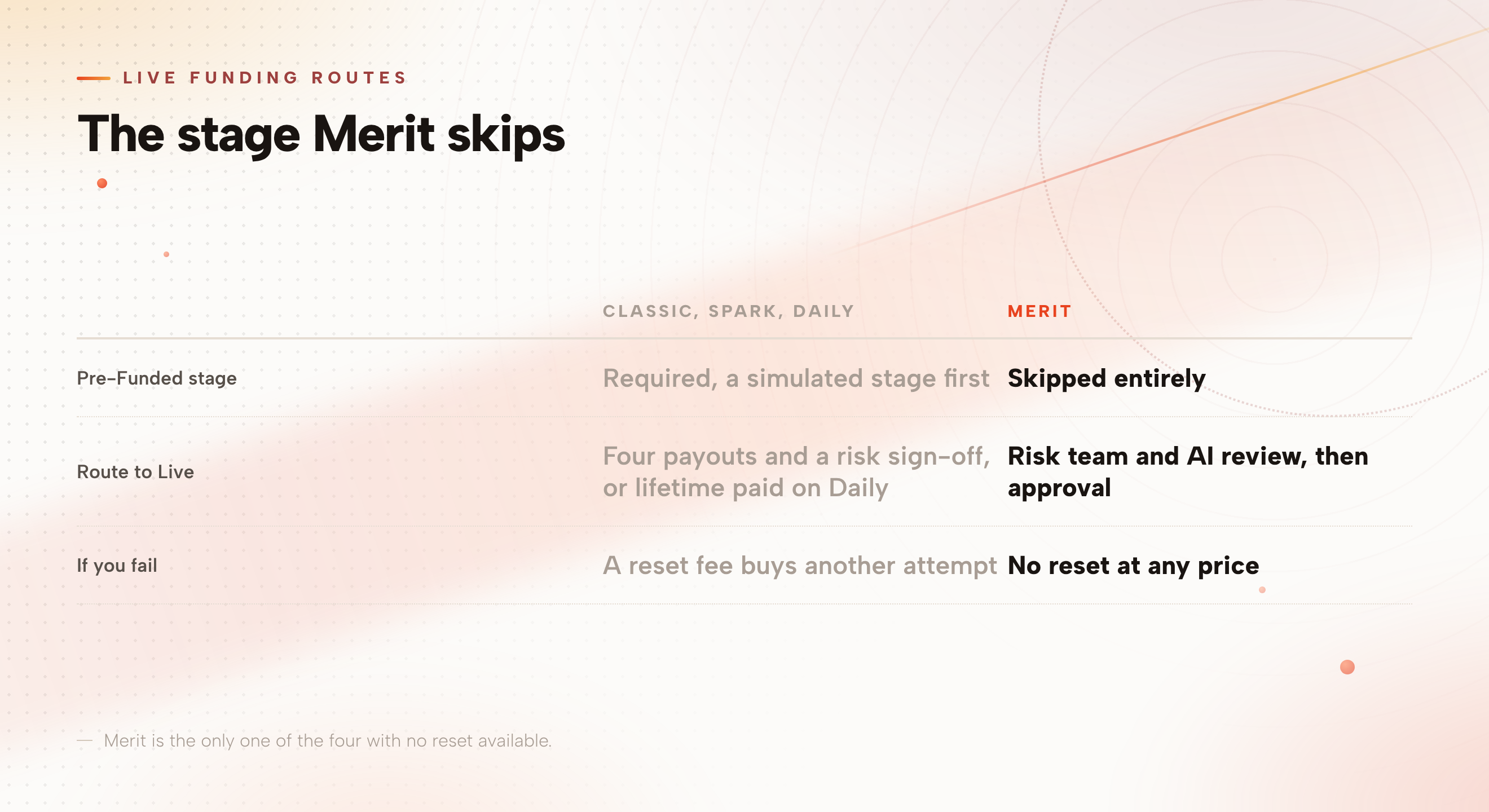
- Classic and Spark: four payouts, plus a risk sign-off
- Daily: a lifetime amount paid, from $1,200 on a Seed account up to $6,000 on a Growth account
- Merit: its own review decides, nothing else, straight to a live $2,000 account
Live account sizes differ by family too: Classic starts a live account at $1,250, $2,000 or $3,500 by size; Daily at $500, $1,250 or $2,000; Spark at $400 or $1,000; Merit at a flat $2,000. From there, every family scales the same way: one more mini contract for each $2,000 of additional Live profit.
Contract caps differ before Live too. A Classic Starter grows from 1 mini or 10 micros toward 1 mini or 15 micros as profit builds past $1,000.
Spark hands you the full cap from day one: 1 mini or 10 micros on a Seed, 2 minis or 20 micros on a Starter. Daily does the same, except its Seed is 6 micros only, with no mini allowance at all until Starter.
Every mini-or-micro figure here is an alternative, never a total: a Spark Starter trades 2 minis or 20 micros, not both at once.
Payout Frequency and Platform Choice
Once an account is paying out, the cadence is another difference. Classic pays weekly. Daily pays on every trading day you trade, capped per account and capped again at $1,000 per trader per day across every Daily account you hold. Spark pays bi-weekly. Merit has no Pre-Funded payout stage: its payouts start only once the live account is funded.
Merit's live account carries its own payout terms rather than the ones above: a $1 minimum withdrawal, no maximum, and no fixed withdrawal period.
The feed you trade on is the last fork. Classic alone lets you choose TFeed, Phoenix's own lower-commission execution feed, or dxFeed, a third-party feed that includes market data.
Daily and Spark trade on TFeed only, but that rule is scoped to the evaluation and Pre-Funded stages. Once Classic, Daily or Spark reaches Live Funded, trading moves to the broker EdgeClear on Rithmic. Merit trades on TFeed throughout its assessment.
Which Account Fits Which Trader
None of the four is a strictly better version of another; each one trades a different convenience for a different cost.
- Classic fits a trader who wants the largest account of the four, up to $100K, or who wants to trade on dxFeed, which none of the other three offers; in exchange it renews monthly until they cancel, and its position size grows in steps rather than arriving whole
- Daily fits a trader who wants cash moving on every session they trade, not just weekly or bi-weekly, and can live with a Seed account's micro-only cap until they size up
- Spark fits a trader who wants full size from day one at the lowest entry price of the four, and would rather meet a consistency rule after passing than before: a Spark evaluation has none where Classic and Daily hold 50 percent, and a funded Spark holds 30 percent where Classic and Daily hold none
- Merit fits a trader who would rather skip the Pre-Funded stage and have the risk team and an AI review their trading directly, accepting one attempt ever with no reset and no guarantee of funding whatever the P&L
Each account's own page carries its full rule set; the evaluations page lists every size on sale.
Even a Merit attempt that does not fund pays something back: a 30 percent discount on all challenges for completing the attempt, a new challenge for a trader who generated at least the live funding balance, and a lifetime Thor licence worth $250 for a Performance Review that comes back with no red values in its Benchmark section.
Which of the four accounts is the cheapest to start?
Spark Seed, at $44 one time, is the lowest entry price of the four. It is not quite the full bill, though: Spark carries a separate $29 activation fee due once you pass, which Classic, Daily and Merit do not charge at all, bringing its first-attempt cost to $44 plus $29.
Minimum payouts differ by family too: $75 on Classic and Daily at every size, $30 on a Spark Seed and $75 on a Spark Starter. Merit live withdrawals start at $1.
Which account has no daily drawdown during the evaluation?
Classic, Daily and Spark evaluations all carry no daily drawdown, only an end of day trailing floor. Only Merit has one: its 30 calendar day assessment runs a 25 percent dynamic daily drawdown alongside a static $2,000 total loss limit.
Which account lets me choose my data feed?
Only Classic. It runs on TFeed, Phoenix's own lower-commission execution feed, or dxFeed, a third-party feed that includes market data, and dxFeed costs $20 more at every size. Daily, Spark and Merit are TFeed only.
How do I actually reach a live funded account?
The trigger depends on the family. Classic and Spark need four payouts plus a risk sign-off. Daily needs a lifetime paid amount that ranges from $1,200 to $6,000 by size. Merit skips the Pre-Funded stage entirely and moves to live funding once its own review clears.
Payout speed is the same across all four families once a payout is due: approval usually runs in milliseconds, and it is sent within 24 hours of that approval.
What happens if I fail an evaluation?
Classic, Daily and Spark all carry a reset fee tied to the account's size, letting you buy another attempt. Merit allows none, one attempt for the life of the account.
See current sizes and pricing for every account family.
Compare evaluations at Phoenix Trader FundingNew funded-account types are trialled at Phoenix Labs as real, tradable accounts before they join the permanent offer. The ones that work graduate; the ones that do not are retired.