


- What a trailing drawdown floor actually is
- The buffer is a different thing, and it is what a payout actually touches
- Phoenix Trader Funding's locked buffer, account by account
- How much you can actually withdraw next time
- Why this trips people up
- Who this actually matters for
Does a Payout Reset Your Drawdown Floor?
What actually happens to your trailing drawdown and your buffer after you withdraw, and why traders keep mixing the two up.
No. A payout does not reset or move your trailing drawdown floor. The floor is anchored to the highest balance your account has ever reached, and withdrawing profit does not change that history, so the floor stays exactly where it was.
What a payout does change is your buffer, a separate amount of room that has to sit between your balance and the floor at all times on some account types.
A trader clears the first payout, requests it, and then starts wondering whether the account just got riskier. The balance dropped. Did the floor drop too? Did some cushion just disappear?
Those are two different questions wearing one confusing name. This guide separates the trailing drawdown floor from the buffer that sits above it, explains what a payout actually touches, and walks through how each works on Classic, Daily, Spark and Merit at Phoenix Trader Funding.
What a trailing drawdown floor actually is
A trailing drawdown is a loss limit that rises every time an account reaches a new equity high, then holds still until the next new high. The floor is the minimum balance the account must stay above; if the balance touches it, the account is closed. It only moves up. A losing day never pulls it back down, and neither does a withdrawal.
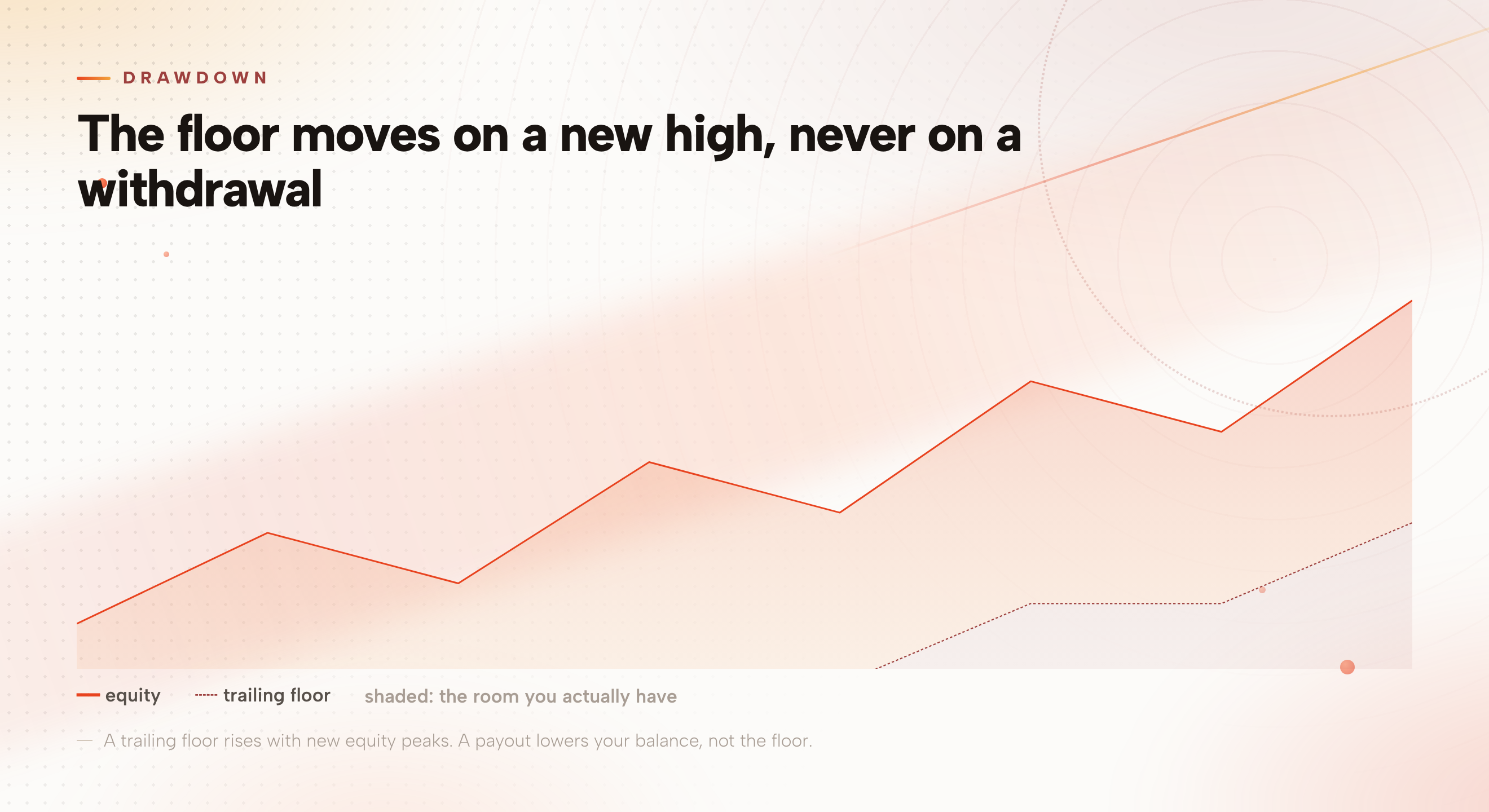
In Phoenix Trader Funding's evaluation stage, the trailing floor stops rising once it reaches the account's starting balance, so it can never trail past breakeven. On the Live-Funded stage, the drawdown switches from trailing to static and also stops adjusting at the starting balance from that point on.
A static drawdown is different from a trailing one: it stays fixed at a set level instead of rising with new highs. Phoenix Trader Funding uses static drawdown only once an account moves to the real-money Live stage.
The buffer is a different thing, and it is what a payout actually touches
The buffer, sometimes called a safety net, is an amount of room that has to remain between your account balance and the drawdown floor. Only profit above the buffer is ever available to withdraw.
Requesting a payout lowers your balance, which shrinks the gap between your new balance and the floor, so the account genuinely does carry less cushion right after a payout than it did the moment before.
That is the part that confuses traders coming from a firm where the buffer is a threshold you build once and never think about again. On some accounts, meeting the buffer requirement one time is enough forever. That is not how it works everywhere, and it is not how it works on every Phoenix Trader Funding account.
Two separate facts, easy to merge into one wrong idea: the drawdown floor never moves backward, ever. The buffer is not a one-time target: on the accounts that carry one, it is locked and has to stay in place the entire time the account is funded.
Phoenix Trader Funding's locked buffer, account by account
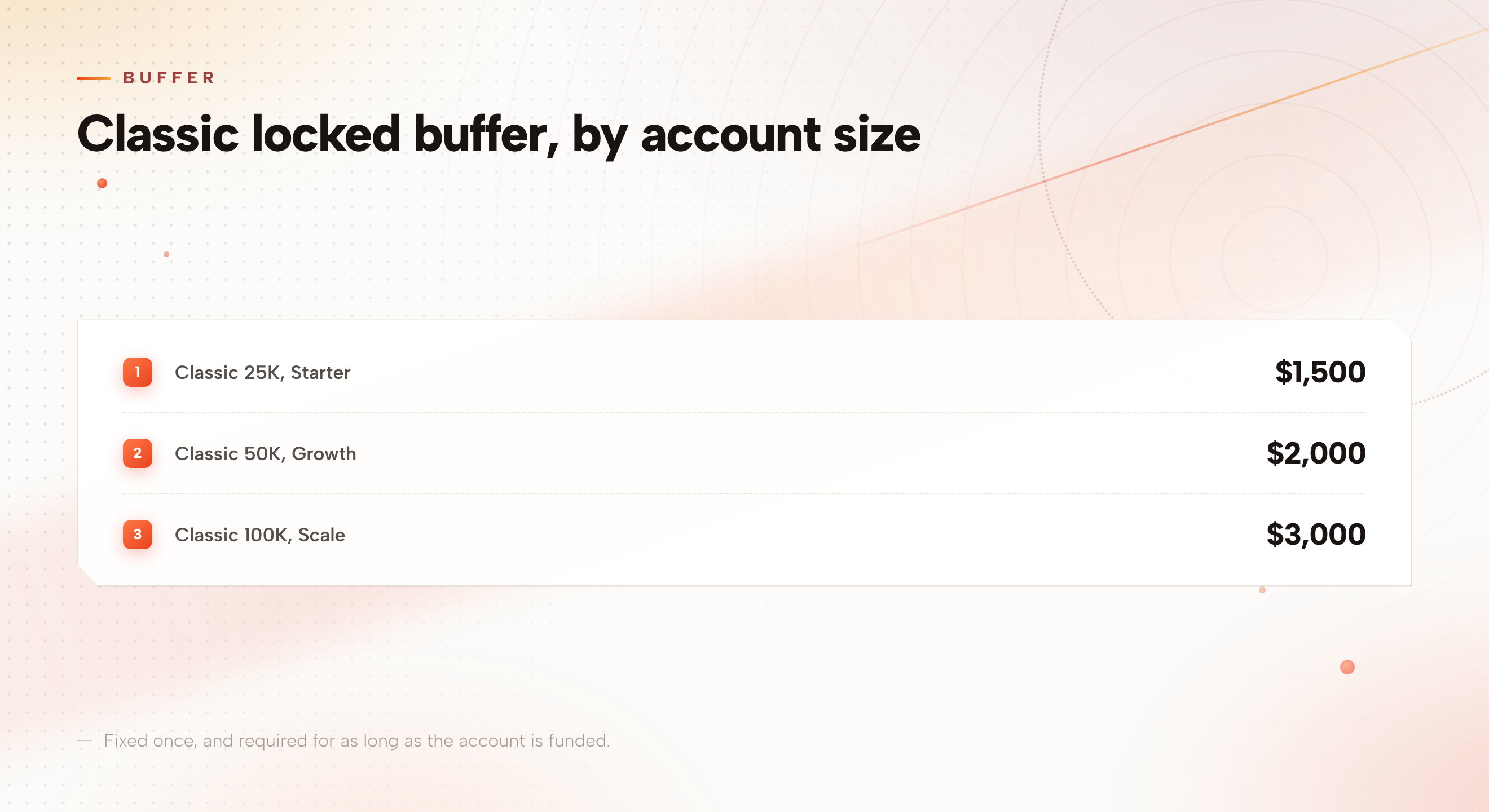
Classic and Daily both carry a locked buffer. "Locked" means the dollar amount is fixed by account size and never changes, and it is not a threshold you clear once. It has to remain between your balance and the floor for as long as the account stays funded, payout after payout.
| Account | Locked buffer |
|---|---|
| Classic 25K, Starter | $1,500 |
| Classic 50K, Growth | $2,000 |
| Classic 100K, Scale | $3,000 |
| Daily 10K, Seed | $600 |
| Daily 25K, Starter | $1,500 |
| Daily 50K, Growth | $2,000 |
| Spark 10K and 25K | No buffer requirement |
| Merit | No buffer requirement |
Spark and Merit require no buffer at all. On Spark, every dollar of profit above the drawdown floor is available to request, with no locked amount held back.
Merit works differently again: its evaluation runs a static total loss limit rather than a trailing floor, and a Merit account does not pay out at all until it reaches the Live stage, so the buffer question does not apply to it the same way.
How much you can actually withdraw next time
The buffer decides how much room has to stay in the account. A separate rule, the per-payout cap, decides the most a single request can pay out even when more profit is sitting above the buffer.
| Account | Per-payout cap | Min profit per counted day |
|---|---|---|
| Classic 25/50/100K | $600 / $1,000 / $2,000 | $100 / $200 / $300 |
| Daily 10/25/50K | $200 / $500 / $1,000 per trading day | None |
| Spark 10/25K | $300 / $400 | $40 / $100 |
| Merit | n/a, Live account only | $0 |
That aggregate cap matters if you hold more than one Daily account. The per-size caps still apply to each account individually, but they never stack past $1,000 a day per trader across all of them. Holding three Daily Growth accounts does not turn into a $3,000 day.
- The buffer sets how much room has to stay in the account
- The per-payout cap sets the most one request can release
- The minimum profit per counted day decides whether a day counts toward the next payout at all
Why this trips people up
Two habits carry over badly from firms that work differently. The first is assuming the floor drops with a withdrawal, because the balance visibly drops and it feels like everything should move together. It does not: the floor only ever tracks the highest balance the account has reached, and a payout does not erase that history.
The second is assuming a buffer, once satisfied, stays satisfied. On a locked buffer, it does not. Plan a withdrawal around leaving the full locked amount in place, not around the smallest number that clears the floor at that exact moment.
Before requesting a payout, check your account's buffer requirement against your current balance and the floor, not just against the floor alone. The buffer is the number that actually limits what leaves the account today.
Who this actually matters for
This matters most to a trader who already has a funded or Pre-Funded account and is deciding how much to request on the next payout. It matters less at the evaluation stage, since no payout exists to request yet.
It also matters to anyone comparing account types before funding one. A locked buffer on Classic or Daily is a real, permanent piece of room a trader has to keep in the account. Spark's lack of one is a genuine structural difference, not a marketing line.
FAQ
Does taking a payout lower my drawdown floor?
No. The floor only rises on a new equity high and never moves down. A payout lowers your account balance, which shrinks the room between your balance and the floor, but it does not change where the floor itself sits.
What is the difference between the drawdown floor and the buffer?
The floor is the minimum balance the account must stay above before it closes. The buffer is a separate amount of room that has to sit between your current balance and that floor on accounts that require one. A payout can only ever affect the buffer, never the floor.
Coming from a firm with a build-once buffer? Treat every Phoenix Trader Funding payout as a fresh check against the locked amount, not a box you only had to tick the first time.
How big is Phoenix Trader Funding's buffer requirement?
Classic carries a locked buffer of $1,500 on the 25K Starter, $2,000 on the 50K Growth and $3,000 on the 100K Scale. Daily carries the same mechanic at $600, $1,500 and $2,000 on its Seed, Starter and Growth sizes. Spark and Merit require no buffer at all.
Once I meet the buffer requirement, do I ever have to think about it again?
Yes, every time. On Classic and Daily the buffer is locked, meaning the full amount has to remain in the account for as long as it is funded. It is not a threshold you clear once and move past.
Can I withdraw $1,000 a day from each of my Daily accounts separately?
No. Each Daily size has its own per-trading-day cap, but Phoenix Trader Funding also applies an aggregate cap of $1,000 per trader per day across every Daily account that trader holds, regardless of how many are open.
The floor remembers your best balance. The buffer is what you leave standing next to it.Phoenix Trader Funding
A trailing drawdown floor and a payout buffer answer two different questions, and mixing them up is the fastest way to misjudge how much room an account actually has. The floor is permanent history. The buffer, where one applies, is a standing requirement rather than a box checked once.
Full rule tables for every account type are on the Phoenix Trader Funding evaluations page, with account-specific rules on the Classic accounts page and further detail in the Phoenix Trader Funding FAQ.
Pick your account and see its exact buffer and payout rules before you fund it.
View Phoenix Trader Funding evaluationsNew funded-account types are trialled at Phoenix Labs as real, tradable accounts before they join the permanent offer. The ones that work graduate; the ones that do not are retired.