

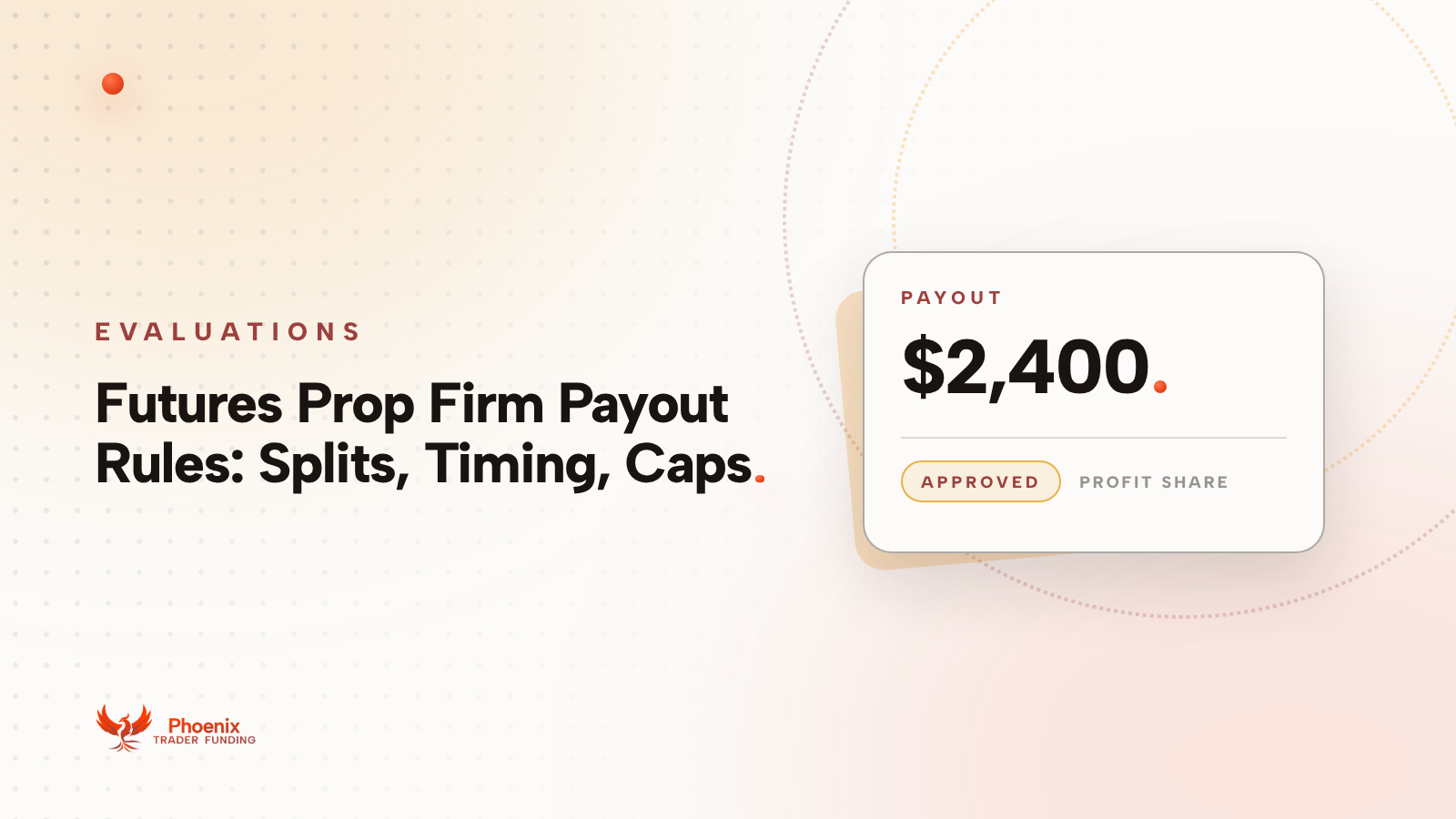
How Do Futures Prop Firm Payouts Actually Work?
Profit splits, minimum days, payout speed and the rules that decide whether a funded account turns into money in your bank.
A futures prop firm payout is your share of the realized, closed-trade profit on a funded account, released once the account clears its minimum trading days and minimum profit conditions. Splits typically run from 50 to 90 percent, and cadence ranges from every trading day to once every two weeks. At Phoenix Trader Funding, payouts are usually cleared in milliseconds and sent within 24 hours of that clearance.
- What a Payout Actually Is
- Profit Split: What Each Account Type Keeps
- How Fast a Payout Actually Moves
- Payout Frequency and Minimum Days, By Account
- The Buffer: A Locked Safety Net Behind Every Payout
- Rules That Can Delay or Deny a Payout
- From Funded Sim to Live Funded Account
- Which Payout Structure Fits You
- FAQ
Most traders shop a prop firm on price and account size, then get surprised later by a payout rule that quietly caps what they take home.
Minimum trading days, minimum profit per day, a locked buffer, an inactivity clause: none of it shows up on the pricing page, and all of it decides whether a profitable account turns into real money.
Passing an evaluation is not the finish line. Getting paid is. Here is exactly how a payout gets calculated, how fast it moves, and where it can go wrong, compared across Phoenix Trader Funding's four account types.
What a Payout Actually Is
A payout is your share of the realized profit sitting on a funded account, released to you on request once the account clears a set of conditions. Realized profit means profit locked in on a closed trade. An open position with a floating gain does not count toward a payout until it is closed.
The firm is not handing you a bonus. It is releasing a percentage of money you already earned trading its capital under its risk rules, with the remainder kept by the firm in exchange for the capital and the risk it carried while you traded.
Profit Split: What Each Account Type Keeps
The profit split is the percentage of realized profit that goes to the trader rather than the firm. Phoenix Trader Funding runs four account types, and the split differs by which one you trade.
| Account | Profit split |
|---|---|
| Classic | 90% |
| Daily | 80% |
| Spark | 90% |
| Merit | 50%, then 80% |
Daily's 80 percent is a deliberate trade-off, not a lesser deal: it is the split accepted in exchange for a payout cadence of every trading day, rather than weekly or bi-weekly.
Merit's structure is a payback mechanism. The split runs 50 percent until your payouts have covered the original entry fee, then moves to 80 percent for the rest of the account's life.
How Fast a Payout Actually Moves
Payout speed is where most of the real difference between firms shows up, and it rarely gets marketed. At Phoenix Trader Funding, a payout request is reviewed by an automated system that usually clears in milliseconds, then the funds are sent within 24 hours of that.
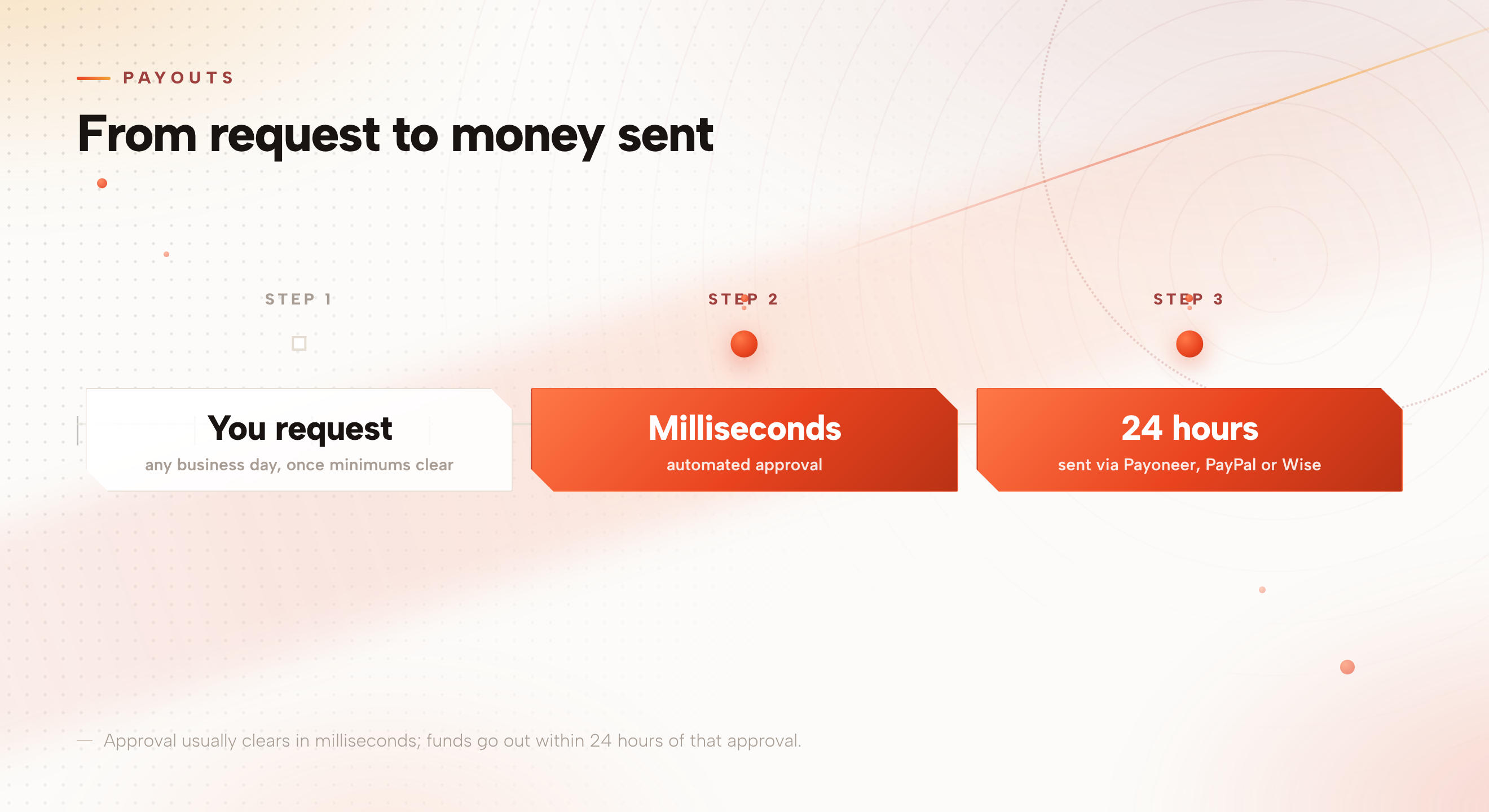
Payouts go out through Payoneer, PayPal or Wise. Those are the only three payout rails Phoenix Trader Funding uses; no other method sends funds out.
A denied payout request comes with an emailed reason rather than a silent hold.
Payout Frequency and Minimum Days, By Account
Splits are only half the picture. The other half is how often you can actually request money and how much has to be there before you can.
| Rule | Classic | Daily | Spark | Merit |
|---|---|---|---|---|
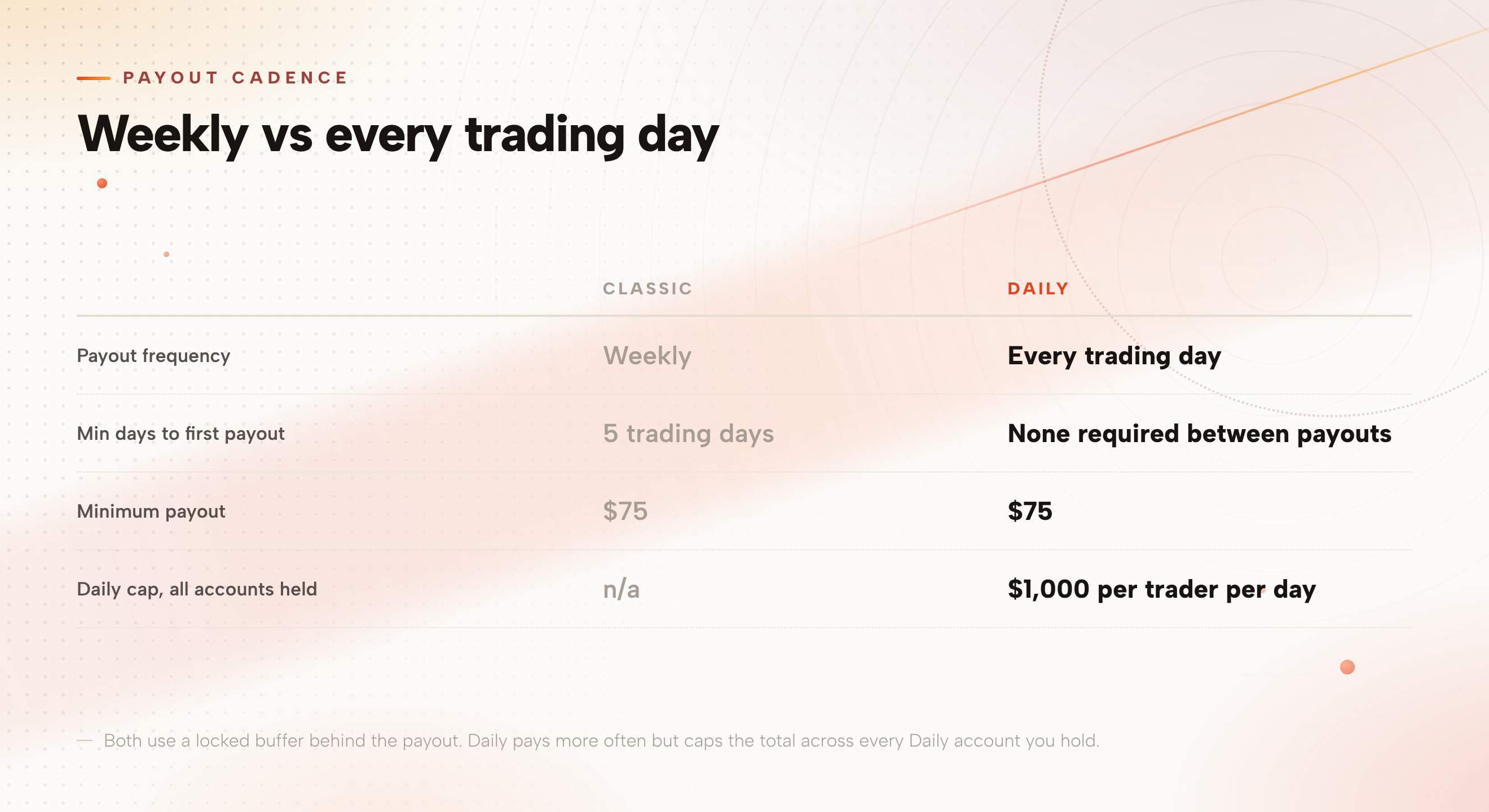
| Payout frequency | Weekly | Every trading day | Bi-weekly | Live account only |
| Min days to first payout | 5 trading days | None required between payouts | 5 trading days | 0 |
| Min profit per counted day | $100 to $300 by size | None | $40 or $100 by size | $0 |
| Minimum payout | $75 | $75 | $30 (Seed) or $75 (Starter) | $0 |
| Per-payout cap | $600 to $2,000 by size | $200 to $1,000 per trading day, by size | $300 or $400 | n/a |
Daily carries one more rule worth knowing before you scale up: the per-size caps above never stack past $1,000 per trader per day, no matter how many Daily accounts you hold.
A trader running three Daily Growth accounts is still capped at $1,000 in payouts on a single day, not $3,000.
The Buffer: A Locked Safety Net Behind Every Payout
Classic and Daily accounts carry a buffer, a locked dollar amount that must remain in the account on top of your starting balance before a payout releases.
The buffer is separate from the trailing drawdown floor, the line that ends your account if your balance falls to it: the buffer never moves, where the drawdown floor can rise as the account grows.
Spark and Merit carry no buffer requirement at all. That is part of why Spark's entry price is lower: less structure sits between a profitable trade and a payout, in exchange for a bi-weekly rather than daily or weekly cadence.
Rules That Can Delay or Deny a Payout
None of these show up as a headline number, and all of them are where a real payout gets held up.
- Open positions at request time do not count. A payout is calculated from closed profit only, so a live trade still running when you submit the request holds up the whole payout.
- A funded Spark account carries a 30 percent consistency rule: no single trading day can count for more than 30 percent of the profit in a payout. Classic, Daily and Merit carry no consistency rule once funded.
- A Pre-Funded account, the simulated funded stage before Live, has to trade at least once every 7 calendar days. A Live Funded account has to trade at least once every 30. Profit sitting on an account closed for inactivity is not paid out.
- A rule violation on a funded account risks payout denial and, depending on severity, account closure.
Close every open trade before requesting a payout. It is the single most common reason a request gets held up, and checking costs nothing.
From Funded Sim to Live Funded Account
Payouts on Classic, Daily and Spark come off a Pre-Funded account: sized and risk-managed by Phoenix Trader Funding but not connected to a live broker. A Live Funded account is the next stage, traded through EdgeClear on Rithmic, a regulated US broker, and it is where the account graduates to.
| Account | Trigger to Live |
|---|---|
| Classic | 4 payouts, plus risk review |
| Daily | Lifetime paid out: $1,200 Seed, $3,000 Starter, $6,000 Growth |
| Spark | 4 payouts, plus risk review |
| Merit | Immediate, right after risk review |
Merit skips the payout-count trigger entirely: a Merit trader moves to Live right after risk review, with no interim payout stage on the simulated account at all.
That is the trade-off behind Merit's single flat fee: no reset, no ongoing subscription, but every payout happens from Live rather than from a Pre-Funded account.
Which Payout Structure Fits You
Classic fits a trader who wants the highest split with no funded consistency rule to plan around, paid weekly, at the cost of a monthly subscription fee. Daily fits a trader who wants cash flow every trading day and can live with an 80 percent split and a $1,000 daily cap.
Spark fits a trader who wants a low one-time entry and can plan around a 30 percent consistency rule once funded. Merit fits a trader who wants a single flat fee, no reset ever, and is fine waiting for the Live stage rather than drawing payouts from a Pre-Funded account.
Steady, closed-out, rule-following trading is what every one of these structures actually pays for.Phoenix Trader Funding
None of the four reward an inconsistent trader. A single outsized day, an inactive account, or an open position at request time costs money under every structure.
FAQ
What percentage of profit do I actually keep at a futures prop firm?
It depends on the firm and the account. At Phoenix Trader Funding, Classic and Spark both keep a 90 percent split, Daily keeps 80 percent, and Merit starts at 50 percent until the entry fee is recouped, then moves to 80 percent.
How often can I request a payout?
It depends on the account. Classic pays weekly, Daily pays every trading day with no minimum days required between requests, and Spark pays bi-weekly. Merit does not pay out until the trader moves to a Live Funded account, which happens immediately after risk review.
Wire transfer and crypto are not payout rails at Phoenix Trader Funding. Only Payoneer, PayPal and Wise send money out; crypto is a way to pay for a challenge, not a way to get paid.
What is the payout buffer, and does it change after a payout?
The buffer is a locked dollar amount, separate from the trailing drawdown floor, that has to stay in a Classic or Daily account for a payout to release. It is fixed by account size and does not move: Classic runs $1,500 to $3,000 and Daily runs $600 to $2,000, by size.
How fast does a payout actually arrive?
A payout request is usually cleared in milliseconds by an automated review system, then sent within 24 hours, through Payoneer, PayPal or Wise. A denied request comes back with an emailed reason.
The $1,000 daily payout cap applies across every Daily account a trader holds combined, not to each account separately.
What can get a payout request delayed or denied?
An open position still running at request time, missing the minimum profit per counted day, a funded Spark account's 30 percent consistency rule, inactivity past 7 calendar days on a Pre-Funded account or 30 on a Live one, or a rule violation on the account.
How do I move from a funded sim account to a real Live account?
For Classic and Spark, 4 payouts plus a risk review moves a trader to a Live Funded account on EdgeClear through Rithmic. Daily unlocks Live on lifetime amount paid out rather than a payout count. Merit traders move to Live immediately after risk review.
The full rule set for every account, including current sizes and pricing, is on the evaluations page, with more payout answers in the full FAQ.
Pick an account and start your evaluation.
Start at phoenixtraderfunding.com. Accounts from $44.New funded-account types are trialled at Phoenix Labs as real, tradable accounts before they join the permanent offer. The ones that work graduate; the ones that do not are retired.