

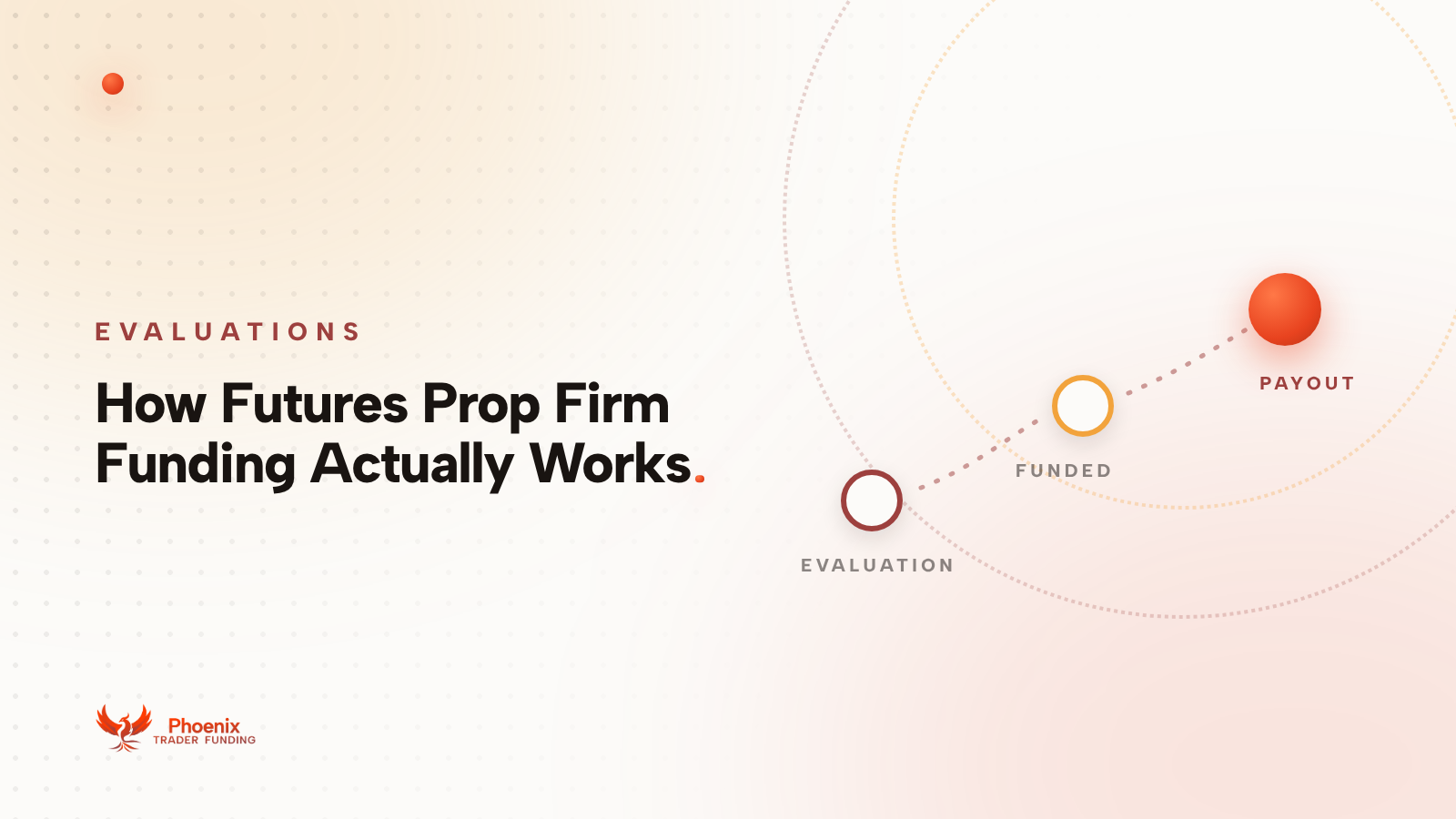
Futures prop firm funding works in four stages: you pay an evaluation fee, trade a simulated account against a profit target and a drawdown limit, move onto a funded account under the firm's risk rules if you pass, and after enough payouts move to a real broker account trading real capital. The only money you ever have at risk is the evaluation fee. Phoenix Trader Funding runs three funding paths, Classic, Spark and Merit, each with its own rule set.
Why does this model exist at all? Because a retail trading account only ever grows as fast as the money you can add to it.
Skill does not have that ceiling. A trader who turns a 3% month into real income on a $100,000 account is doing the exact same thing on a $5,000 account, just for $150 instead of $3,000. The strategy is identical. The paycheck is not.
Funding futures prop firm accounts exist to close that gap. You pay a fee, prove you can manage risk under a defined rule set, and trade a funded account instead of your own capital. Here is exactly how that process works end to end, and how each of the three paths differs once you are in one.
What Getting Funded at a Futures Prop Firm Actually Means
A futures prop firm is a company that funds traders who pass its evaluation: you trade the firm's simulated account under its risk rules instead of depositing your own capital. It is not lending you money to deposit into a personal account. You pay an evaluation fee, trade a simulated account against a defined profit target and drawdown limit, and if you meet the target without breaking the rules, the firm moves you onto a funded account under its own risk umbrella. The profit target is the amount of simulated profit you must reach to pass the evaluation.
The only cash you ever have at risk going in is that evaluation fee. If the account breaches its drawdown, it closes and you are out the fee, nothing more. Your personal savings never touch the trade.
The Four Stages Every Funded Account Goes Through
- Evaluation. Pick an account, pay the fee, and trade a simulated account with a starting balance, a profit target and a drawdown limit until you hit the target or breach a rule.
- Funded stage. Still a simulated account, but the profit target is gone and you are trading under the firm's ongoing risk rules instead of a pass or fail test.
- Payouts. Once the account clears its minimum trading days and minimum profit per day, you can request your share of the profit on a set schedule.
- Live funding. After enough payouts, the firm moves you to a real broker account trading real capital under its name.
Every firm builds that same four-stage shape differently: different fees, different drawdown math, different payout gates. That is what actually separates one prop firm from another, more than any headline number on the pricing page.
Three Funding Paths, Three Different Rule Sets
Phoenix Trader Funding runs three separate funding products, and they are built for different traders rather than being tiers of the same thing.
| Account | Size | Price | Activation fee | Min trading days |
|---|---|---|---|---|
| Classic Starter | $25K | $89/month | none | 2 |
| Classic Growth | $50K | $128/month | none | 2 |
| Classic Scale | $100K | $269/month | none | 2 |
| Spark Starter | $25K | $39/month | $29 one-time | 1 |
| Spark Growth | $50K | $69/month | $29 one-time | 1 |
| Merit | $2K | $69 one-time | none | 1 (30 max, one attempt) |
Classic is built around rule freedom. No daily drawdown to watch during the session, no activation fee once you pass, and no strategy restrictions: Tier 1 news trading through FOMC, CPI and NFP releases is allowed, along with scalping with no minimum hold time, Martingale and DCA, and copy trading. Add a $75 minimum payout and a pass reachable in as few as 2 trading days, and the pitch is simple: fewer things to trip over on the way to a payout.
Spark is the cheapest way into a Phoenix challenge: the 25K Starter runs $39 a month, well under Classic Starter's $89. That lower price comes with two trade-offs worth knowing before you buy: a $29 one-time activation fee once you pass, and a drawdown that switches from end-of-day in the evaluation to real-time intraday once you are funded, with a 30% consistency rule appearing at that same point. You are trading under a stricter, more active rule set in exchange for the lower entry cost.
Merit is structurally different from the other two. A single $69 payment, not a subscription, with no profit target at all: instead you get a 30 calendar day window to trade well, one attempt, no reset if it does not work out. If you do not reach live funding, you get a full Performance Review of the attempt instead of a second shot. All three accounts scale a profit split as you clear payouts: Classic keeps 90% from the first payout, Spark keeps 80%, and Merit starts at 50% until you have recouped that $69, then moves to 80% on everything after. The split matters less than whether you can actually clear the drawdown and reach a payout in the first place, which is the part worth reading closely before you buy.
The Rule That Decides More Than the Price Tag
Drawdown type is what actually determines whether a given trader passes, and it barely shows up in a price comparison.
Classic and Spark evaluations both run on an end-of-day trailing drawdown: the limit recalculates once at the close of each session rather than tracking your open equity tick by tick, and it stops moving once it reaches your starting balance. Classic keeps that end-of-day structure after you get funded too. Spark does not: the funded Spark account trails in real time on open equity, not just at the close, so the rules that got you through the evaluation are not the rules you trade under afterward.
Merit skips the trailing structure entirely. It runs a static $2,000 total drawdown that does not move with your equity, plus a 25% dynamic daily cap on top of that, which is closer to a fixed stop than a moving one.
What Can Get an Evaluation or a Payout Denied
- Consistency rule: 50% during a Classic or Spark evaluation, meaning no single day can carry more than half your total profit. It disappears on funded Classic and on Merit, and reappears as a 30% rule on funded Spark.
- Overnight and over-week positions are prohibited on every account type.
- Cross-account hedging, opening opposite positions on two accounts so one wins regardless of the market, is prohibited across the board.
- Automated systems that generate their own entries, HFT bots and EAs, are off the table on every account.
- Inactivity: a funded sim account has to trade at least once every 7 calendar days, a Live account at least once every 30, and profit sitting on an account closed for inactivity is not paid out.
What Changes Once You Are Funded
Classic and Spark funded accounts pay out bi-weekly once the account clears 5 trading days and a minimum profit per counted day that scales with account size. The minimum payout is $75 on both. Merit is different in shape, not just in numbers: there is no interim payout stage at all, since Merit traders move straight to a Live account after risk review and every payout happens from there.
Graduation to live funding follows a fixed rule. For Classic and Spark, four payouts on the account or $6,000 total withdrawn, plus a risk review, moves the trader to a Live Funded account on EdgeClear through Rithmic; Merit traders move to Live immediately after the same risk review.
Every Classic and Spark challenge also comes with a free practice account on the same parameters, useful for testing a strategy before you risk the evaluation fee on it, with unlimited free resets. Renewing a challenge that has not failed earns a free reset coupon that carries over rather than expiring.
The Ecosystem Behind a Funded Account
A funded account is not just a balance and a rule sheet. Three tools ship alongside it that change how the account actually gets traded day to day.
Odin is Phoenix's own trading platform, built around the same futures-first workflow the evaluations run on.
Thor is a trade copier for traders running more than one funded account. Copy trading is allowed on every Phoenix account type, and Thor is the copier built for it.
Saga is an AI trade journal, free forever on every Phoenix account, useful for reviewing a session honestly instead of guessing at what went wrong.
Which Path Actually Fits You
Classic fits a trader who wants the fewest rules to plan around once funded and does not mind a monthly subscription fee to get that. Spark fits a trader who wants the lowest entry price and is comfortable trading around a real-time drawdown and a consistency rule once funded. Merit fits a trader who wants one flat payment, no subscription, no reset, and is fine skipping straight past an interim payout stage in exchange for that simplicity.
None of the three reward guessing. A big single day, an inactive account or a rule breach costs money under every structure. Pick based on which rule set actually matches how you already trade, not which account looks cheapest on the checkout page.
FAQ
What does getting funded actually mean at a futures prop firm?
You pay an evaluation fee, trade a simulated account under a defined profit target and drawdown, and if you pass, the firm moves you onto a funded account under its own risk rules. You never deposit trading capital.
How much money do I actually risk to get a funded futures account?
Only the evaluation fee. If the account breaches its drawdown limit, it closes and you lose the fee you paid, nothing beyond that.
What's the real difference between Classic, Spark and Merit?
At Phoenix Trader Funding, Classic is a monthly subscription with no daily drawdown and no activation fee, and allows a pass in as few as 2 trading days. Spark costs less per month but adds a one-time activation fee, allows a pass in as little as 1 trading day, and switches to a real-time intraday drawdown once funded. Merit is a single one-time fee with a static drawdown, no reset and no profit target: instead it runs a 30 calendar day window.
Does the drawdown limit change once I'm funded?
On Classic it stays an end-of-day trailing drawdown that only recalculates at the close. On Spark it switches from end-of-day in the evaluation to a real-time intraday trailing drawdown once funded. Merit uses a static total drawdown with a dynamic daily cap the entire time.
How do I move from a funded sim account to a real live account?
For Classic and Spark, four payouts on the account or $6,000 total withdrawn, plus a risk review, moves you to a Live Funded account on EdgeClear through Rithmic. Merit traders move to Live immediately after the same risk review. Before that point, Classic and Spark funded accounts pay out bi-weekly once the account clears 5 trading days and the minimum profit per day; Merit does not pay out until the trader moves to a Live account.
The full rule set for all three paths, including current sizes and pricing, is on the evaluations page, and the full rule and payout FAQ is at phoenixtraderfunding.com/faq.
Pick your account and start your evaluation at phoenixtraderfunding.com. Accounts from $39.