

Is There a Funded Trading Account With No Profit Target?
Most funded futures evaluations make you hit a dollar target before a firm will fund you. One Phoenix account does not.
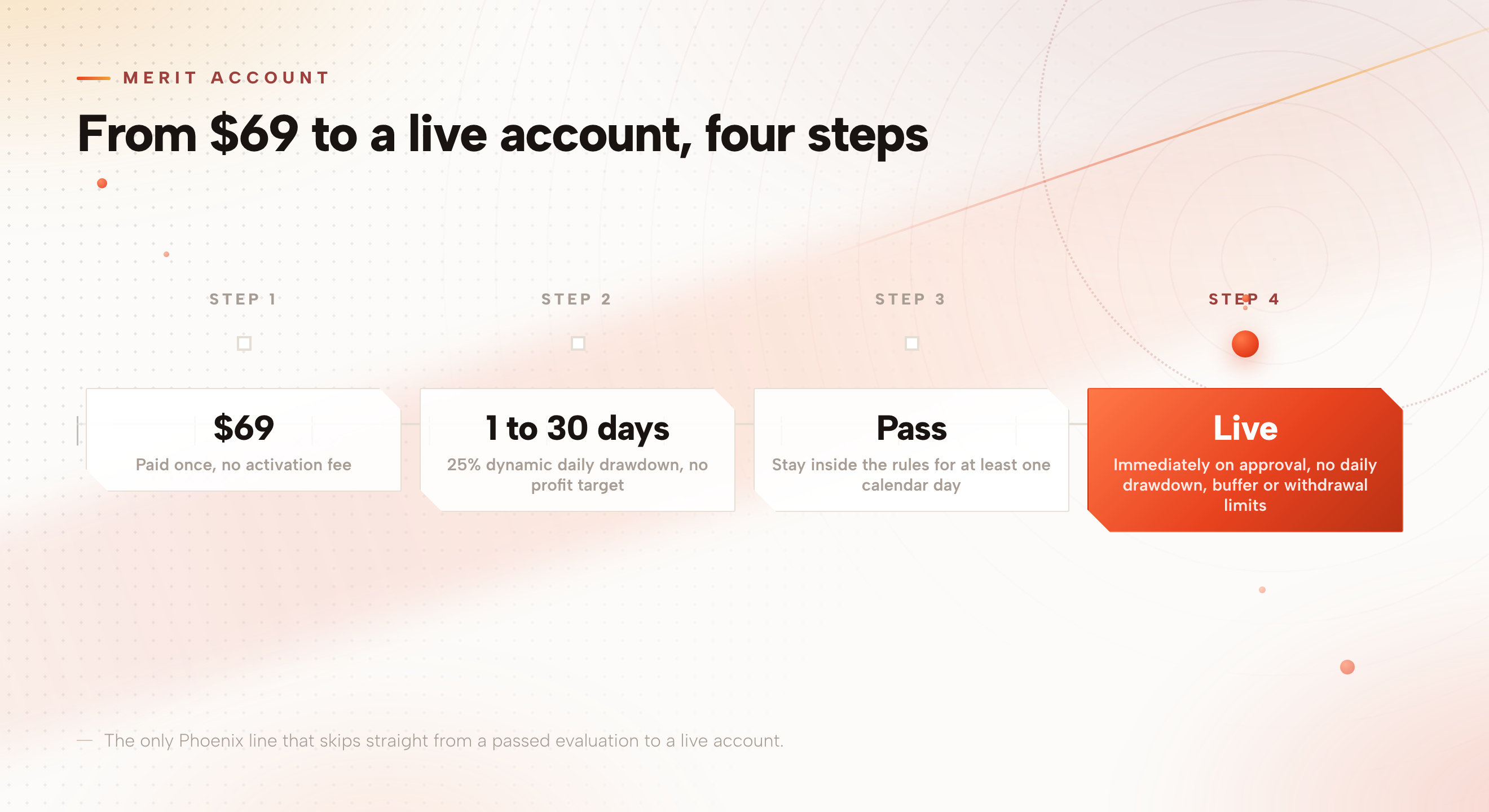
Yes. Phoenix Trader Funding's Merit account is a $2,000 funded challenge with no profit target at all. You pass by staying inside its drawdown limits across a one to thirty calendar-day window, not by earning a set dollar amount, and it costs $69, paid once, with nothing added later.
Pass it and you move to a live funded account right away, instead of waiting through a string of payouts the way the other Phoenix lines require.
- What a profit target normally requires
- How the Merit evaluation actually works
- The daily drawdown, evaluation only
- What happens the moment you pass
- What changes once you are live
- What happens if you do not pass
- Who the Merit account fits
A profit target is the dollar amount an evaluation account has to earn before a prop firm will fund it, on top of staying inside the drawdown limit. Nearly every funded futures challenge on the market carries one, usually a fixed percentage of the starting balance.
That target is also why most evaluations take weeks. A trader has to generate real, counted profit, not just avoid losing money, before a firm hands over funded capital.
Merit skips that step. Trade inside its rules for at least one day, up to a maximum of thirty, and there is no dollar or percentage goal attached to passing at all.
What a profit target normally requires
On a typical evaluation, a trader clears a set profit figure while staying inside a drawdown limit. Most also carry a consistency rule, a cap on how much of that profit any single day may contribute, so one lucky session cannot carry the whole pass.
Phoenix Trader Funding's own Classic account works this way: a Classic Starter needs $1,500 in profit on a $25,000 account, inside a trailing drawdown, a floor that moves up once a day as the account grows rather than tracking every tick. Daily and Spark run similar structures at their own sizes, all listed on the funded evaluations page.
| Account | Profit target | Reset if you fail | Live funding trigger |
|---|---|---|---|
| Classic (25K/50K/100K) | $1,500 / $3,000 / $6,000 | $89 / $128 / $269 | 4 payouts, plus approval |
| Daily (10K/25K/50K) | $600 / $1,500 / $3,000 | $39 / $69 / $99 | Lifetime paid: $1,200 / $3,000 / $6,000 |
| Spark (10K/25K) | $600 / $1,500 | $29 / $39 | 4 payouts, plus approval |
| Merit ($2K) | None | Never allowed | Immediately |
How the Merit evaluation actually works
A Merit account is a single $2,000 challenge for $69, paid once. That price is all in: no activation fee, and nothing added when you pass. Classic, Daily and Merit all skip that fee; Spark is the only line here that charges one.
- One to thirty calendar days to pass, one attempt only
- Up to two contracts, or twenty micro contracts
- No consistency rule: one strong day is enough on its own
Full terms sit on the evaluation FAQ, including what happens to a Merit challenge that does not pass, covered in the section below.
The daily drawdown, evaluation only
The Merit account does carry a daily drawdown, but only during the evaluation: a 25 percent dynamic daily drawdown applies on top of a static total drawdown of $2,000, the full account balance. That total drawdown does not trail your balance upward the way Classic's does; it is a fixed floor set once.
The exact balance the 25 percent is measured against is on the evaluation FAQ linked above along with the rest of the Merit terms; what matters here is that the rule exists at all, and only at this stage.
Traders who have read that Merit carries no daily drawdown, which is true once it goes live, sometimes read the evaluation-stage rule as a contradiction. It is not: the two stages carry different rules, and Merit is the one line where they differ this much.
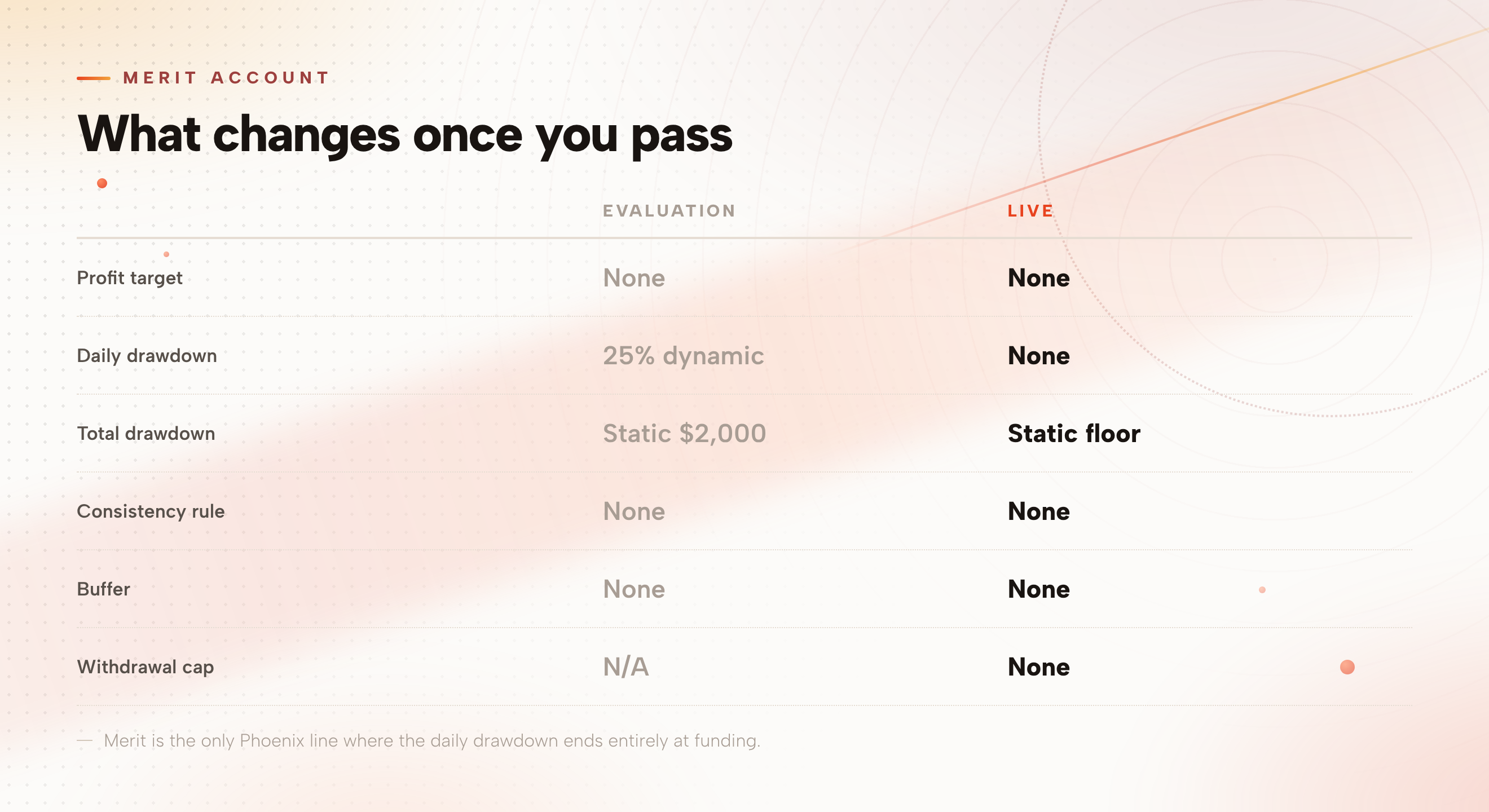
Read the two stages separately. The evaluation limits how much you can lose in a single day and in total while the firm decides whether to fund you. Once funded, that daily limit is gone, and only the live-stage rules below apply.
What happens the moment you pass
Classic and Spark move to live funding after four payouts and a risk approval, a process that runs across weeks of funded trading. Daily unlocks on a lifetime amount paid instead of a payout count. Merit skips both: pass it, clear approval, and the live account activates immediately.
What changes once you are live
A live Merit account drops several rules the evaluation carried.
- No daily drawdown once funded, only the account's static floor
- No buffer requirement locking part of the balance away
- No cap on how much you withdraw at once
- No consistency rule governing how profit is earned
- Withdrawal fees above $500 are covered by the firm itself
The account still carries a profit split, and Merit's is adaptive: 50 percent until you have recouped your $69 entry in profit, then 80 percent afterward. It is one detail among several, not the reason to pick this account.
What happens if you do not pass
A failed Merit evaluation cannot be reset, at any price, ever. That is a firm line, not an oversight: the one-time $69 buys a single attempt, traded for the account's immediate live funding and lack of a profit target.
A trader who does not get funded still receives a Performance Review and tiered consolation rewards. Nobody walks away with nothing to show for the $69.
Who the Merit account fits
- Fits: a trader confident enough to risk one $69 attempt for a shot at immediate live funding
- Fits: someone who wants the smallest possible commitment before trading real firm capital
- Does not fit: a trader who expects a second try, since Merit allows exactly one attempt and never resets
No profit target does not mean no rules; the only one left is not losing.Phoenix Trader Funding
What happens if I breach the daily drawdown limit during the evaluation?
The evaluation fails immediately, the same consequence every Phoenix evaluation carries for any rule violation.
How much does a Merit account cost, and is it really one payment?
$69, charged once: no activation fee, no recurring charge, unlike Classic and Daily's monthly bills.
What happens if the evaluation is still open when the thirty-day window ends?
Phoenix Trader Funding documents the window itself: a one-calendar-day minimum, a thirty-calendar-day maximum, and exactly one attempt either way. Exactly how a breach at any point inside that window is handled sits on the evaluation FAQ linked above.
Does a live Merit account get bigger over time?
Yes, one additional mini contract per $2,000 of extra live profit, the same way every Phoenix Live account scales. Only the daily drawdown, buffer, withdrawal cap and consistency rule are Merit's live-specific exceptions.
What does the two-contract limit actually let you trade?
Two standard futures contracts, or twenty micro contracts, never both together. Enough for one instrument, or thinner exposure spread across micro-sized trades.
The two decisions that matter come down to timing and price: one to thirty calendar days to pass, and $69 that is never charged twice.
See the full Merit rules and start for $69.
Start a Merit accountNew funded-account types are trialled at Phoenix Labs as real, tradable accounts before they join the permanent offer. The ones that work graduate; the ones that do not are retired.