

Can You Scalp a Funded Futures Account?
What the rule allows, what scalping costs in commissions, and where the limits sit.
Yes. Phoenix Trader Funding allows scalping on Classic, Daily, Spark and Merit, with no minimum trade duration at any stage of the account. The rule is not what shapes a scalper's results. The commission per side, the contract cap and the type of drawdown on your account do.
- What scalping means on a futures account
- Why trading fees decide whether scalping pays
- How many contracts a scalper can trade
- How the drawdown behaves when you scalp
- Where scalping stops
- Practice before you pay a fee
- A checklist before you scalp a funded account
- Who scalping suits
- Frequently asked questions
A scalper takes many small trades and holds each one for a short time. Some firms attach a minimum hold time to their plans, which can turn the whole style into a rule breach before the first trade is placed. Phoenix attaches none, so the questions left are practical ones about cost, size and drawdown.
What scalping means on a futures account
Scalping is a trading style that aims for many small gains by holding each position for seconds or minutes. A tick is the smallest price move a futures contract can make, and a scalper often targets only a few of them per trade. A round turn is one complete trade: the entry plus the exit that closes it.
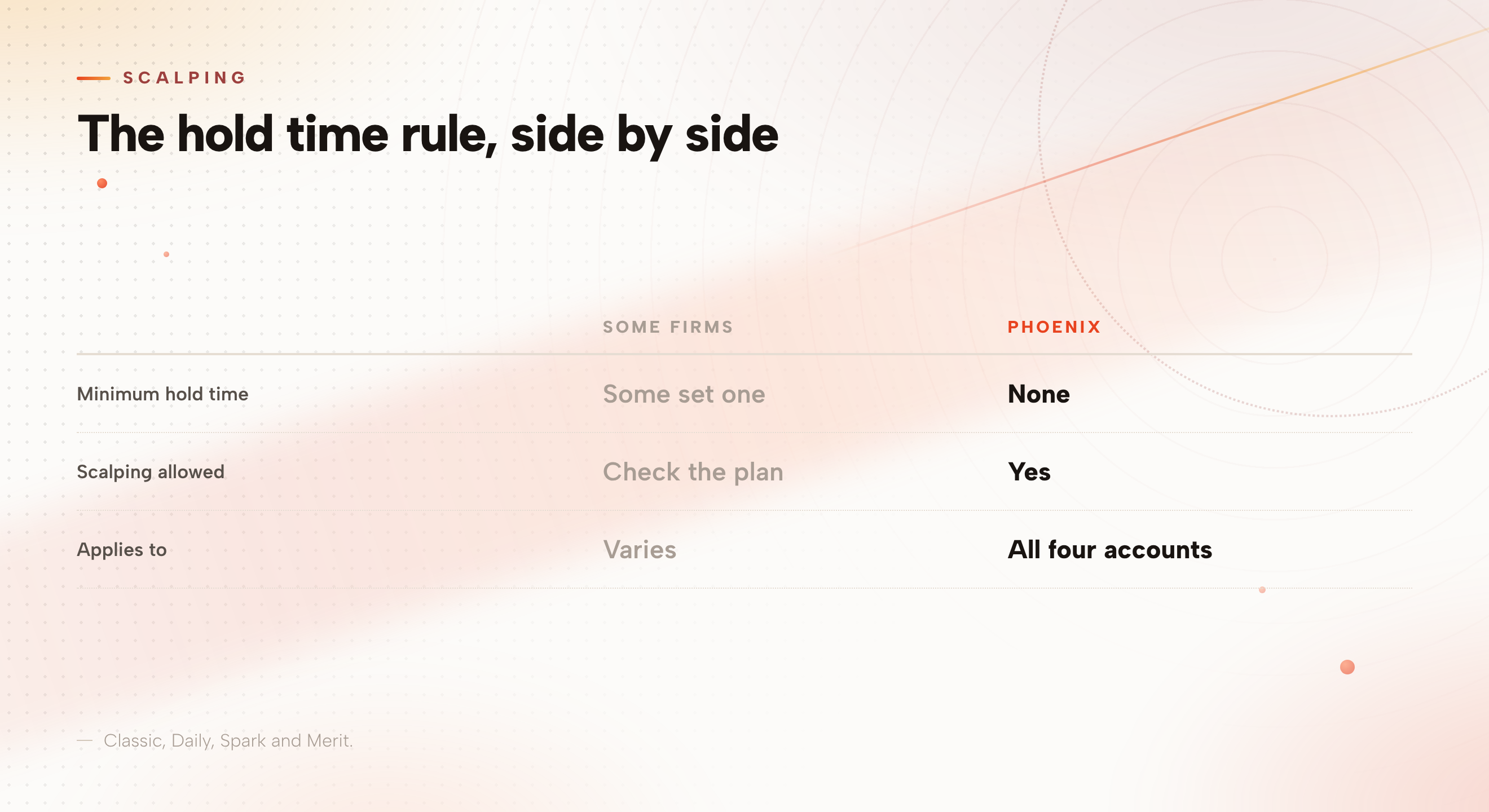
Phoenix Trader Funding allows scalping on all four account lines: Classic, Daily, Spark and Merit. There is no minimum trade duration, and the rule holds at every stage, so a trade that lasts seconds counts like any other trade.
Why trading fees decide whether scalping pays
A commission is a fee charged on each side of a trade, once when you enter and once when you exit, so every round turn pays it twice. A swing trader barely notices that cost. A scalper who makes many round turns a day and aims for a few ticks each feels it on every single trade.
The data feed you choose sets the rate. TFeed, Phoenix's own execution feed, charges about half of what dxFeed does. ES, the E-mini S&P 500 contract, costs $1.09 per side on TFeed against $2.18 on dxFeed. MES, the micro version at a tenth of the size, costs $0.36 against $0.71.
An ES round turn on TFeed costs $2.18, entry and exit together: the price of a single side on dxFeed. A dxFeed round turn costs twice the TFeed one.
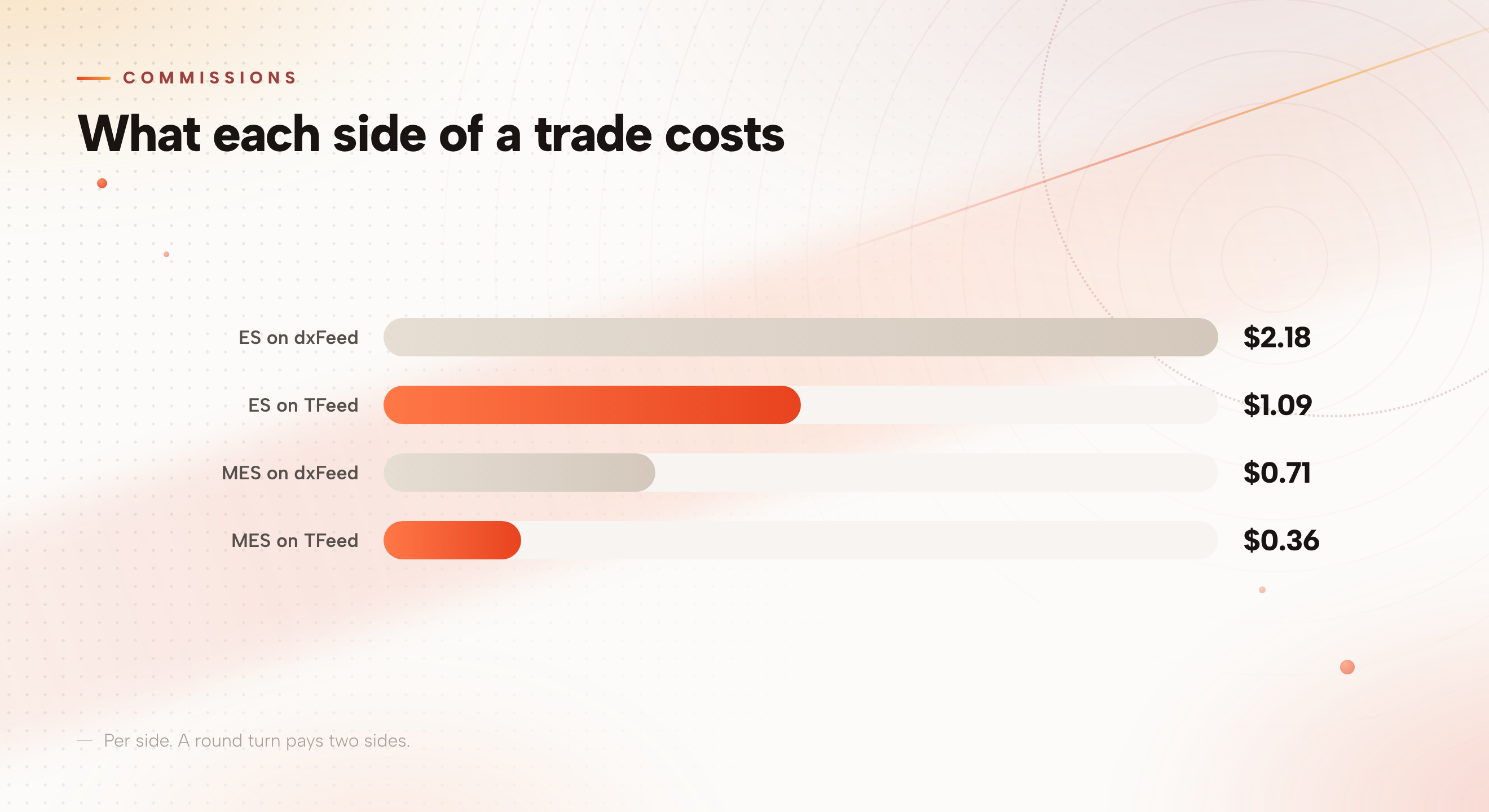
Read the bars as a cost per side, not per trade. MES carries a lower per-side rate than ES on both feeds, and it moves less per tick, so the two contracts suit different position sizes.
Spark, Daily and Merit run on TFeed only, so the lower rate comes with those three accounts. Classic is available on either feed.
The per-side fee is the one cost a scalper pays on every trade, win or lose. Price a round turn on your feed before you decide how many trades a day your style needs.
How many contracts a scalper can trade
A contract cap is the largest position you can hold at one time on an account. For a scalper it sets how much each small move is worth, so the cap for your exact account size matters before the first trade. Each cap offers minis or micros as alternatives, never a total.
Classic works on a scaling plan: each account starts below its headline cap, and the size you may trade grows with the profit you build. The table shows where each Classic starts and the top size it reaches.
| Account | Starts at | Tops out at |
|---|---|---|
| Classic 25K | 1 mini or 10 micros | 1 mini or 15 micros |
| Classic 50K | 1 mini or 10 micros | 3 minis or 30 micros |
| Classic 100K | 2 minis or 20 micros | 6 minis or 60 micros |
The next table covers the other three lines. Spark and Daily have no scaling plan, so the cap applies in full from day one.
| Account | Contract cap |
|---|---|
| Spark 10K | 1 mini or 10 micros |
| Spark 25K | 2 minis or 20 micros |
| Daily 10K | 6 micros only |
| Daily 25K | 1 mini or 15 micros |
| Daily 50K | 3 minis or 30 micros |
| Merit | 2 minis or 20 micros |
A micro is a tenth the size of a mini, so micro allowances let you size a position in finer steps. Daily's smallest account is the extreme case: it allows micros only.
Size can also grow after funding. Live is the live-funded stage a Phoenix account can reach after review, and on a Live account the size grows by 1 mini for each $2,000 of additional profit made there.
How the drawdown behaves when you scalp
A trailing drawdown is a loss limit that follows your account balance upward as you make profit. At Phoenix it stops trailing once it reaches the starting balance. End of day trailing means the limit moves once, when the session closes. Intraday trailing means it can move up during the session.
| Account | Evaluation | Funded |
|---|---|---|
| Classic | End of day | End of day |
| Daily | End of day | End of day |
| Spark | End of day | Intraday |
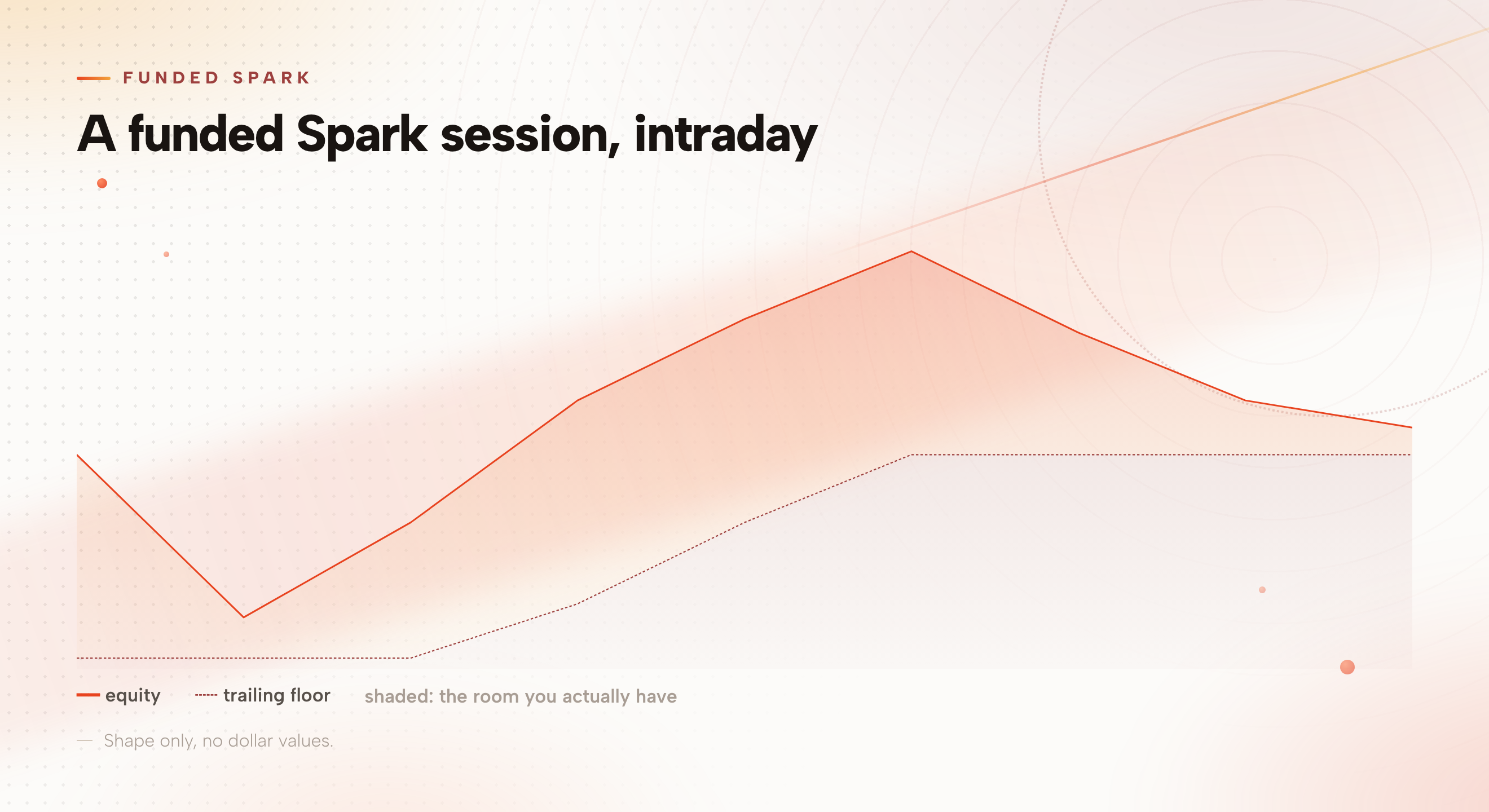
This matters most to a scalper on a funded Spark account. Profit taken early can lift the intraday limit within the same session, so a session that makes a new high and then gives profit back finishes with less room than it began with. On Classic, Daily and the Spark evaluation, the same round trip leaves the limit where it was.
There is no daily drawdown on the Classic, Daily or Spark evaluation, so the trailing limit is the only loss limit you work against there.
Merit is built the other way round. It is a 30 calendar day assessment with one attempt, it carries a 25% dynamic daily drawdown and a static total loss limit of $2,000 in place of a trailing drawdown, and funding is not promised at any result. Scalping is allowed there too, and a scalper on Merit watches the day's loss and the fixed total, not a rising peak.
Where scalping stops
Scalping is a style, not a loophole, so the same rules apply to it as to any other trade. These are the prohibitions that a scalper meets.
| Prohibited | Where it applies |
|---|---|
| Overnight or overweek positions | All accounts |
| Hedging across accounts | Every line, evaluation and funded |
| HFT or EA bots | Every line, evaluation and funded |
| Flipping | Funded accounts |
| One tick trading on bonds | Funded accounts |
HFT is high frequency trading, and an EA is an expert advisor, an automated trading program. A scalper who places trades by hand is neither. The overnight rule is the one scalpers meet least, because a scalp usually ends within minutes.
Flipping means token trades placed only to validate a day or to dodge inactivity. The definition is about why a trade is placed, not how long it lasts, so a short trade taken on a real setup is scalping and not flipping.
Practice before you pay a fee
A Practice account is a free simulated account with the same parameters as the challenge, and it can never be funded. Classic, Daily and Spark each have one, with unlimited free resets and unlimited accounts. Merit has none, because it is a one off assessment.
- Pick the account and size. Choose the line and the size you plan to buy.
- Set your position size. Keep it at or below the contract cap for that account.
- Run your setup. Trade it for a full week of sessions.
- Compare the worst day. Check your worst session against the drawdown your Practice account runs on.
Practice copies the challenge, so it carries the evaluation drawdown. The Spark evaluation trails end of day, so a Spark Practice account cannot rehearse the intraday floor of a funded Spark. If you are heading for a funded Spark, note how far each practice session fell from its high.
A checklist before you scalp a funded account
- Price a round turn on the feed your account uses
- Read the contract cap for your exact account size
- Know whether your drawdown trails end of day or intraday
- No EA or HFT bot. Copying trades between your own accounts is allowed
- Close every position before the day ends
Who scalping suits
Scalping suits a trader whose edge shows up in many small, quick trades, and the account rules give that style three things to work with.
The first is size: every line allows micros, so a position can be set in fine steps, and the Daily 10K allows micros only. The second is cost: TFeed charges about half of what dxFeed does, and it is the only feed on Spark, Daily and Merit, with a choice on Classic.
The third is session shape. If yours often peak early and give some back, a funded Classic or Daily holds the floor until the close, while a funded Spark moves it during the session.
This article describes account rules. It is education, not financial or trading advice, and trading futures carries a risk of loss. Phoenix Labs experiment accounts publish their own rulebook, so this page covers only Classic, Daily, Spark and Merit.
Frequently asked questions
Is scalping allowed on a funded futures account?
Yes, at Phoenix Trader Funding. Scalping is allowed on Classic, Daily, Spark and Merit with no minimum trade duration, at every stage of the account. Other firms differ by plan and stage, so read the rule for your exact account before you buy.
Is there a minimum hold time for trades?
No. Phoenix sets no minimum trade duration, so a trade that lasts a few seconds is a normal trade. The rule to respect is the one against flipping, token trades placed only to validate a day or dodge inactivity, on funded accounts.
Which feed is cheaper for scalping?
TFeed. It charges about half of what dxFeed does: ES costs $1.09 per side on TFeed against $2.18 on dxFeed, and MES costs $0.36 against $0.71. Spark, Daily and Merit run on TFeed only, and Classic is available on either feed.
Can I scalp with micro contracts?
Yes. Each account's cap allows micros, and the Daily 10K allows micros only, up to 6. A micro also carries a lower fee than a mini on both feeds.
Contract caps are either or. On a Spark 10K, 1 mini or 10 micros means one choice or the other, never the two added together.
Does a real time trailing drawdown matter to a scalper?
On a funded Spark account, yes. The limit trails intraday, so profit taken early in a session can raise it within that session. Classic and Daily stay end of day when funded, and the Classic, Daily and Spark evaluations trail end of day.
Can I use a bot to scalp?
No. HFT and EA bots are prohibited on every line, in evaluation and funded. Placing trades yourself is allowed, and so is copy trading between your own accounts.
The full rules for each account are on the evaluations page, the feeds and platforms are laid out in the connection guide, and general questions are answered in the FAQ.
Start your evaluation at phoenixtraderfunding.com.
New funded-account types are trialled at Phoenix Labs as real, tradable accounts before they join the permanent offer. The ones that work graduate; the ones that do not are retired.