

Can You Trade News on a Funded Futures Account?
FOMC, CPI and NFP are allowed on Classic, Daily, Spark and Merit. Here is how to size a release against your drawdown.
Yes. Phoenix Trader Funding allows news trading, including Tier 1 releases like FOMC, CPI and NFP, on Classic, Daily, Spark and Merit, in the evaluation and on the funded account. Scalping with no minimum hold time is allowed too. What limits a release day is not a news rule. It is how much of your drawdown one move can use.
- What news trading means on a prop firm account
- News rules at Phoenix, account by account
- The releases traders mean by news
- How much room one release can use
- What you can run on a release day
- A release day checklist
- Who trading news on a funded account suits
- Frequently asked questions
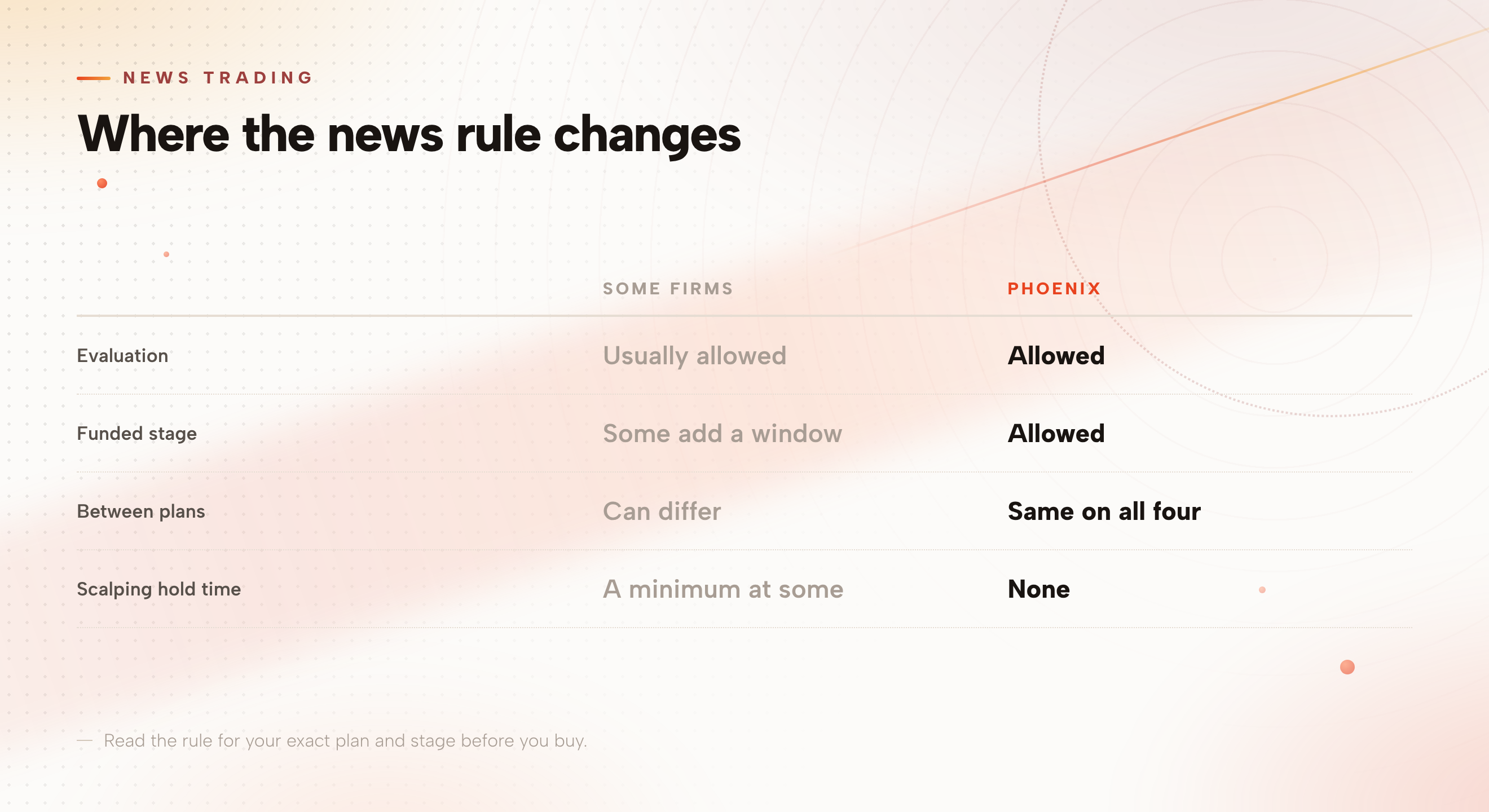
Many rule pages answer this with "it depends": allowed in the evaluation, restricted once funded, different on the next plan. Before you plan a trade around a release, read the news rule for your exact account and stage.
What news trading means on a prop firm account
News trading means opening, holding or closing a futures position around a scheduled economic release. A Tier 1 event is one of the releases that move index futures hardest: the FOMC rate decision, the CPI inflation report and the NFP jobs report.
A blackout window is a stretch of minutes before and after a listed release when a firm bans open positions or new orders. Some firms apply one only to funded accounts, so a rule that was harmless in the evaluation starts to matter after you pass.
Phoenix lists news trading as allowed on every account card, with Tier 1 events included. The rule you read before you buy is the rule you trade under once you are funded.
Before you buy any evaluation, get four answers in writing.
- Is the news rule the same in the evaluation and on the funded account?
- Does it cover new orders, pending orders and positions you already hold?
- Which events and which products does it name?
- Is it on a rules page you can save, or only in a chat reply?
News rules at Phoenix, account by account
At Phoenix Trader Funding, news trading is allowed on all four account lines. What differs from one line to the next is the drawdown, and on a release day the drawdown decides how large a position you can sit through.
An end of day trailing drawdown is a loss limit that rises with your account's high point and updates once a day, not tick by tick. A real time trailing drawdown follows that high point as the session unfolds.
| Account | News trading | Drawdown in the evaluation | Drawdown once funded |
|---|---|---|---|
| Classic | Allowed | End of day trailing | End of day trailing |
| Daily | Allowed | End of day trailing | End of day trailing |
| Spark | Allowed | End of day trailing | Real time, intraday trailing |
| Merit | Allowed | Static $2,000 total limit, 25% dynamic daily drawdown | On Live: static overall floor, no daily drawdown |
Classic and Daily keep an end of day trailing drawdown in the evaluation and on the funded account. Spark trails end of day in the evaluation, then switches to real time, intraday tracking once funded. The Merit evaluation has a static $2,000 total limit and a 25% dynamic daily drawdown, and Merit Live has a static overall floor and no daily drawdown.
Of the four, only the Merit evaluation carries a daily drawdown. The Classic, Daily and Spark evaluations carry none.
The releases traders mean by news
CPI, the consumer price index, measures how fast prices are rising and prints monthly. NFP, nonfarm payrolls, counts the jobs the US economy added and also prints monthly. The FOMC is the Federal Reserve committee that sets the policy rate.
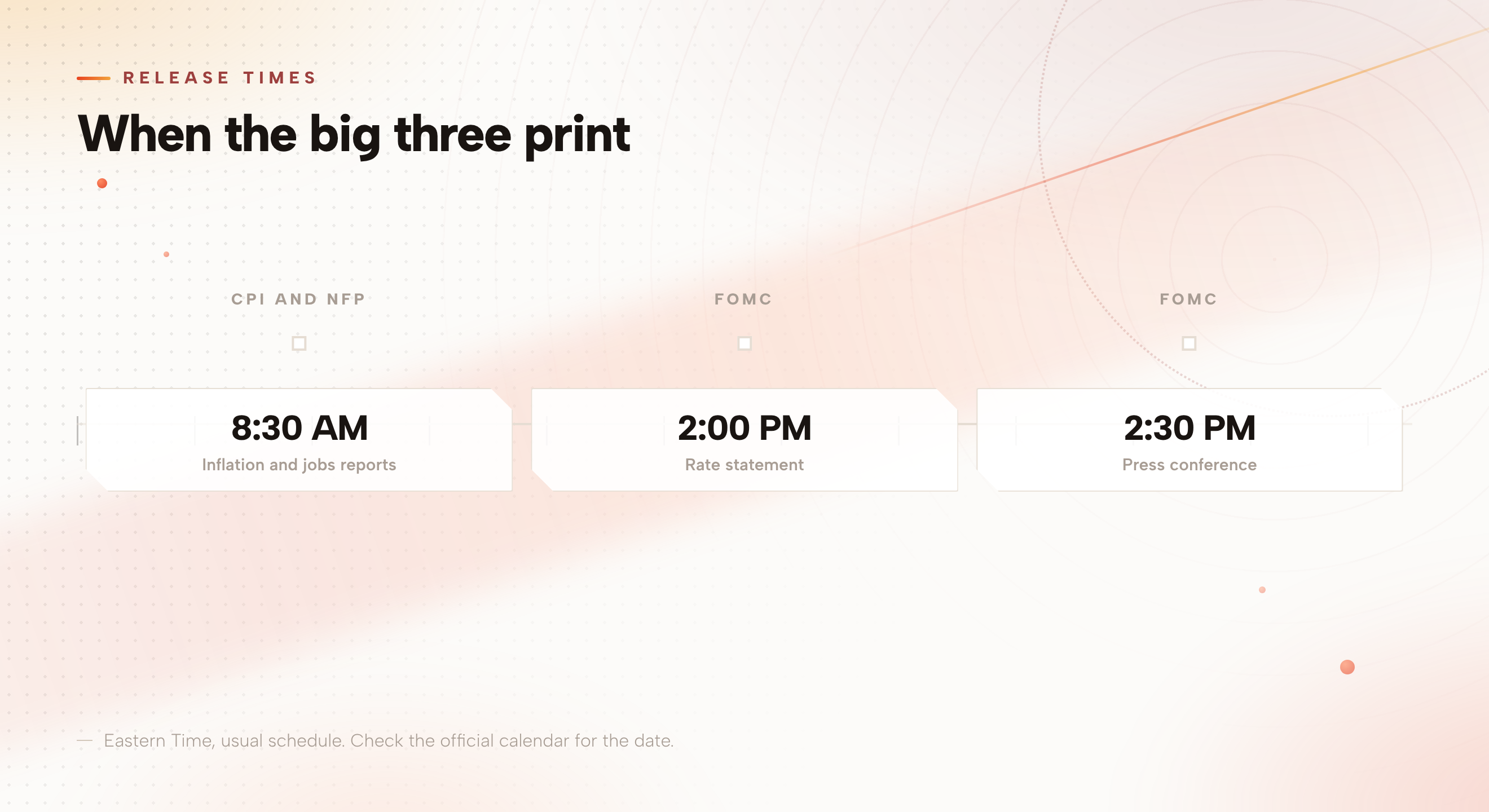
CPI and NFP print at 8:30 AM Eastern. The FOMC statement lands at 2:00 PM and the press conference follows at 2:30 PM. All three arrive while the futures market is open and well before the end of the US trading day, so you never have to hold a position overnight to trade them.
How much room one release can use
Permission settles whether you can trade the release. Your drawdown settles how large a move you can sit through, and that is arithmetic you can finish before the print.
- Take your roomYour balance minus your current drawdown floor. On a fresh account that is the full trailing drawdown in the chart below; a losing day leaves less.
- Find the point valueThe exchange publishes the dollar value of one point for every futures contract.
- Count your contractsA micro is one tenth the size of its mini, so ten micros move like one mini.
- DivideDivide your room by the dollar value of one point across all your contracts. The result is how many points against you the account can absorb.
Worked example, Spark 25K evaluation. The account has $1,000 of trailing drawdown and allows up to 2 minis or 20 micros, which are alternatives and never a total. Compare 2 E-mini S&P 500 (ES) with 4 Micro E-mini S&P 500 (MES) on the same room.
Two ES move twice what one ES moves on every point. Four MES move four tenths of it, because a micro is one tenth of its mini. The same $1,000 therefore lasts five times as many points on 4 MES as on 2 ES. Size, not permission, decides whether one print can take the account.
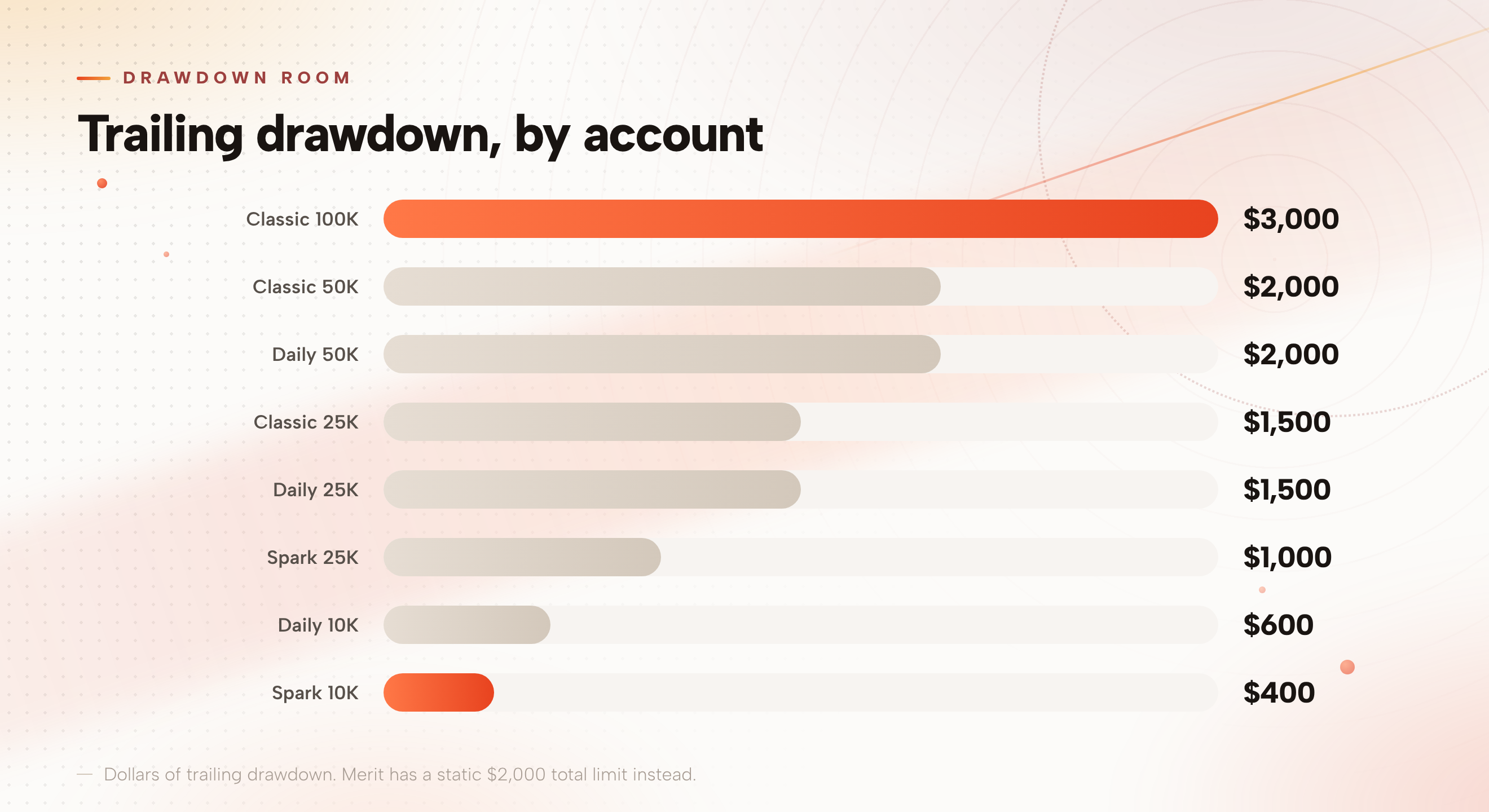
Classic carries $1,500 on the 25K, $2,000 on the 50K and $3,000 on the 100K. Daily carries $600 on the 10K, $1,500 on the 25K and $2,000 on the 50K. Spark carries $400 on the 10K and $1,000 on the 25K. Merit has a static $2,000 total limit instead of a trailing one.
A stop is not a wall. A stop order becomes a market order once it triggers, so it fills at the next available price, and in the first seconds after a print that price can sit several ticks past your stop. The room you work out is a ceiling on risk, not a prediction of the fill.
On a funded Spark account the floor trails in real time, so profit you take on the first move of a release can lift it within the session: give that profit back on the reversal and you finish with less room than you started with.
On Classic, Daily and the Spark evaluation the floor moves only once a day, so the same round trip inside one session leaves it where it was.
Permission to trade a release is not an edge on it.The rule and the arithmetic are separate questions
What you can run on a release day
The news rule is one of several freedoms that apply on all four lines at once. These are all allowed:
- Scalping, with no minimum trade duration
- Copy trading between your own accounts
- VPN and VPS, which are monitored
The short list that applies on every account is no overnight or overweek positions, no hedging across accounts and no HFT or EA bots. None of the three is a news rule, and none of them gets in the way of the three releases above, which all print during the trading day.
A release day checklist
Most of the work on a release day happens before the print.
- Check the official calendar for the exact date and time of the release
- Write down your drawdown, your contract count and the points of room they leave
- Know whether your account trails end of day or in real time
- Decide where the trade is wrong before the print, not after it
- Plan to close the day flat, because overnight and overweek holds are not allowed
Who trading news on a funded account suits
News trading suits a trader who already has a tested edge on volatile prints and sizes down for them. It is a poor shortcut for someone who has never traded one. A release can move price a long way in seconds, and the evaluation will show you which kind of trader you are.
If you have never traded a print, watch two or three with no position first and note how far price travels in the first minute. This is education about how the rule works, not trading advice.
Frequently asked questions
Can you trade news on a funded futures account?
Yes, at Phoenix Trader Funding. News trading, including Tier 1 events like FOMC, CPI and NFP, is allowed on Classic, Daily, Spark and Merit, in the evaluation and on the funded account. Other firms vary by plan and stage, so read the rule for your exact account before you buy.
Do I need to close my trades before a release?
No news rule requires it, because news trading is allowed on all four account lines. The overnight and overweek rule still applies, so the close that matters is the one at the end of the day, and all three big releases print before it.
Which news events count as Tier 1?
Phoenix names FOMC, CPI and NFP: the Federal Reserve rate decision, the inflation report and the jobs report. CPI and NFP print at 8:30 AM Eastern, and the FOMC statement lands at 2:00 PM Eastern.
Can I scalp the news candle?
Yes. Scalping is allowed on all four lines with no minimum trade duration, so a trade that lasts seconds is a normal trade.
Does the Merit daily drawdown matter for news trading?
It can, because a single day's loss can build fastest around a release. The Merit evaluation carries a 25% dynamic daily drawdown on top of its static $2,000 total limit, and the Merit page explains how it works. Classic, Daily and Spark evaluations carry no daily drawdown.
Merit is a 30 day assessment with one attempt for the life of the account, so read its daily drawdown before you buy it.
Does going Live change the news rule?
No. Phoenix waives its strategy rules on Live except the overnight and overweek one, so news trading stays allowed. The drawdown is what changes: Classic, Daily and Spark Live accounts pick up a scalable daily limit set with you, Merit Live has no daily drawdown, and every Live account keeps a static overall floor.
The full rules for each account are on the evaluations page, the Merit rules are on the Merit page, and general questions are answered in the FAQ.
Start your evaluation at phoenixtraderfunding.com.
New funded-account types are trialled at Phoenix Labs as real, tradable accounts before they join the permanent offer. The ones that work graduate; the ones that do not are retired.