


What's the Cheapest Way to Get a Funded Trading Account?
A $69 one-time account with no monthly bill, no reset if you fail, and immediate live funding if you pass. Here's how it works, and exactly who it suits.
The cheapest way to reach a live funded trading account at Phoenix Trader Funding is the Merit account: a $2,000 account for a single $69 fee, paid once, with no monthly subscription and no profit target to hit.
Spark Seed lists lower at $44, but its $29 activation fee and four-payout wait before live funding make Merit the cheaper, faster route overall.
There is no reset if you fail: one attempt for a low, one-time price, which is why Merit suits a narrower kind of trader than the others.
- How the cheapest route to live funding works
- The rules while you're proving it
- What happens the moment you pass
- What happens if you don't pass
- Who a $2,000 account suits
Most funded futures evaluations ask for real money and real patience: an account priced in the hundreds of dollars, weeks of trading, and a profit target measured in thousands before a firm hands over its capital. That prices out a trader who just wants to find out, cheaply, whether they can hold to real rules.
Phoenix Trader Funding sells four funded lines, and one of them is built for exactly that question.
How the cheapest route to live funding works
The account is called Merit, and it is a $2,000 evaluation with a single $69 fee. An activation fee is a separate charge some firms add the moment a trader passes, on top of the entry price already paid. Merit does not carry one: the $69 is genuinely all in, nothing added at checkout and nothing added when you pass.
| Account | Entry price | Billing | Activation fee |
|---|---|---|---|
| Classic Starter, 25K | from $89 | Monthly | None |
| Daily Seed, 10K | $99 | Monthly | None |
| Spark Seed, 10K | $44 | One time | $29 one time |
| Merit, 2K | $69 | One time | None |
That is a different shape from the rest of the lineup. Classic and Daily still bill monthly for as long as the challenge stays open. Merit and Spark are both paid once, but Spark adds a separate $29 activation fee the moment a trader passes, which Merit does not.
A reader scanning that table might ask why $69 counts as cheapest when $44 sits right above it. $44 is the lowest entry price, not the lowest all-in one: Spark's $29 activation fee falls due only when you pass, never summed at checkout.
The price is only half the wait. A passed Spark evaluation still needs four payouts plus a risk approval before it reaches live funding, while Merit goes live immediately on approval.
Those four payouts are also money the trader collects rather than an empty wait, since Spark's Pre-Funded stage pays out bi-weekly, up to $300 a payout on a Seed account.
The rules while you're proving it
A drawdown limit is the maximum an account is allowed to lose before the evaluation fails automatically. Merit runs two at once: a 25 percent dynamic daily drawdown, recalculated against the account's own balance rather than fixed to one number, and a static $2,000 total drawdown, a fixed floor that does not move once it is set.
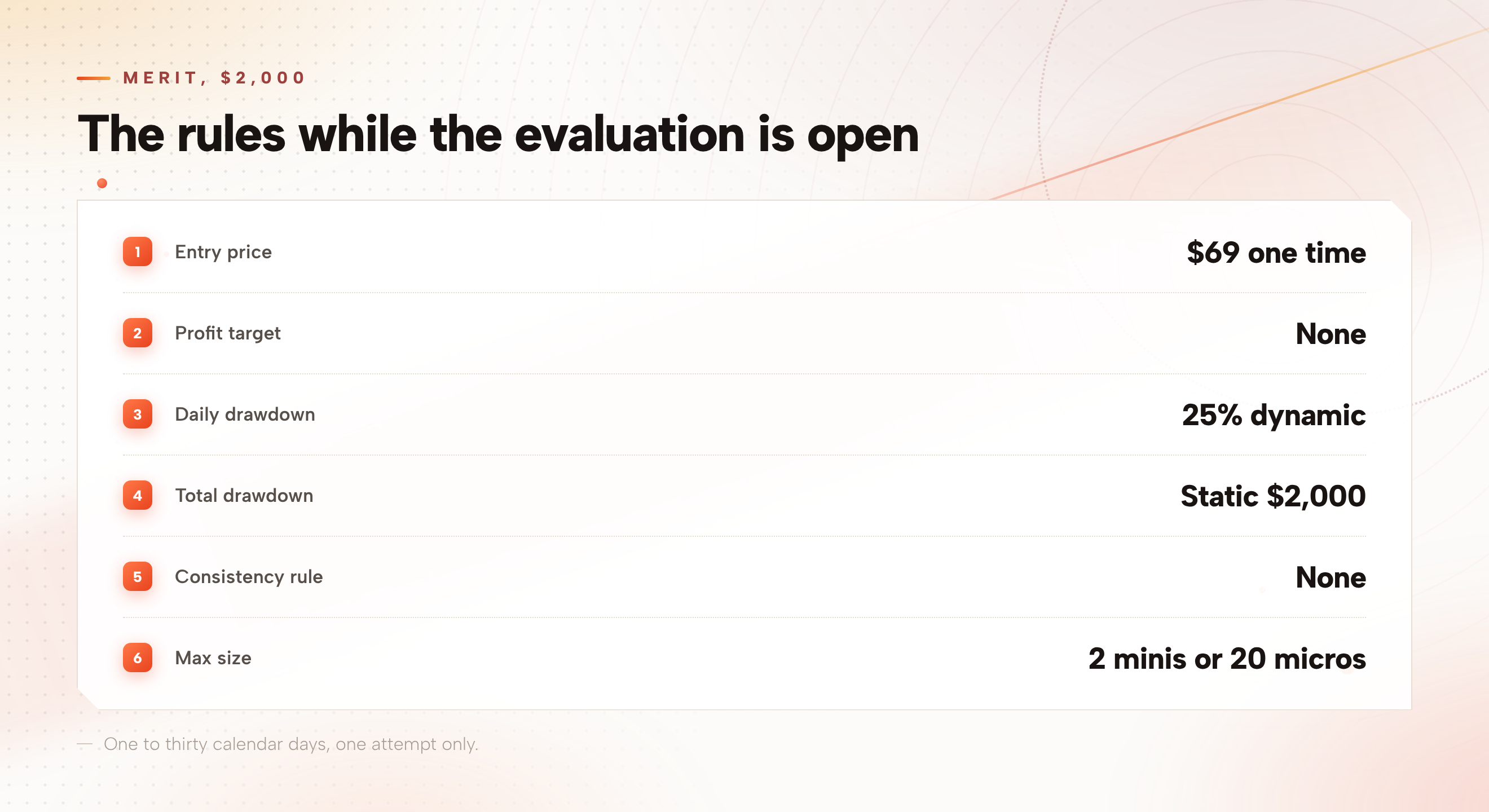
There is no profit target and no consistency rule, a cap some firms place on how much of total profit any single day may contribute. The evaluation runs a minimum of one calendar day and a maximum of thirty, with one attempt ever: one strong day is enough on its own, provided the account never breaches either drawdown limit first within that window.
That window runs in calendar days, not trading days: a trader who plans against the wrong unit risks running out of time with sessions still left on their own schedule. Full rule detail sits on the evaluations page.
What happens the moment you pass
Pass Merit and the account moves to live funding immediately on approval. Every other Phoenix line makes a trader wait: Classic and Spark require four payouts plus a risk approval before moving to a live account, and Daily unlocks once a trader has been paid a set lifetime total. Merit skips that entire waiting period.
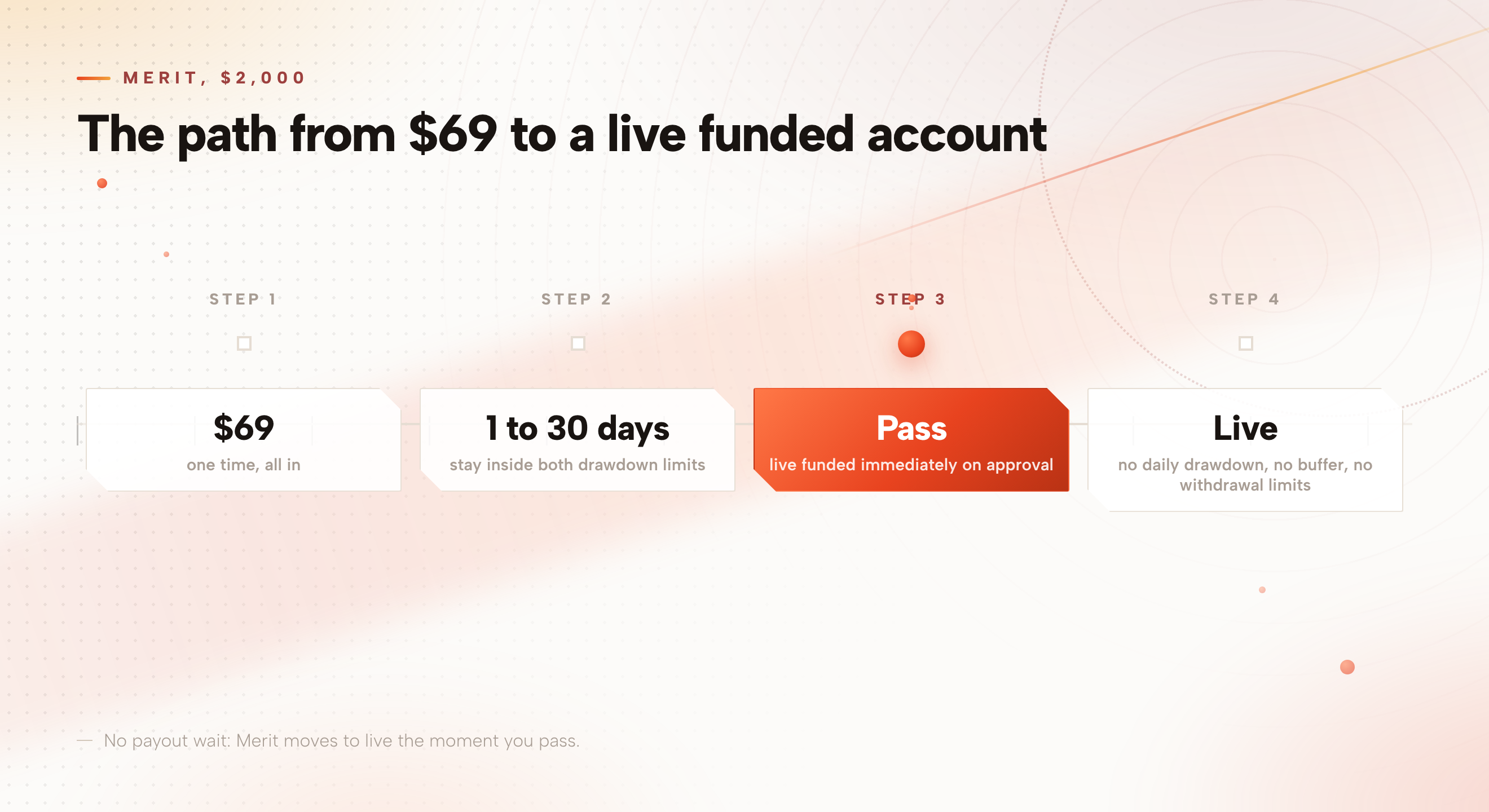
- No daily drawdown once live, only the static floor
- No buffer requirement holding money back from a withdrawal
- No withdrawal limits and no consistency rule
- Withdrawal fees are covered on any request above $500
The live account holds $2,000 and keeps the same static drawdown covered above, the same fixed floor. There is no separate payout schedule either, no minimum profit per counted day and no per-payout cap, so a withdrawal is never staged the way it is on the firm's other funded lines.
What happens if you don't pass
Merit's tradeoff for the low, one-time price is that there is no reset, at any price or size. Every other Phoenix line sells a paid reset if a challenge fails: $89 on a Classic Starter, $39 on a Daily Seed, $29 on a Spark Seed. Breach a drawdown limit on Merit and the $69 attempt is gone for good.
A trader who does not pass is not left with nothing: Phoenix Trader Funding sends a Performance Review, a 20 to 30 page personal report on the trading, plus tiered consolation rewards.
Who a $2,000 account suits
Merit suits a trader who wants to find out, at the lowest possible cost, whether they can hold to real drawdown limits under a real funded structure, without committing to a monthly bill while they find out. It also suits someone who wants live funded status fast, with no string of payouts to clear first.
It does not suit a trader who wants a second attempt if the first one fails. Merit's single-attempt structure is a real constraint, and it belongs on the before-you-buy side of the decision, not the fine print.
Size is the other limit. Merit tops out at $2,000, well below what Classic, Daily or even Spark's smallest accounts allow, so it is a way to start cheaply rather than a way to scale.
How much does a Merit account cost?
$69, paid once, with nothing added later whether you pass or not.
Does a Merit account have a profit target?
No. There is no dollar or percentage target. You pass by staying inside a 25 percent dynamic daily drawdown and a static $2,000 total drawdown, within the calendar-day window covered above.
Can I reset a Merit account if I fail the evaluation?
No. A reset is never available on Merit. A trader who does not pass receives a Performance Review and consolation rewards instead.
How fast do I get live funded after passing a Merit evaluation?
Immediately on approval. Classic and Spark both require four payouts plus a risk approval first, and Daily unlocks on a lifetime paid threshold, so Merit is the fastest route to live funding in the lineup.
Merit, Spark, Classic and Daily each solve a different problem. Merit's is the cheapest possible route to a live funded account, nothing more and nothing less.
Merit is the narrowest account Phoenix Trader Funding sells, and that is by design. It trades a lower ceiling and a single attempt for the lowest entry price and the fastest route to a live funded account in the lineup. Full terms for every account size are in the Phoenix Trader Funding FAQ.
See the full Merit rules and start a $2,000 account for $69.
View Merit at Phoenix Trader FundingNew funded-account types are trialled at Phoenix Labs as real, tradable accounts before they join the permanent offer. The ones that work graduate; the ones that do not are retired.