


What Makes Trading Conditions Good or Bad at a Futures Prop Firm?
The six things that decide whether you can actually trade the way you planned to, once real money is on the line.
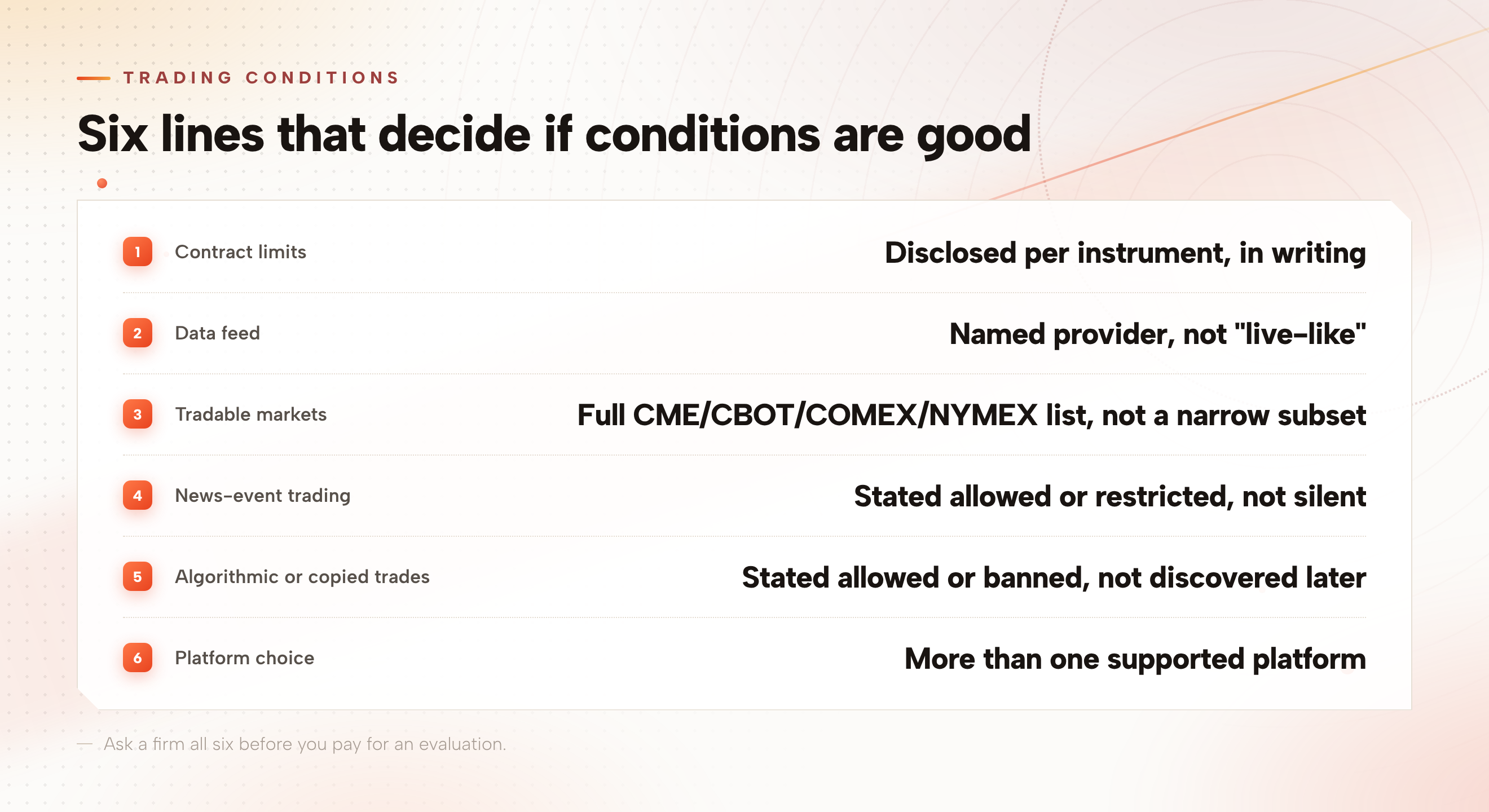
Good trading conditions at a futures prop firm mean the contract limits, the data feed, the tradable markets, and the rules on strategy and platform choice are all disclosed in writing before you pay for an evaluation. Bad conditions are the same items left vague, discovered only when a trade does not fill the way you expected. Ask all six before you fund an evaluation, not after.
- What "Trading Conditions" Actually Means
- Contract and Position Limits: The Line Firms Blur Most
- Execution Quality: What You're Actually Trading Against
- Which Markets You Can Trade, and What the Data Costs
- What You're Allowed to Do, and What Voids the Account
- Platform Choice Matters More Than It Sounds
- When Bad Conditions Aren't the Real Problem
- FAQ
Most traders shopping for a futures prop firm compare two numbers: the entry price and the profit split. Trading conditions, the actual mechanics of placing and holding a trade once you are funded, get almost no attention by comparison, and they are the part that decides whether the account is usable day to day.
Contract limits, data feed quality, which markets you can access, and what strategies are allowed all fall under it. This walks through the six that matter most, in the order to check them.
What "Trading Conditions" Actually Means
The term covers everything that happens between placing an order and seeing it reflected in your account, plus the boundaries around what you are allowed to trade and how. It is different from evaluation rules like drawdown or consistency requirements, which govern whether you pass, not whether the trading itself behaves the way you expect.
A data feed that lags the real market, a contract list that excludes half of what you trade, or a rule that only surfaces after you break it: none of these are evaluation terms, and none get checked by comparing two firms' price tags.
Contract and Position Limits: The Line Firms Blur Most
A contract limit caps how many futures contracts you can hold at once, and it usually scales with account size and with how much profit you have banked since the evaluation started. Every firm needs some cap to manage its own risk.
A contract limit you cannot find in writing before you fund the account is the rule most likely to interrupt a trade that was already working.Contract and position limits
Ask whether the cap applies per instrument or across your whole portfolio, and whether it grows as your account grows or stays fixed for the life of the account. A firm that cannot answer either question in one sentence has not actually decided.
- Does the cap apply per instrument, or across the whole account
- Does it grow as the account grows, or stay fixed
- Is it written down anywhere before you fund the account
Execution Quality: What You're Actually Trading Against
Execution quality is how closely a fill, the price at which your order actually completes, matches what you saw on your screen when you clicked. Slippage is the gap between the two, and every firm has some.
This comes down to the data feed behind the platform. Phoenix Trader Funding runs two: dxFeed and TFeed, its own execution feed, and the per-side cost differs between them: $1.09 on the ES through TFeed against $2.18 through dxFeed on the same contract.
| What to ask | Why it matters |
|---|---|
| Who provides the price data | An unnamed or unverified provider cannot be checked against the real market |
| Are fills and slippage simulated realistically | A frictionless simulation makes the evaluation easier and the funded account harder |
| Is level 2 market depth included or billed separately | Some firms bundle it, some charge it as a recurring add-on per exchange |
A firm that will not name its data provider, or describes its environment only as "live-like," is not giving you enough to judge execution quality at all.
Which Markets You Can Trade, and What the Data Costs
A narrow contract list restricts strategy even for traders who only ever touch two or three symbols, because it removes the option to diversify or hedge across correlated markets later.
Phoenix Trader Funding trades CME, CBOT, COMEX and NYMEX futures only, with level 1 market data included on every account and level 2 depth of market available for $15 a month per exchange or $40 a month for a four-exchange bundle.
What You're Allowed to Do, and What Voids the Account
Permitted trading styles are a trading condition too, and firms vary more here than traders expect. Some restrict news-event trading entirely. Some ban scalping below a minimum hold time. Some treat any automated or copied execution as a violation regardless of intent.
Phoenix Trader Funding allows news trading including Tier 1 events like FOMC, CPI and NFP releases, scalping with no minimum trade duration, and copy trading. It prohibits the same things across every account: overnight and over-weekend positions, hedging across two of your own accounts, and automated bots.
- News-event trading: stated as allowed or restricted, not left silent
- Scalping: minimum hold time named, or stated as none
- Automated and copied trades: explicitly allowed or explicitly banned
- Overnight and cross-account rules: written down, not implied
A firm that leaves any of this unstated is asking you to discover its actual policy through a violation, not before one.
Platform Choice Matters More Than It Sounds
A firm that supports one platform is betting that platform fits every trader's workflow, and it usually does not. Charting tools, order types and hotkey behavior differ enough between platforms that forcing a trader onto an unfamiliar one adds friction exactly when precision matters most.
Counting its own supported terminals plus the wider roster available through its trade copier and live route, Phoenix Trader Funding connects to well over 20 trading platforms, including Odin, Quantower, NinjaTrader, Tradovate and TradingView.
When Bad Conditions Aren't the Real Problem
Sometimes the conditions really are the issue: an undisclosed contract cap, a data feed that does not match the real market, or a strategy ban discovered mid-trade. Asking the six questions above before funding an evaluation catches most of that in advance, at any firm.
If it did, the fix is reading the rules next time, not switching firms and hitting the same gap again with a different name on it.
- Contract limit: written down, per instrument or per account, before you fund it
- Data feed: named provider, checkable against the real market
- Tradable markets: the full exchange list, not just the pricing-page highlights
- Strategy rules and platform choice: stated up front, not discovered mid-trade
FAQ
What are trading conditions at a futures prop firm?
Trading conditions are the rules and infrastructure that shape how a trade actually executes and settles: contract limits, data feed quality, tradable markets, and what strategies are permitted. They are separate from business terms like price, profit split or drawdown, which govern the evaluation, not the trade itself.
How do I know if a firm's data feed is realistic?
Ask the firm to name its data provider and check whether fills and slippage are modeled on the real market or generated by the firm's own simulation. A firm that will not name a provider or only describes its environment as "live-like" has not actually answered the question.
The rules that decide whether an account survives are rarely the ones printed in bold on the pricing page.Six lines to check before any evaluation
Are contract limits the same at every prop firm?
No. A contract limit caps how many futures contracts you can hold at once, and it typically scales with account size and banked profit, but the exact cap, whether it applies per instrument or across the account, and how it grows all vary by firm.
Does Phoenix Trader Funding allow news trading and scalping?
Yes. Phoenix Trader Funding allows news-event trading including Tier 1 releases like FOMC, CPI and NFP, and scalping with no minimum trade duration, across every account. It prohibits overnight and over-weekend positions, hedging across a trader's own accounts, and automated bots.
- Contract limits and data feed: named and written down
- Tradable markets and permitted strategies: stated up front
Why does platform choice count as a trading condition?
Because the platform is where every order actually gets placed, and forcing a trader onto one unfamiliar terminal adds friction exactly when precision matters most. A firm offering real platform choice, rather than a single default, is offering a genuinely different trading condition, not just a preference.
The full evaluation rule set is on the evaluations page, and the platforms, data feeds and setup steps are covered on the connection guide. General questions are answered on the FAQ.
Start your evaluation at phoenixtraderfunding.com.
New funded-account types are trialled at Phoenix Labs as real, tradable accounts before they join the permanent offer. The ones that work graduate; the ones that do not are retired.