

Which Funded Trading Accounts Actually Pay Out Every Trading Day?
How Daily accounts turn a green day into a payout, what the split costs, and how the cap works.
A Daily funded trading account pays out at the end of every trading day instead of weekly or biweekly, in exchange for an 80 percent profit split rather than 90. At Phoenix Trader Funding, a green day's profit matures across the next three trading days before it clears, and every account carries a per-day payout cap that never stacks past $1,000 across every Daily account one trader holds.
- What "paid every trading day" actually means
- The tradeoff: an 80 percent split instead of 90
- How much you can withdraw in a day
- The rules during the evaluation
- What carries through once you are funded
- How a Daily account reaches Live funding
- Daily against the rest of the lineup
- Who this fits
- Frequently asked questions
Most funded futures accounts make a trader wait: bank a green week, clear a minimum, then sit through a review before a payout releases. The Daily family exists because that wait is what traders complain about most once funded.
What "paid every trading day" actually means
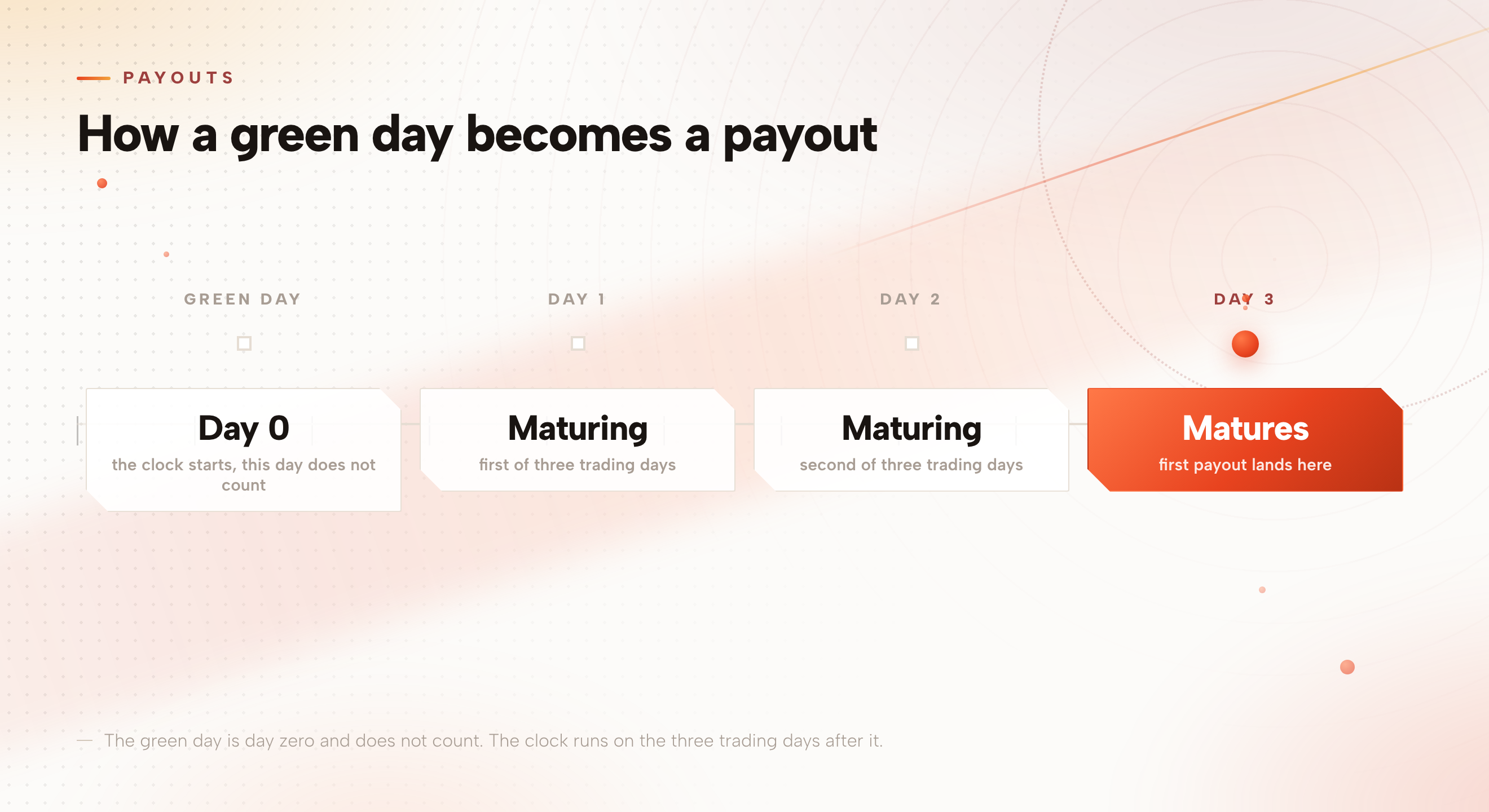
A Daily account does not pay out the moment a trade closes green. The first profitable trading day starts a clock: that day's profit matures across the next three trading days before it is released. The clock only advances on days you actually trade.
The tradeoff: an 80 percent split instead of 90
Nothing about this cadence is free. Classic and Spark accounts split profit 90 percent to the trader. A Daily account splits 80 percent. That gap is the price of being paid every day rather than waiting for a weekly or biweekly release.
How much you can withdraw in a day
Each Daily size carries its own per-day payout cap: $200 on a Seed, $500 on a Starter, $1,000 on a Growth. A Daily account requires no minimum profit on any single counted day for that day to count toward the payout cadence. The payout itself, once it is calculated, still has to clear a separate $75 minimum before it goes out.
Each size also carries a locked buffer, a safety net the payout cannot draw beneath: $600 on a Seed, $1,500 on a Starter, $2,000 on a Growth.
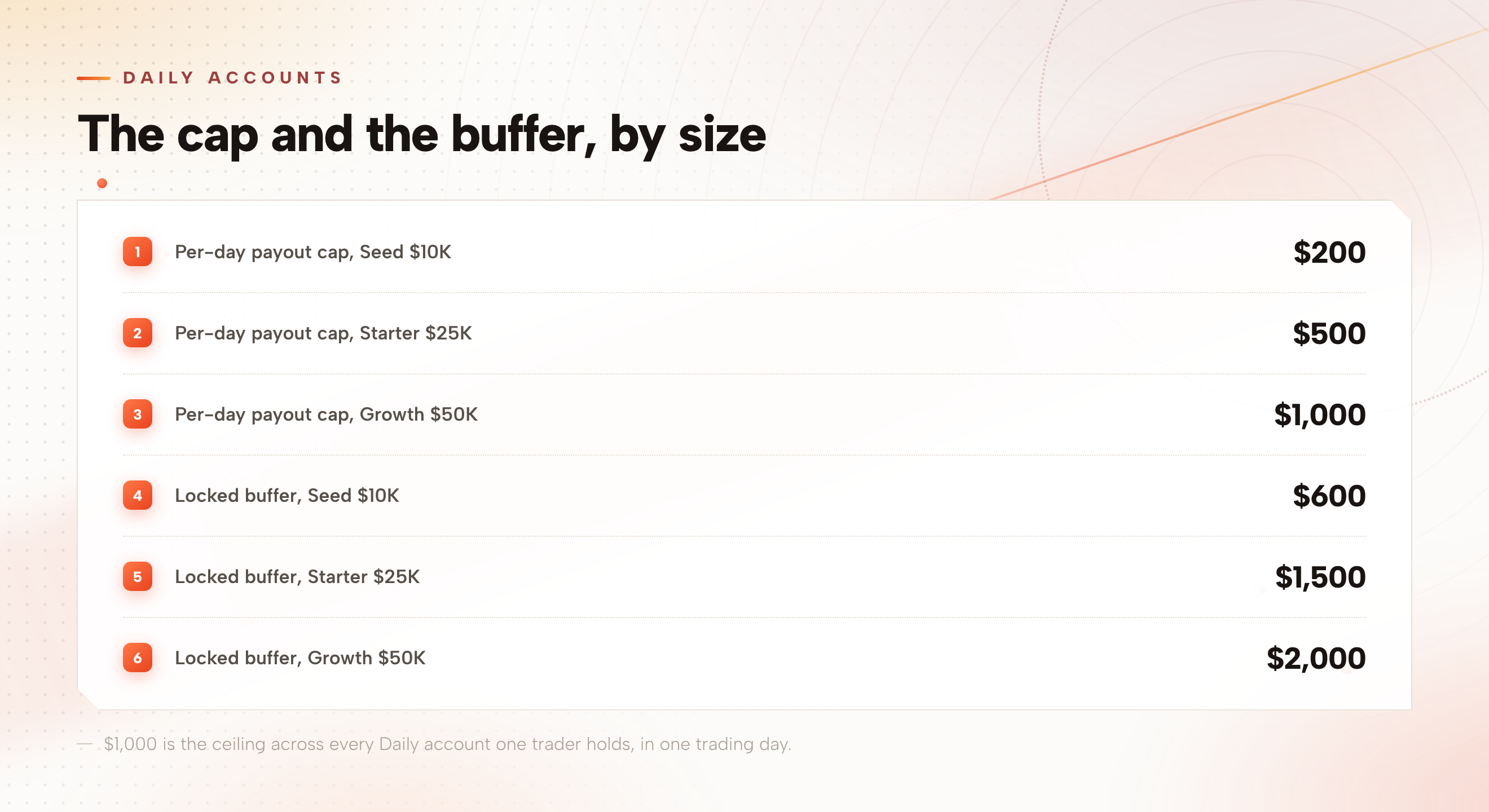
The aggregate cap matters more than it looks. A trader holding three Daily Growth accounts does not collect $3,000 on a strong day; they collect $1,000, the ceiling that applies across every Daily account they hold.
The rules during the evaluation
Daily accounts run on TFeed, Phoenix Trader Funding's own execution feed, with no dxFeed option on this line. TFeed carries no market data of its own, so a Daily trader needs a separate leader account supplying it.
The evaluation uses an end-of-day trailing drawdown, a loss limit recalculated at the close of each day: it sits a fixed distance below your highest closing balance and rises with it as you bank profit, stopping once it reaches your starting balance.
| Rule | Daily Seed $10K | Daily Starter $25K | Daily Growth $50K |
|---|---|---|---|
| Profit goal | $600 | $1,500 | $3,000 |
| Trailing drawdown (EOD) | $600 | $1,500 | $2,000 |
| Minimum trading days | 2 | 2 | 2 |
| Consistency rule (eval only) | 50% | 50% | 50% |
| Max position | 6 micros | 1 mini or 15 micros | 3 minis or 30 micros |
What carries through once you are funded
The end-of-day trailing drawdown does not tighten once a Daily evaluation passes. It carries unchanged through both the evaluation and the Pre-Funded stage, the simulated funded account a trader trades before reaching Live status.
Daily and Classic both keep the end-of-day floor once funded. Spark does not: it moves to a real-time intraday drawdown the moment it is funded.
How a Daily account reaches Live funding
Classic and Spark unlock Live funding after four payouts plus a risk approval. Daily works differently: it unlocks on the lifetime amount paid out to the trader, not a payout count. A Daily Seed needs $1,200 paid out lifetime, a Starter needs $3,000, and a Growth needs $6,000.
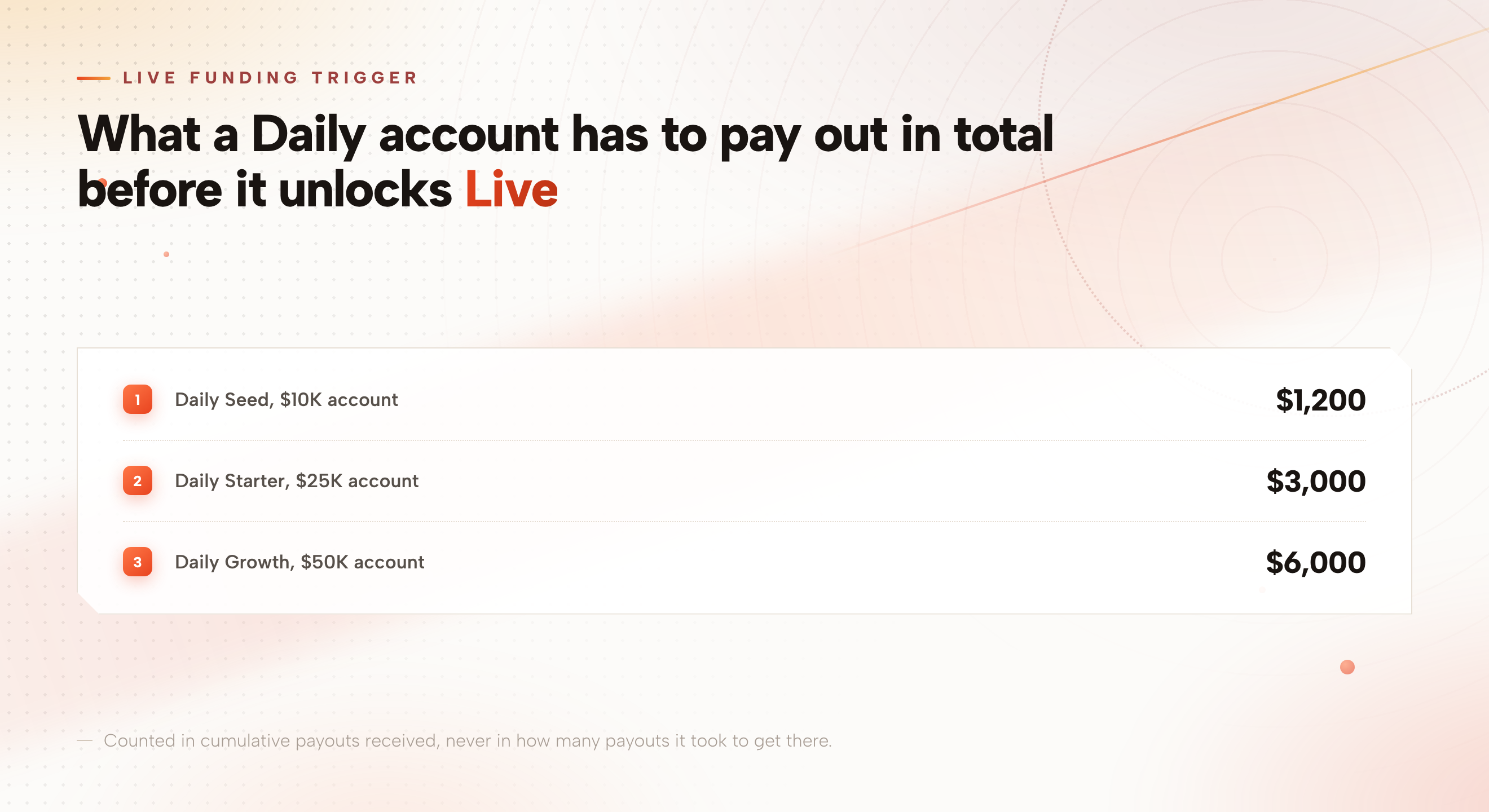
Once that lifetime figure clears, the account moves to Live: real capital on EdgeClear, a broker running on Rithmic. Live amounts scale with the size traded: $500 for a Seed, $1,250 for a Starter, $2,000 for a Growth.
A Live account's drawdown is static, a fixed floor set at your starting balance, rather than the trailing floor used during the evaluation and the Pre-Funded stage.
Daily against the rest of the lineup
The honest way to pick between account families is to compare what each one pays you and when.
| Rule | Daily | Classic | Spark |
|---|---|---|---|
| Payout frequency | Every trading day | Weekly | Biweekly |
| Profit split | 80% | 90% | 90% |
| Minimum payout | $75 | $75 | $30 to $75 |
| Data feed | TFeed only | TFeed or dxFeed | TFeed only |
| Live unlock trigger | Lifetime amount paid | 4 payouts | 4 payouts |
Who this fits
- A trader who wants cash on the same day it is earned, not a week or two later.
- A trader already set up on TFeed, who does not need dxFeed's built-in market data.
- A trader comfortable trading full size from day one, with no scaling ramp to grow into.
It does not suit a trader chasing the highest split available, or one who wants a large lump sum on a slower cadence. It also does not fit a trader who wants dxFeed's data: Daily runs on TFeed only, and so does Spark.
Frequently asked questions
Do I need a minimum number of trading days between payouts?
No. Daily requires no minimum number of trading days between payouts, so a green day that clears the maturity window can be followed by another payout the very next day it qualifies. Classic and Spark both require 5 trading days between payouts.
What happens to the maturity clock on a day I don't trade?
Nothing moves. The clock only advances on days you actually trade, so a day with no trades simply does not count toward the three trading days a green day's profit needs before it clears.
See the full Daily rules and start an account that pays every trading day.
View Daily accounts at Phoenix Trader FundingNew funded-account types are trialled at Phoenix Labs as real, tradable accounts before they join the permanent offer. The ones that work graduate; the ones that do not are retired.