

How Many Contracts Can You Trade on a Funded Account?
The cap depends on the account family and size, and on whether that family scales your size up or hands you the full amount on day one.
At Phoenix Trader Funding, the contract cap runs from 6 micro contracts on the smallest Daily account up to 6 mini contracts on the largest Classic account, and it depends on the family you pick, not just the size. Classic raises the cap in steps as profit banks in. Spark and Daily hand you the full cap immediately. Merit holds one fixed cap through its 30-day assessment.
Once any account moves to Live funding, the cap can grow: one more mini for every $2,000 of additional Live profit.
- What a Contract Limit Actually Caps
- The Full Position-Size Table
- Classic Grows Your Position Size as You Bank Profit
- Spark and Daily Skip the Ladder Entirely
- Merit's Cap During the Assessment
- Once You're Live, Every Account Scales the Same Way
- Asking for More Than the Plan Allows
- Which Approach Fits How You Trade
Three Phoenix Trader Funding accounts share the exact same $25,000 size, and none of them opens with the same position-size cap: Classic Starter opens at 1 mini or 10 micros, Daily Starter opens at 1 mini or 15 micros, and Spark Starter opens at 2 minis or 20 micros. At the same balance, the account family decides.
What a Contract Limit Actually Caps
A contract limit is the maximum number of futures contracts you can hold open at once.
A mini contract is the standard-size futures contract for a given market (an ES or NQ contract, for example); a micro contract is a tenth the size of its mini equivalent.
Minis and micros are alternatives, never a total: an account's cap is stated as one or the other, and each account sets its own micro figure alongside its mini number. Daily Starter's 1 mini sits beside 15 micros; Spark Seed's 1 mini sits beside 10 micros. Both headline the same "1 mini," but the micro alternative underneath it is not fixed at ten to one.
The Full Position-Size Table
These are the maximum contracts allowed on each Phoenix Trader Funding evaluation, stated as mini contracts with the micro alternative alongside.
| Account | Size | Max contracts |
|---|---|---|
| Classic Starter | $25,000 | 1 mini or 15 micros |
| Classic Growth | $50,000 | 3 minis or 30 micros |
| Classic Scale | $100,000 | 6 minis or 60 micros |
| Daily Seed | $10,000 | 6 micros only |
| Daily Starter | $25,000 | 1 mini or 15 micros |
| Daily Growth | $50,000 | 3 minis or 30 micros |
| Spark Seed | $10,000 | 1 mini or 10 micros |
| Spark Starter | $25,000 | 2 minis or 20 micros |
| Merit | $2,000 | 2 minis or 20 micros |
Daily Seed is the only Classic, Daily, Spark or Merit account with no mini allowance at all: it caps out at 6 micro contracts, smaller than the 1-mini floor every other account on this list starts at.
Classic Grows Your Position Size as You Bank Profit
Classic is the one family with a scaling plan before Live funding: the cap rises in steps as your account's profit crosses set bands, and the same steps apply during the challenge and the Pre-Funded stage. Each tier starts smaller and climbs to the max contracts figure in the table above.
| Classic tier | Starting size | Grows to |
|---|---|---|
| Starter, $25,000 | 1 mini or 10 micros | 1 mini or 15 micros once profit passes $1K |
| Growth, $50,000 | 1 mini or 10 micros | 3 minis or 30 micros in the $2-4K profit band |
| Scale, $100,000 | 2 minis or 20 micros | 6 minis or 60 micros in the $4-6K profit band |
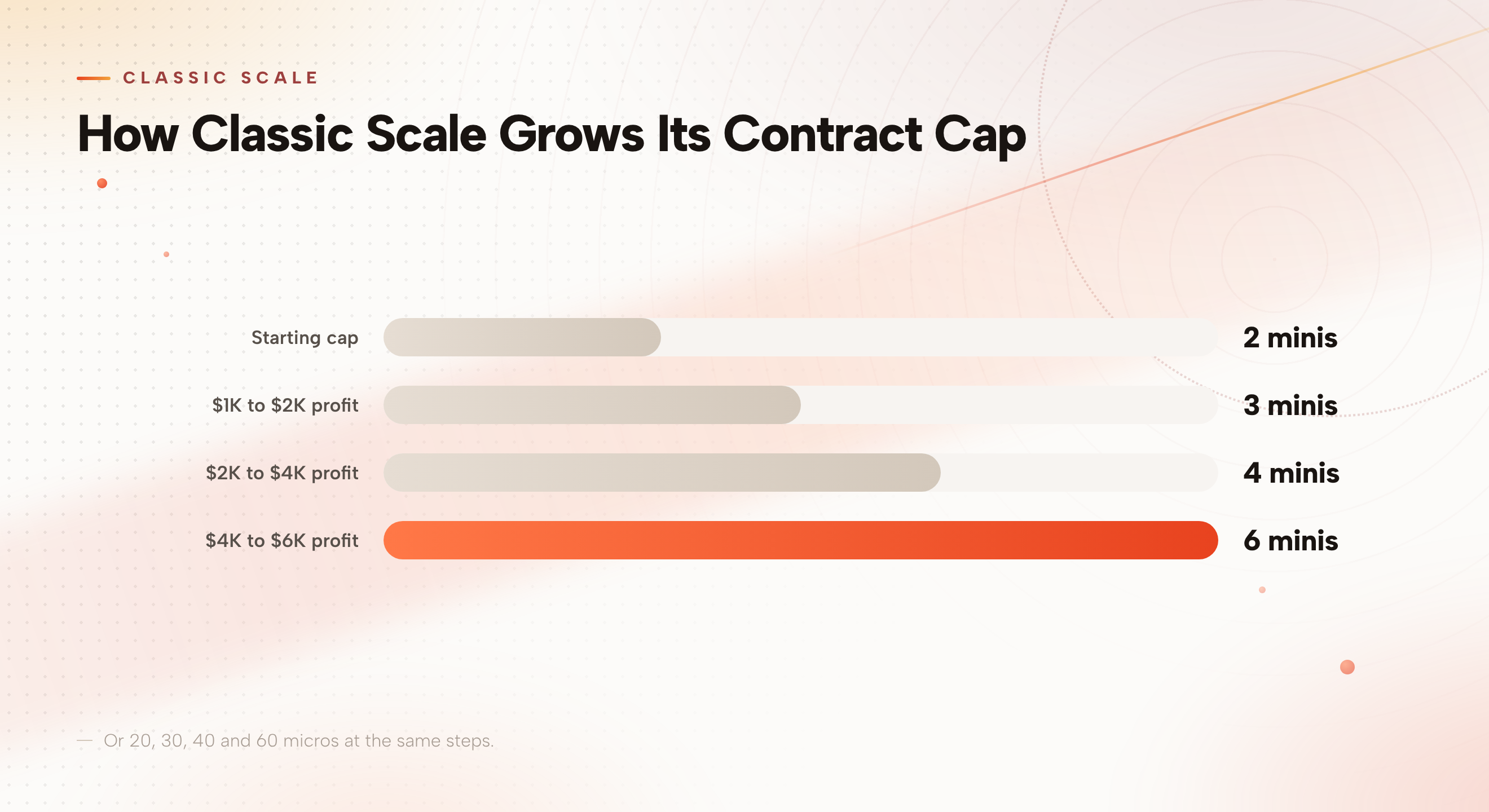
Growth and Scale both pass through an intermediate step too: Growth moves from 1 to 2 minis in the $1-2K profit band before reaching 3, and Scale moves from 2 to 3 minis in that same band, then to 4 in the $2-4K band, before reaching 6.
The full rule set for the family, drawdown, payout schedule and all, sits on the Classic account page.
Spark and Daily Skip the Ladder Entirely
Spark and Daily carry no scaling plan before Live funding. Both hand you the full contract cap from your very first trade, at every size, with nothing to unlock and no profit band to cross first.
Daily Growth trades 3 minis or 30 micros from its first order, the same cap Classic Growth reaches only in the $2-4K profit band.
That means Spark Starter trades its full 2 minis or 20 micros from the first order. Neither family has anything to grow into before Live.
Merit's Cap During the Assessment
Merit carries one position-size cap, 2 minis or 20 micros, for the whole 30 calendar day assessment: one attempt for the life of the account, no reset at any price.
Merit skips the Pre-Funded stage entirely: a trader the review accepts goes straight to a live $2,000 funded account. Full assessment rules are on the Merit account page.
Once You're Live, Every Account Scales the Same Way
Position size changes again once an account goes Live: every family, Classic, Spark, Daily and Merit alike, gains one more mini for every $2,000 of additional Live profit.
Asking for More Than the Plan Allows
None of the caps or scaling above, including Live-stage growth, are things a trader can push past alone. Trading beyond your plan needs a manual request that Phoenix Trader Funding reviews against the account's own trade history, judged case by case rather than automatically at any profit band.
Which Approach Fits How You Trade
A trader who wants to prove a strategy at small size before scaling into it fits Classic's ladder well: the account grows with you, on your own timeline, as the profit shows up.
A trader who already knows the size they want to trade, and does not want to wait on a milestone to reach it, fits Spark or Daily better. Either way, the position-size approach is only one piece of the decision alongside the drawdown type and the payout schedule.
How many contracts can I trade on a funded futures account?
It depends on the account family and size, not the dollar balance alone. Before Live funding, the cap ranges from 6 micro contracts on a Daily Seed account up to 6 mini contracts or 60 micros on a Classic Scale account, across Classic, Daily, Spark and Merit accounts, with every size in between listed in the table above.
Does my position size limit grow as I make profit?
During the challenge and Pre-Funded stage, only on Classic: its cap rises in steps as your account's booked profit crosses set bands, up to the account's maximum. Spark and Daily hold one fixed cap through those stages, starting at their full size immediately. Merit has neither a challenge nor a Pre-Funded stage; it holds one fixed cap through its 30-day assessment.
Once any account moves to Live funding, the cap grows the same way for every family: one more mini for each $2,000 of additional Live profit.
A published cap is a ceiling, not a target. Trading the maximum contracts your account allows on every single trade is a risk decision you make, not a requirement the account sets.
What's the difference between a mini and a micro futures contract?
A micro contract is a tenth the size of its mini equivalent. Phoenix Trader Funding states most caps as a mini figure with the micro alternative alongside it; Daily Seed is the exception, capped at 6 micros only with no mini figure at all.
Is the contract limit the same during the evaluation and once funded?
The same plan runs through both stages: on Classic, the same scaling steps and profit bands apply in the challenge and the Pre-Funded simulated stage, and Spark and Daily's single fixed cap holds through both the same way. Once an account moves to Live funding, the cap changes again: every family adds one mini for each $2,000 of additional Live profit.
Can I request a bigger position size than my account's plan allows?
Yes, but only as a manual request reviewed against your own trade history, and it is never automatic. The published scaling plan is what every account gets by default; anything past it is judged case by case.
Compare the position-size rules on every account before you fund one.
See evaluations from Phoenix Trader FundingNew funded-account types are trialled at Phoenix Labs as real, tradable accounts before they join the permanent offer. The ones that work graduate; the ones that do not are retired.