

How Much Does It Cost to Reset a Failed Prop Firm Evaluation?
What a reset buys you, what it costs by account, and why Merit never offers one.
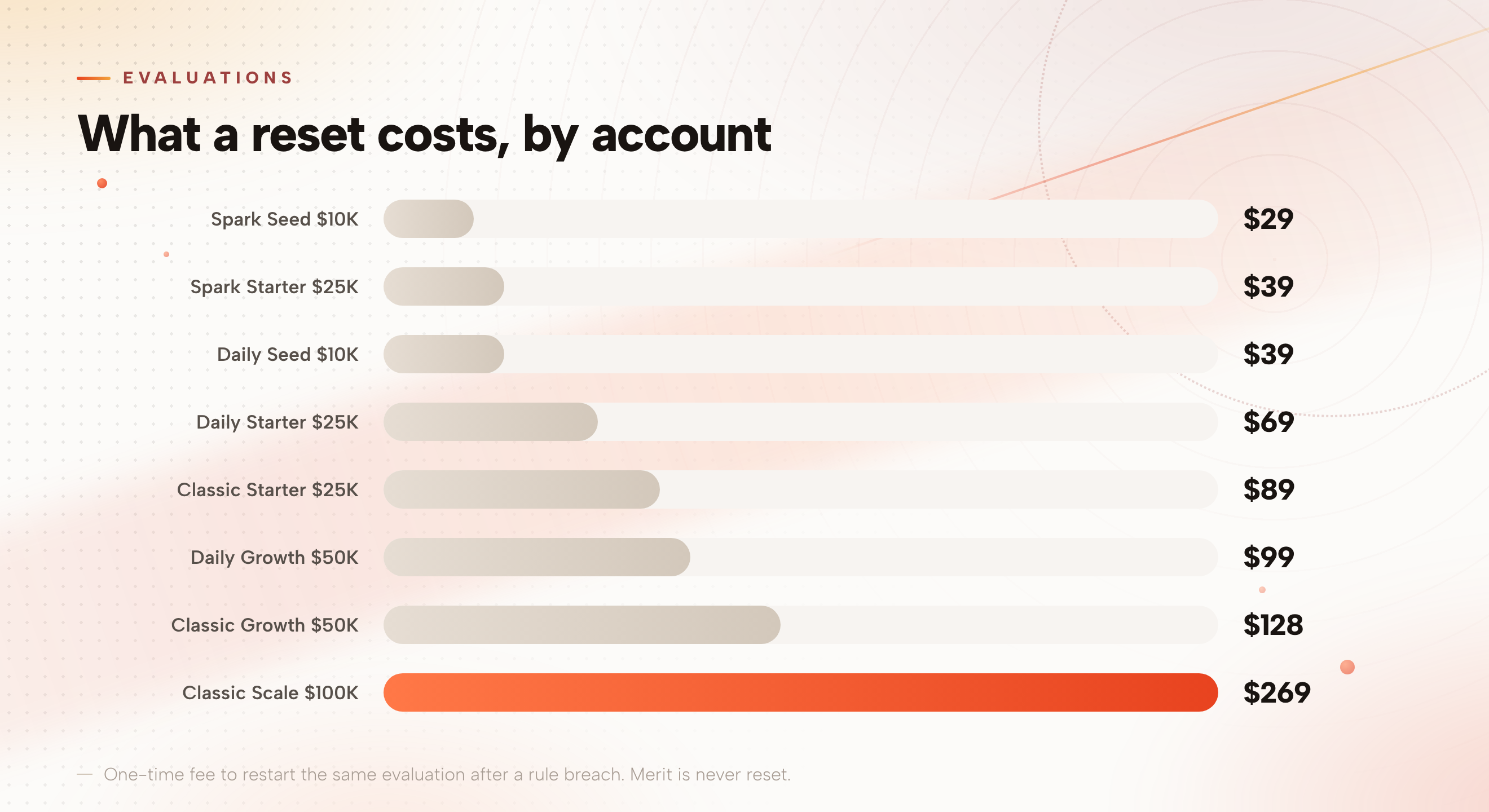
Resetting a failed evaluation means paying a fee to restart the same challenge from zero, instead of buying a new one. On Classic the fee matches the account's list price; on Daily and Spark it costs less than buying that account again. It ranges from $29 on a Spark Seed $10K to $269 on a Classic Scale $100K, and Merit cannot be reset at any price.
- Reset versus renewal: two different things
- Why prop firms charge for a reset at all
- What a reset costs at Phoenix Trader Funding, by account
- Ways to avoid paying a reset fee
- Why Merit is never reset
- Is a reset worth paying for?
You breach a drawdown limit two days before hitting your profit target. The evaluation is over. Now you are staring at a checkout screen asking for money again, and the number is not obviously the one you paid the first time.
Reset versus renewal: two different things
A reset restarts the same evaluation after you have breached a rule, such as the trailing drawdown, and failed. Your trading history and progress toward the profit target reset to zero, and your account balance returns to its starting balance, though you keep the same account type and size. It is a paid restart, not a refund.
A renewal is different, and it applies to Classic. A Classic challenge does not expire: it renews every 30 days at the account's normal monthly price, and you can cancel any time. A renewal is not itself free, and it does not touch your progress; only a rule breach does. What a clean renewal earns you is a Reset Coupon: a free reset you can bank and use later.
Spark is paid once. It does not bill monthly, and it does not renew this way: a Spark challenge left untraded for 90 calendar days is disabled instead.
Why prop firms charge for a reset at all
An evaluation exists to prove you can trade a funded account without breaching the firm's risk rules first. When you fail, the firm has already spent real cost on the attempt: platform access, data feed licensing, review time. A reset fee covers the cost of restarting that process.
What a reset costs at Phoenix Trader Funding, by account
Reset fees here are set per account type and size, not as one flat number. On Classic, the fee equals the account's list price; on Daily and Spark it is lower. The full table:
| Account | Size | Reset fee |
|---|---|---|
| Classic Starter | $25K | $89 |
| Classic Growth | $50K | $128 |
| Classic Scale | $100K | $269 |
| Daily Seed | $10K | $39 |
| Daily Starter | $25K | $69 |
| Daily Growth | $50K | $99 |
| Spark Seed | $10K | $29 |
| Spark Starter | $25K | $39 |
| Merit | $2K | Not offered |
Ways to avoid paying a reset fee
A reset fee is not the only way to keep trading after a setback, though neither of the routes below helps with the fee you owe right now. Both are things to have in place before your next attempt.
- Practice on the free account first. Every Classic, Daily and Spark challenge comes with a free Practice account: same rules and parameters as the real challenge, unlimited free resets, unlimited accounts, and never fundable. Break the rule there instead of on the paid attempt, and it costs nothing.
- Renew a Classic challenge without failing. A Classic challenge renews automatically every 30 days at its normal monthly price. A clean renewal, one where you have not breached a rule, earns one free Reset Coupon; coupons are cumulative, so a trader who renews cleanly more than once can bank more than one. There is a second free case: a challenge that fails at the 30-day renewal point also resets for free.
The cheapest reset is the one you never pay for: free on the Practice account, or free with a Reset Coupon banked from a clean Classic renewal.Both routes above end in a free reset
None of this applies to a funded account. The reset fee table above covers challenge accounts only.
Why Merit is never reset
Merit is a $2K account, $69 paid once, with no profit target: you trade for up to 30 calendar days under a static $2,000 total drawdown limit, while the risk team and an AI review every trade. A person then decides whether to fund you, and there is no guarantee of funding whatever the P&L.
The first Merit purchase deactivates every other Merit account you hold, and buying another later means holding a different Phoenix account type first.
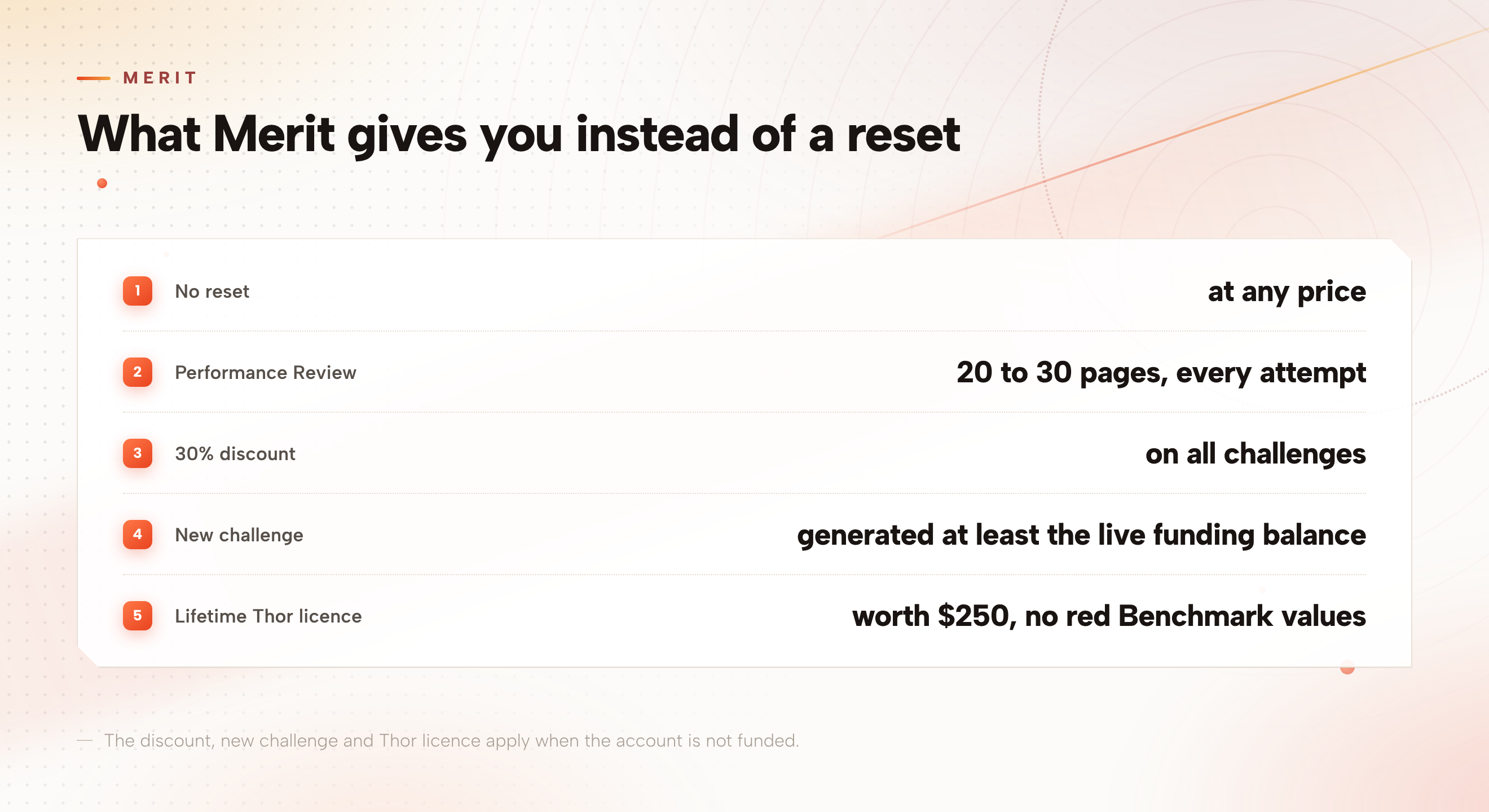
If a Merit account does not reach funding, the trader still gets something for the attempt: a Performance Review, a 20 to 30 page personal report built from their own trades, plus tiered consolation rewards.
Everyone who completes a Merit attempt gets a 30 percent discount on all challenges, a trader who generated at least the live funding balance gets a new challenge, and a Review with no red values in its Benchmark section earns a lifetime Thor licence worth $250.
Is a reset worth paying for?
A trailing drawdown is a floor measured end of day during a challenge: it trails a fixed distance below your account's peak balance and rises as the peak rises, but it stops rising once it reaches your starting balance.
So you are never required to protect more than you started with, and once you breach that floor the challenge ends.
Whether a reset is worth it depends on why you hit that floor. If it came from one identifiable mistake, such as oversizing a position, holding through news, or ignoring your own stop, a reset puts you back on the same account for no more than buying it again.
- One identifiable mistake, otherwise a solid run: a paid reset is usually the faster path back.
- A pattern that is likely to repeat: the free Practice account tells you for nothing whether the fix actually worked.
Does a reset fee refund any part of what I originally paid?
No. A reset is a new charge to restart the same evaluation; it is not a refund or a credit against the original challenge fee.
Is a reset cheaper than buying the same account again?
On Classic, no: a reset costs the same as the account's normal list price. On Daily and Spark, yes: both cost less than buying that account again, for example $39 against $99 a month on a Daily Seed, or $29 against $44 one time on a Spark Seed.
Do the trading days I already logged still count after a reset?
No. A reset sends your logged trading days and your progress toward the profit target back to zero. Your balance returns to the account's starting balance, for example $25,000 on a Classic Starter.
Can a Merit account be reset if I almost qualified?
No. Merit does not offer a reset at any price, regardless of how close the account came to qualifying. A trader who generated at least the live funding balance does get a new challenge, a separate reward and not a reset.
Every Classic, Daily and Spark challenge ships with a free Practice account and unlimited resets on it.
See the evaluation rules at Phoenix Trader FundingNew funded-account types are trialled at Phoenix Labs as real, tradable accounts before they join the permanent offer. The ones that work graduate; the ones that do not are retired.