

Lowest Profit Target at Phoenix: $600 on 2 Accounts
Which Phoenix account asks for the smallest profit goal, what sits beside that goal, and where the trade-offs are.
The lowest profit target at Phoenix Trader Funding is $600, and two accounts carry it: Spark Seed and Daily Seed, both $10,000 accounts. Every $25,000 account asks for $1,500, each $50,000 account for $3,000 and Classic Scale, the $100,000 account, for $6,000.
Merit has no profit target: it is a 30 calendar day assessment with no guarantee of funding. Spark Seed also has no consistency rule in the evaluation, and Daily Seed pays out every trading day once funded.
- What a profit target is
- Every profit goal on a Phoenix account
- Read the goal beside the drawdown
- Contract size sits beside both numbers
- Spark Seed against Daily Seed
- Merit has no profit target
- What changes after you pass
- Which account fits which trader
- Practice against the goal first
- How to check your own goal
What a profit target is
A profit target is the dollar amount an evaluation account has to earn before it passes. Phoenix Trader Funding calls it the profit goal, and the two terms mean the same thing.
The goal is one condition among several, and the others change how it feels to chase:
- A fixed dollar amount, set by account type and size
- A trailing drawdown, which is the loss floor under your balance
- A cap on the contracts you can hold
- On some accounts, a consistency rule and a minimum number of trading days
Read alone, the goal tells you what to earn and nothing about the room you have to earn it.
Every profit goal on a Phoenix account
This table lists every account on sale from the lowest goal to the highest, with the drawdown, position size and price that sit beside each one.
| Account | Profit goal | Trailing drawdown | Max contracts | Price |
|---|---|---|---|---|
| Spark Seed, $10K | $600 | $400 | 1 mini or 10 micros | $44 once, plus $29 activation fee |
| Daily Seed, $10K | $600 | $600 | 6 micros only | $99 once |
| Spark Starter, $25K | $1,500 | $1,000 | 2 minis or 20 micros | $74 once, plus $29 activation fee |
| Classic Starter, $25K | $1,500 | $1,500 | 1 mini or 15 micros | From $89, monthly |
| Daily Starter, $25K | $1,500 | $1,500 | 1 mini or 15 micros | $199 once |
| Classic Growth, $50K | $3,000 | $2,000 | 3 minis or 30 micros | From $128, monthly |
| Daily Growth, $50K | $3,000 | $2,000 | 3 minis or 30 micros | $329 once |
| Classic Scale, $100K | $6,000 | $3,000 | 6 minis or 60 micros | From $269, monthly |
| Merit, $2K | None | None, static $2,000 total loss limit and a 25% dynamic daily drawdown | 2 minis or 20 micros | $69 once |
In short, the goal is $600 on the two $10,000 Seed accounts, $1,500 on every $25,000 account, $3,000 on both $50,000 accounts and $6,000 on Classic Scale. Every trailing drawdown in the table is measured at the end of the day in the evaluation.
Classic is priced per data feed, so its prices start at the figure shown, and it bills monthly. Daily, Spark and Merit are each paid once. Spark and Daily run on TFeed only: TFeed is Phoenix's own execution feed, and it carries no market data.
Read the goal beside the drawdown
A trailing drawdown is a loss floor that sits one drawdown distance below your highest balance and rises when that high rises. On Classic, Daily and Spark it is measured at the end of the day in the evaluation, and it stops rising once it reaches your starting balance.
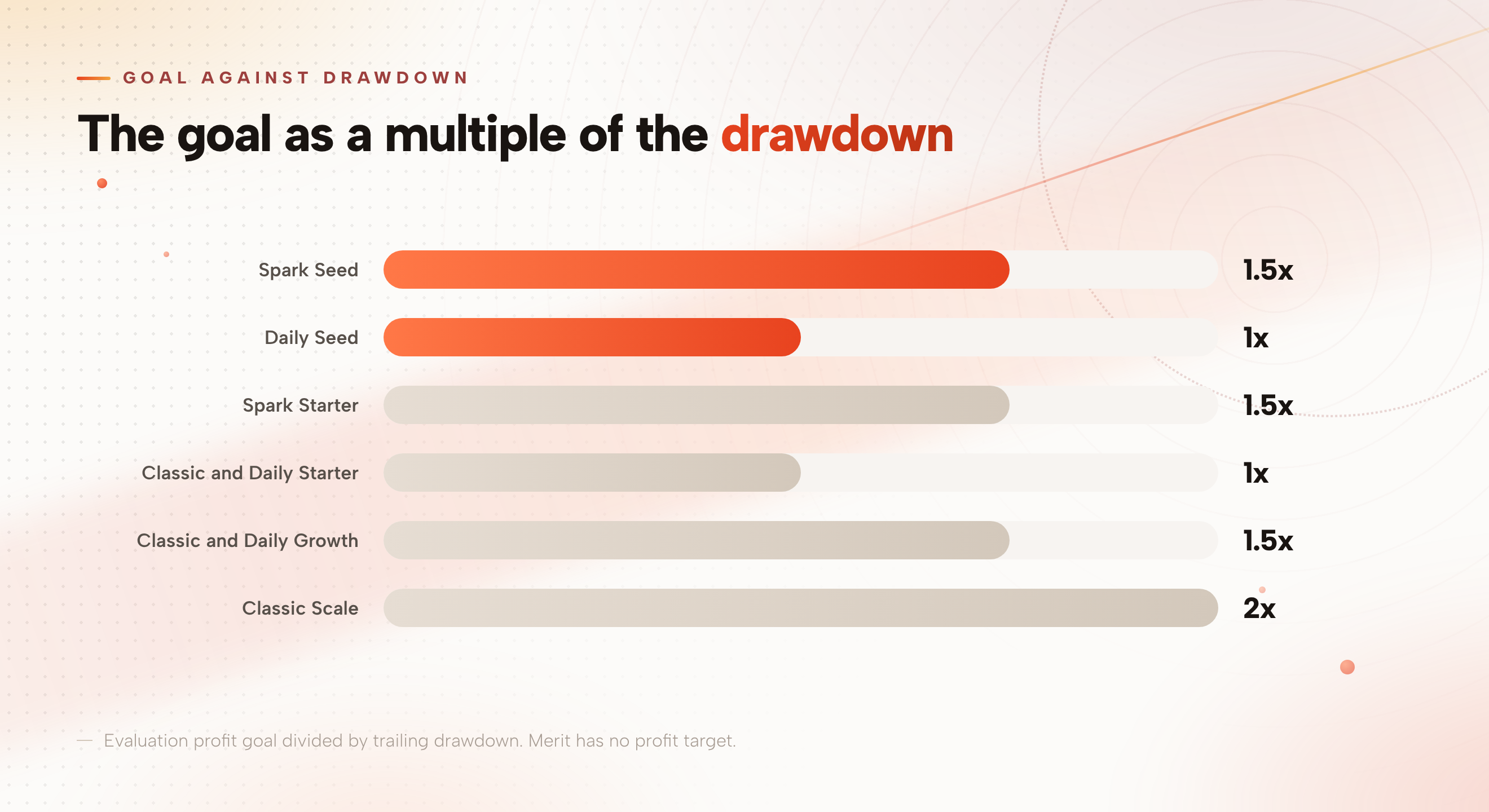
The drawdown is your room to earn the goal. Spark Seed asks for $600 and gives you $400 of room, and Daily Seed asks for the same $600 with $600 of room. Classic Starter and Daily Starter pair $1,500 with $1,500 of room.
Divide each goal by its drawdown and three multiples appear. The goal equals the drawdown on Daily Seed, Classic Starter and Daily Starter. It is 1.5 times the drawdown on Spark Seed, Spark Starter, Classic Growth and Daily Growth, and 2 times on Classic Scale.
A lower goal is less to earn, not an easier pass. What decides an attempt is how much room you have while you earn it, and how much size the contract cap lets you trade.
The guide to what a trailing drawdown is and where it stops shows how the floor rises, steps and locks.
Contract size sits beside both numbers
The contract cap decides how quickly a balance can move, so it belongs next to the goal and the drawdown. Spark and Daily have no scaling plan and open at full size on day one. A scaling plan is a schedule that starts an account small and raises its cap as profit builds.
Classic works differently. It does have a scaling plan, so the cap in the table is a ceiling you reach as profit builds. Classic Starter opens at 1 mini or 10 micros and moves to 1 mini or 15 micros once the account is above $1,000 of profit.
A mini and a micro are two contract sizes, and a cap lists them as alternatives, never as a total.
Spark Seed against Daily Seed
Both $600 accounts are $10,000 sizes, and they are built differently. The figure puts them side by side.
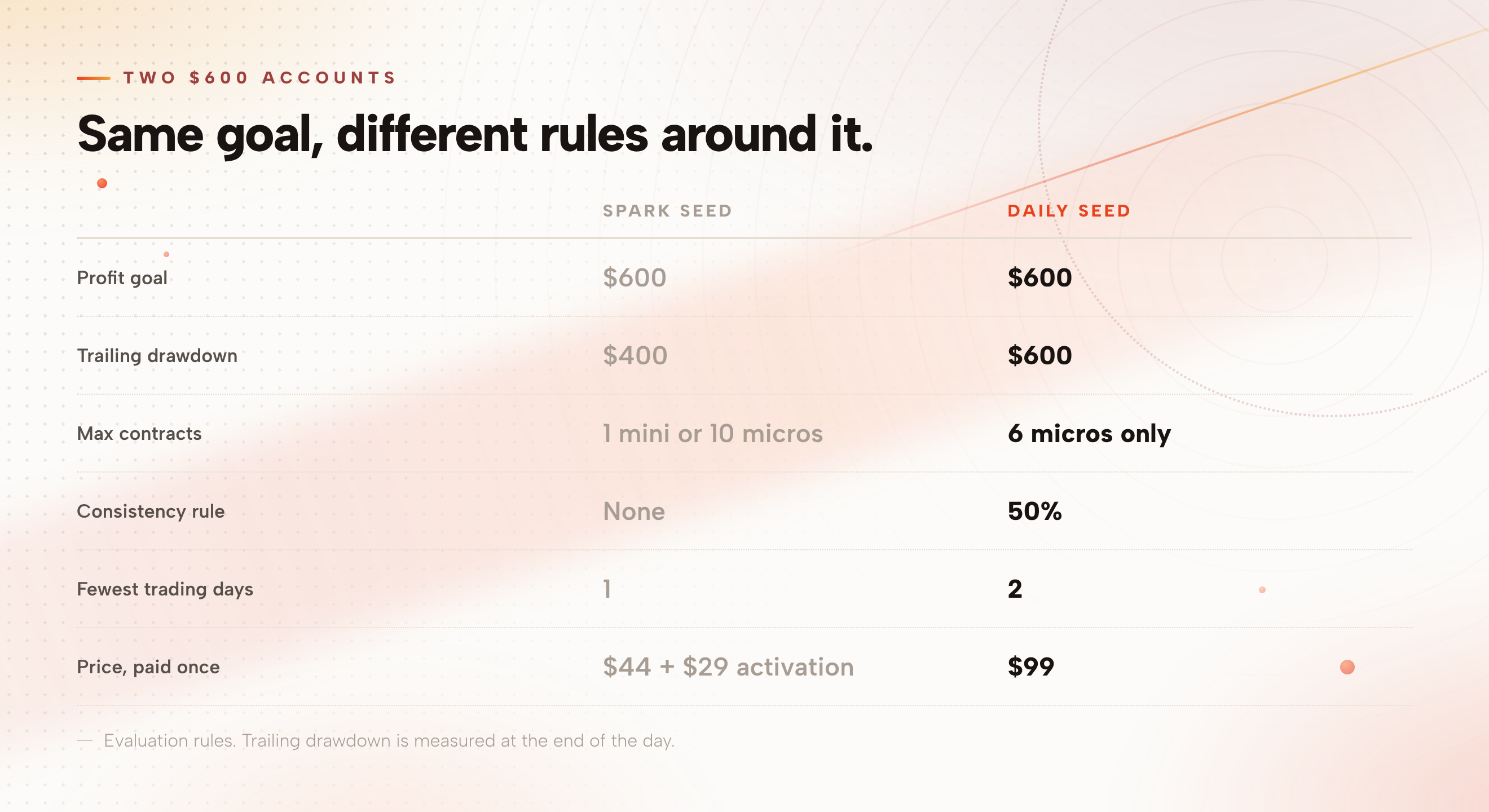
Spark Seed is the one with no consistency rule in the evaluation. A consistency rule limits how much of your total profit a single trading day may account for, and Daily Seed carries one at 50%. The answer on what a consistency rule is and when it applies goes through it stage by stage.
Spark Seed also asks for a minimum of one trading day, where Daily Seed asks for two.
Spark Seed is the cheapest way into a Phoenix challenge. It lists at $44, paid once, plus a $29 one-time activation fee. Daily Seed lists at $99, paid once, with no activation fee.
Daily also pays out every trading day once funded. The guide to which funded accounts pay out every trading day covers that in full.
Merit has no profit target
If the goal is the part you want to skip, Merit is the account without one. It is a 30 calendar day assessment on a $2,000 account, paid once at $69, with one attempt for the life of the account.
The Phoenix risk team and an AI review every trade, and a human then decides on live funding. Funding is not guaranteed at any result, because only quality counts. The Merit accounts page sets out how it is judged.
The Merit evaluation carries a 25% dynamic daily drawdown, a limit on how much one trading day can lose, while Classic, Daily and Spark evaluations carry no daily drawdown.
What changes after you pass
The goal belongs to the evaluation. Profit above it does not carry into the funded account, so the number that matters is the goal itself, not how far past it you finish.
Spark Seed's missing consistency rule is an evaluation rule. Once a Spark account is funded, a 30% consistency rule applies and the trailing drawdown moves from the end of the day to real time. Daily stays at the end of the day through the challenge and the funded account.
Payout frequency also differs by type. Classic payouts are weekly, Spark payouts are bi-weekly, and Daily payouts are every trading day. The lowest goal and the lightest evaluation are not the whole account, so read the funded rules of the account you pick before you buy.
Which account fits which trader
- Spark Seed: the $600 goal for $44 to start, with full size on day one, one minimum trading day and no consistency rule in the evaluation. Its $400 drawdown is the smallest on the list.
- Daily Seed: the same $600 goal with $600 of drawdown, and payouts every trading day once funded. Position size is 6 micros only.
- Spark Starter, Classic Starter or Daily Starter: a $1,500 goal on a $25,000 account, with more room than either Seed.
- Merit: no goal to chase and a 30 calendar day assessment in its place, with a 25% dynamic daily drawdown while Classic, Daily and Spark evaluations carry no daily drawdown.
For all four account types in one comparison, read Classic, Spark, Daily or Merit: 4 funded accounts compared.
Practice against the goal first
Classic, Daily and Spark come with a free practice account that uses the same goal, drawdown and position size as the challenge. Resets on it are free and unlimited, and so is the number of practice accounts you can open. Merit has no practice account, because it is a single 30 calendar day assessment.
A practice account can never be funded. It is for testing your own trading against a given goal and drawdown, not an attempt at the challenge.
How to check your own goal
- Find the goalIt is the dollar amount for your account type and size.
- Find the drawdownIt sits beside the goal and is the room you have while you earn it.
- Find the contract capIt limits the size you can trade, so it shapes how fast either number can move.
- Read the three togetherThe goal is what you must earn, the drawdown is what you can lose on the way, and the cap limits both.
This article describes account rules and arithmetic. It is education, not financial or trading advice, and trading futures carries a risk of loss.
FAQ
What is the lowest profit target at Phoenix Trader Funding?
It is $600, on Spark Seed and Daily Seed, both $10,000 accounts. The next goal up is $1,500 on every $25,000 account. Merit has no profit target.
Is a lower profit target easier to pass?
Not by itself. A lower goal is less to earn, but the drawdown and the contract cap decide how much room and size you have. Spark Seed gives $400 of room against its $600 goal, and Daily Seed gives $600.
Resetting a Spark Seed challenge costs $29, and resetting a Daily Seed challenge costs $59. Both are less than buying the account again.
Does Spark Seed have a consistency rule?
No, a Spark Seed evaluation carries none. The funded Spark account has one, set at 30%.
Does profit above the target carry into the funded account?
No. The funded account does not inherit anything earned beyond the goal.
The $29 Spark activation fee falls due when you pass, not at checkout, so $44 is what a Spark Seed costs to start.
Which Phoenix account has no profit target?
Merit. It is a 30 calendar day assessment instead of a target, paid once at $69, and funding is decided by a human review with no guarantee at any result.
Which account with a $600 goal costs less?
Spark Seed. Its entry price is $44 against $99 for Daily Seed, and each is paid once.
See the profit goal, drawdown and price of every account side by side.
Compare the Phoenix Trader Funding evaluationsNew funded-account types are trialled at Phoenix Labs as real, tradable accounts before they join the permanent offer. The ones that work graduate.