

Is Martingale Allowed on a Funded Futures Account?
What the rule allows on Classic, Daily, Spark and Merit, and how many doubling steps the cap fits.
Yes. Phoenix Trader Funding allows martingale and DCA within a single account on Classic, Daily, Spark and Merit. The contract cap and the drawdown set how far a martingale can run. Doubling from one micro, the cap fits 3 to 6 steps depending on the account, and the drawdown floor can end a ladder sooner.
- What martingale and DCA mean on a futures account
- Is martingale allowed on Classic, Daily, Spark and Merit?
- How a martingale ladder adds up
- How many martingale steps fit under the contract cap
- Where the drawdown ends the ladder first
- How DCA differs from a martingale ladder
- What changes when you hold more than one account
- Work out your own ladder in four steps
- Frequently asked questions
What martingale and DCA mean on a futures account
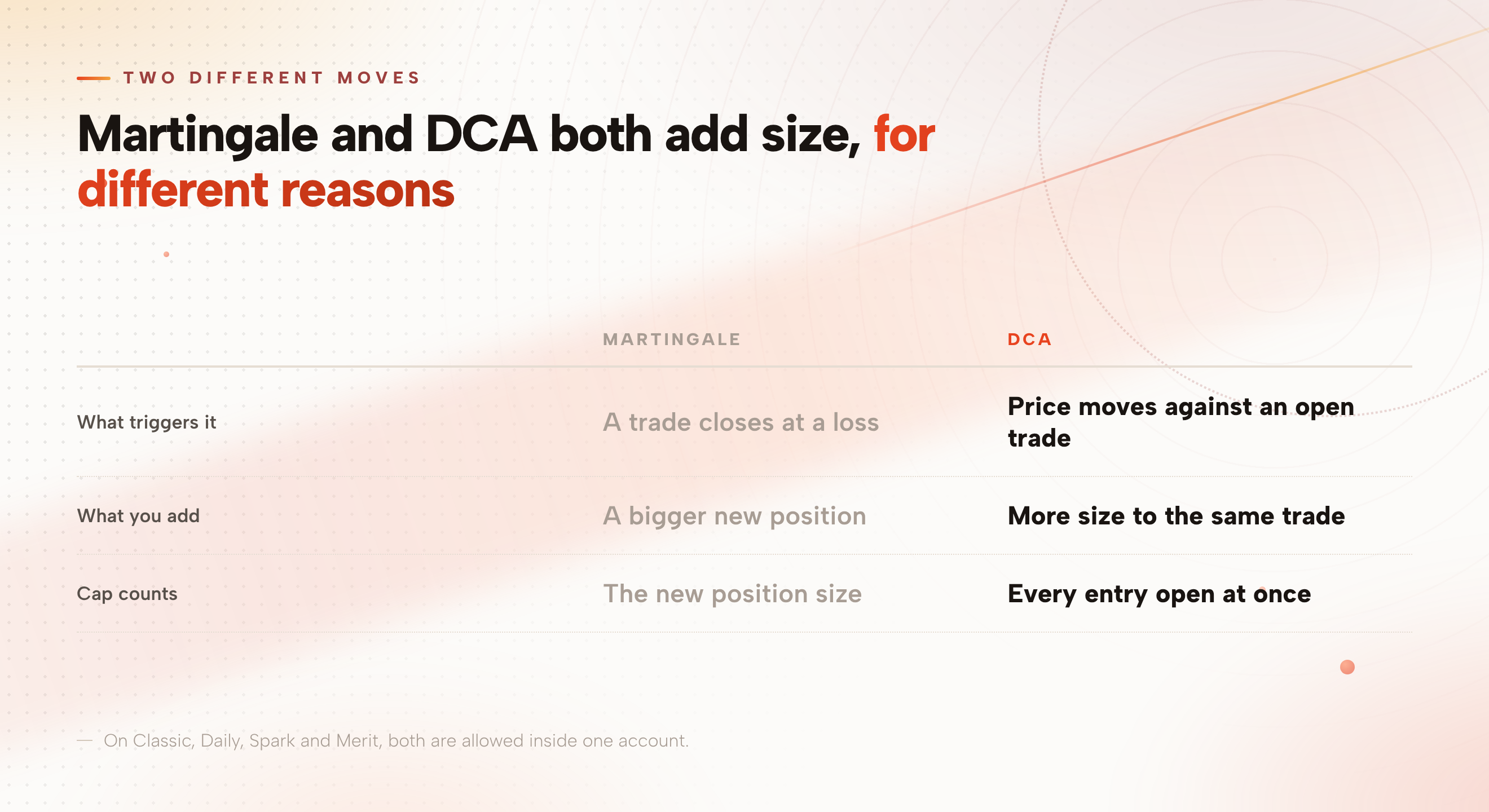
Martingale means raising your position size after each losing trade, most often by doubling it, so that a single winner pays back everything lost since the ladder began. Each rung is a new trade with its own stop and target.
DCA, short for dollar cost averaging, means adding to a position that is already open while price moves against it, which pulls your average entry toward the market. It happens inside one trade. Phoenix treats the two as separate things, and each has its own cap arithmetic.
A contract is one unit of a futures product. A mini is the full-size contract and a micro is a tenth of it. The cap counts contracts, and a cap written as 1 mini or 10 micros means one or the other, never the two added together.
Is martingale allowed on Classic, Daily, Spark and Merit?
Yes, at every stage of the account, as long as the sizing happens inside one account. The Help Center entry on prohibited strategies lists martingale and DCA among the strategies allowed on every account, beside news trading, scalping and copy trading between your own accounts.
- Classic: allowed in the evaluation and when funded. The cap grows with profit on all three sizes.
- Daily: allowed, with no scaling plan, so the full cap applies from day one.
- Spark: allowed, again with the full cap from day one and no scaling plan.
- Merit: allowed during the 30 calendar day assessment. A human decides on live funding, and funding is not promised at any result.
How a martingale ladder adds up
Take a ladder that opens with 1 contract and doubles after every loss. The sizes run 1, 2, 4, 8, 16, 32. Call the loss on the opening position one stop. If every step uses the same stop distance, the losses stack to 1, 3, 7, 15, 31 and 63 stops, each total one more than double the last.
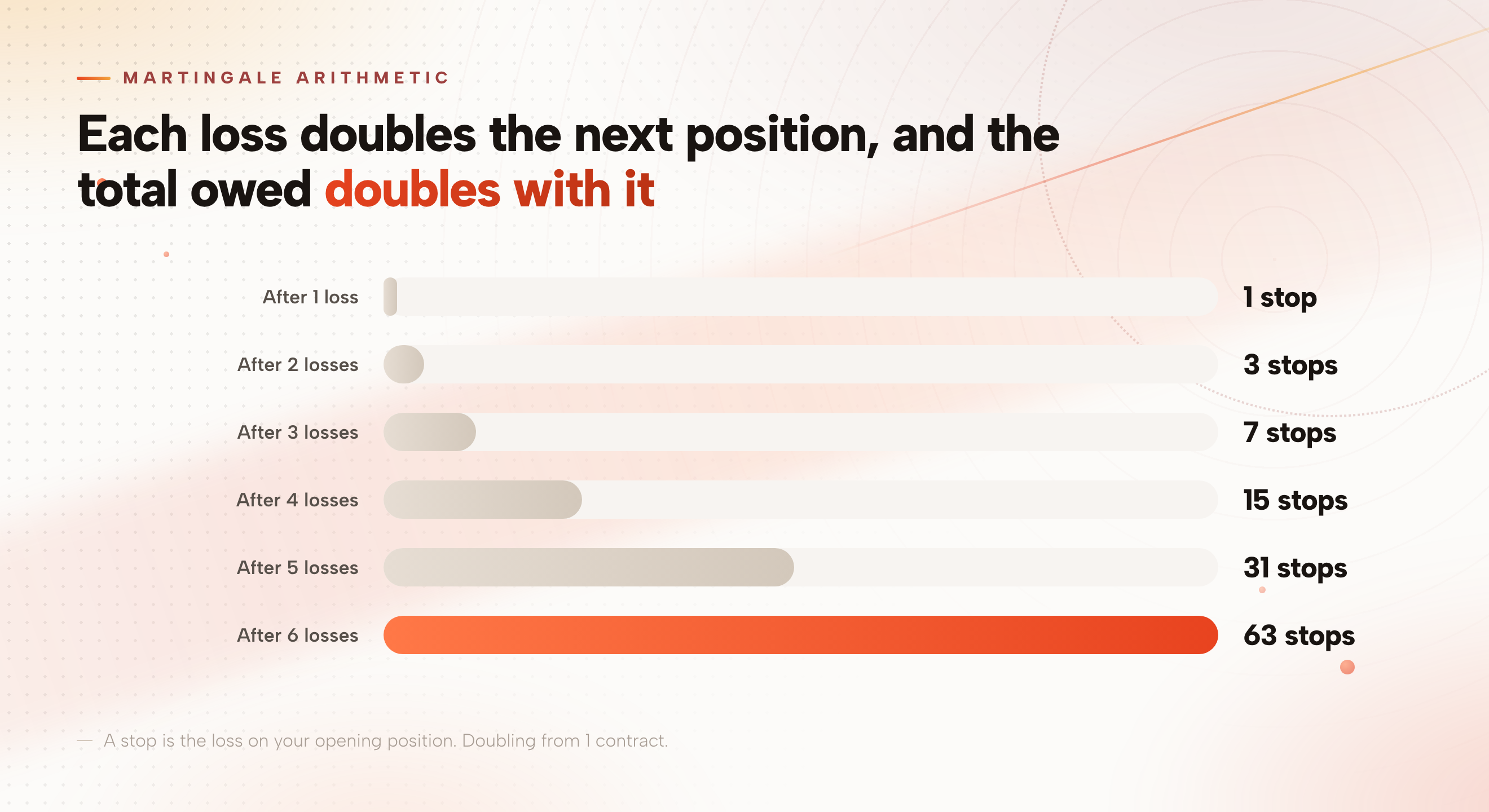
Read the other side of that chart. A win on any step pays back every loss before it and nets exactly one stop, provided the target sits as far from entry as the stop does. Every rung puts everything lost so far at risk again, and the prize for getting through is one stop.
Now set the ladder against a drawdown. Suppose one stop costs a tenth of it. That is an illustration, not a recommendation: use your own stop.
| Losses in a row | Total lost, in stops | Share of the drawdown used |
|---|---|---|
| 1 | 1 | One tenth |
| 2 | 3 | Three tenths |
| 3 | 7 | Seven tenths |
| 4 | 15 | One and a half times the whole drawdown |
On that account the fourth loss ends the ladder, and the account with it. The cap does not matter once the floor is reached. A ladder is over at whichever comes first, the cap or the floor, and fees and slippage on every rung push the real total a little above these counts.
How many martingale steps fit under the contract cap
The cap limits the size of a step, not the number of losses you can take. Doubling from one micro, the sizes run 1, 2, 4, 8, 16, 32, and the next step exists only if it still fits under the cap. A cap of 6 micros fits 3 steps, because 8 is over. A cap of 60 fits 6, because 64 is over.
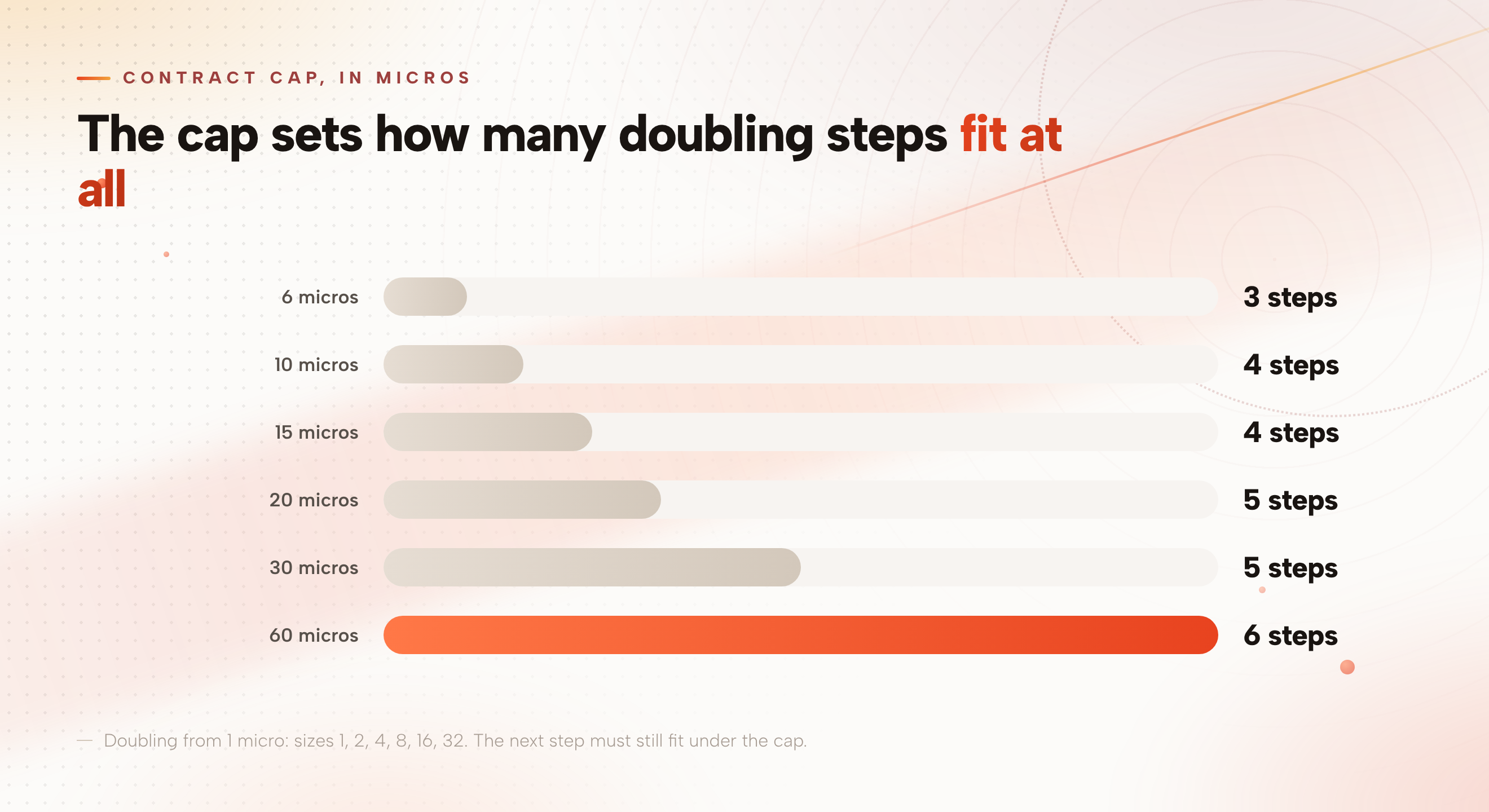
Caps are alternatives, so work the ladder in the unit you trade. This answer on contract caps explains how they work. Below, every account is counted at the top of its range, once in micros and once in minis.
| Account | Contract cap | Steps in micros | Steps in minis |
|---|---|---|---|
| Classic Starter | 1 mini or 15 micros | 4 | 1 |
| Classic Growth | 3 minis or 30 micros | 5 | 2 |
| Classic Scale | 6 minis or 60 micros | 6 | 3 |
| Daily Seed | 6 micros only | 3 | None |
| Daily Starter | 1 mini or 15 micros | 4 | 1 |
| Daily Growth | 3 minis or 30 micros | 5 | 2 |
| Spark Seed | 1 mini or 10 micros | 4 | 1 |
| Spark Starter | 2 minis or 20 micros | 5 | 2 |
| Merit | 2 minis or 20 micros | 5 | 2 |
A 1 in the minis column means the cap leaves no room to double at all. Classic caps start lower and grow with profit: Growth opens at 1 mini or 10 micros and Scale at 2 minis or 20 micros, so those two ladders begin one step shallower than the table shows. Opening with 2 micros instead of 1 takes a step off every ladder.
Where the drawdown ends the ladder first
Your drawdown is the room between your balance and the floor, and every step in the ladder spends it. The drawdown type decides when the floor moves. Classic and Daily trail end of day, in the evaluation and when funded. Spark trails end of day in the evaluation, then trails intraday once funded.
During the 30 calendar day assessment, Merit has no trailing floor: it carries a 25% dynamic daily drawdown and a static total loss limit of $2,000. On Classic, Daily and Spark the trailing floor stops moving at your starting balance, and profit above that level adds to your room.
| Account | Trailing drawdown | Top cap, in micros |
|---|---|---|
| Classic Starter | $1,500 | 15 |
| Classic Growth | $2,000 | 30 |
| Classic Scale | $3,000 | 60 |
| Daily Seed | $600 | 6 |
| Daily Starter | $1,500 | 15 |
| Daily Growth | $2,000 | 30 |
| Spark Seed | $400 | 10 |
| Spark Starter | $1,000 | 20 |
| Merit | None, static $2,000 total loss limit | 20 |
The trailing drawdown is $1,500 on Classic Starter, $2,000 on Classic Growth and $3,000 on Classic Scale. It is $600 on Daily Seed, $1,500 on Daily Starter and $2,000 on Daily Growth, and $400 on Spark Seed and $1,000 on Spark Starter.
Work it backwards. Divide your drawdown by what one stop costs to count the stops of room you have. The two accounts below show it at one stop size.
Both results use the same illustrative stop on one micro: a stop that costs a thirtieth of the $1,500 Classic Starter drawdown, before fees. This is arithmetic at one stop, not a recommendation, so swap in your own.
On Classic Starter, $1,500 is 30 stops of room. Four losses cost 15 and fit, but the 15 micro cap has no room for a fifth rung of 16, so the cap ends the ladder at four rungs.
On Spark Starter, the same stop makes $1,000 into 20 stops of room. The 20 micro cap does fit a fifth rung of 16, but four losses already cost 15 and a fifth takes the total to 31, so the floor ends the ladder during rung five.
How DCA differs from a martingale ladder
DCA adds to the same trade instead of opening a new one after a loss. The cap is a ceiling on position size, so every add counts toward it, and a DCA plan has to fit under the cap in total. On a 10 micro cap, the first entry and every add can never exceed 10 micros between them.
A DCA plan needs numbers you set before the first entry: how many adds, how big each is, and where the whole position closes if price keeps going. Without that last number the plan has no end, and the floor supplies one for you.
The risk shape differs. A martingale ladder piles up realised losses between trades. A DCA position carries one open loss that grows with every add. Either way, the loss you can take is set by the drawdown on your account, not by the strategy.
What changes when you hold more than one account
Martingale sizing and DCA stay open inside one account, and holding several accounts is fine. The line the Help Center draws is between accounts. Re-entering the same trade on another account after one is stopped out, or trading bigger on the next account to win back what the last one lost, counts as martingale across accounts.
That rule covers your other Phoenix accounts and accounts at other firms, so keep each ladder inside the account it started on.
This article describes account rules and arithmetic. It is education, not financial or trading advice, and trading futures carries a risk of loss. Phoenix Labs experiment accounts publish their own rulebook, so this page covers only Classic, Daily, Spark and Merit. The experiments archive records the real rules of every concept put on sale.
Work out your own ladder in four steps
- Find your capRead the contract cap for your account and pick one unit, minis or micros.
- Count the stepsDouble from your opening size until the next step would pass the cap.
- Price one stopWork out what your opening position loses at your stop, fees included.
- Divide the roomDivide your drawdown by that cost, then compare the result with 1, 3, 7, 15, 31 and 63.
Whichever count is smaller, the cap's or the floor's, is how many rungs your ladder really has.
Frequently asked questions
Is martingale allowed on a funded futures account?
Yes, at Phoenix Trader Funding, within a single account. It is allowed on Classic, Daily, Spark and Merit at every stage, inside the contract cap. Other firms differ, so read the rule for your own account before you buy.
Is DCA the same as martingale?
No. Martingale raises the size of a new trade after a loss. DCA adds to a trade that is already open. Phoenix allows both inside one account and treats each as itself.
How many martingale steps does the contract cap allow?
Doubling from one micro, a cap of 6 micros fits 3 steps, 10 or 15 fits 4, 20 or 30 fits 5 and 60 fits 6. Counted in minis, a cap of 1 allows no doubling, a cap of 2 or 3 allows 2 steps and a cap of 6 allows 3.
Can I run a martingale across two of my accounts?
No. Martingale sizing is allowed inside a single account. Re-entering a stopped-out trade on another account, or trading bigger on the next one to win back a loss, is ruled out by the Help Center, and that includes accounts at other firms.
Does the cap or the drawdown stop a ladder first?
Whichever is reached first. A small stop leaves the cap to end the ladder, and a large stop lets the floor end it. Divide your drawdown by the cost of one stop to see which one you have.
Contract caps are either or. On a Spark Seed, 1 mini or 10 micros means one choice or the other, never the two added together.
Is there a different martingale rule on Merit?
No. The rule is the same: martingale and DCA are allowed inside the account. What differs is that Merit has no profit goal. Over 30 calendar days the Phoenix risk team and an AI review every trade, a human decides on live funding, and funding is not promised at any result. The published selection criteria include maximum drawdown and how long recovery takes.
Can I use a bot to run a martingale?
No. HFT and EA bots are prohibited on every account, in evaluation and funded. Placing the trades yourself is allowed, and so is copy trading between your own accounts.
Pick the account whose cap and drawdown fit the way you size, and read its rules before you buy.
Compare the evaluationsNew funded-account types are trialled at Phoenix Labs as real, tradable accounts before they join the permanent offer. The ones that work graduate; the ones that do not are retired.