

Prop Firm Account Size: $25K, $50K or $100K Classic
Same rules at every size, different numbers. Here is what moves when the balance does.
A Phoenix Trader Funding Classic account comes in three sizes, and the size sets the price, profit goal, drawdown room, contract limit and reset fee. Starter is $25K from $89 a month, Growth is $50K from $128 and Scale is $100K from $269. Choose by how many contracts you usually trade, not by the balance.
- What Changes With the Size, and What Does Not
- Profit Goal Against Drawdown Room
- Contract Limits: Where the Size Shows Most
- What a Bigger Size Costs
- The Funded Stage Changes With Size Too
- Which Classic Size Fits Which Trader
- Common Questions
Most guides to prop firm account size stop at the balance. At Phoenix Trader Funding the balance is only the label. The numbers that decide how an evaluation plays out are the profit goal, the drawdown room and the contract limit, and on a Classic account all three change with the size.
This guide takes the three sizes on the Classic accounts page, Starter, Growth and Scale, and lays out what each one changes: the evaluation, the monthly cost, the contract schedule and the funded stage.
What Changes With the Size, and What Does Not
Classic is the Phoenix account line that bills monthly. Every Classic evaluation runs on the same two defining rules: an end of day trailing drawdown and no daily drawdown.
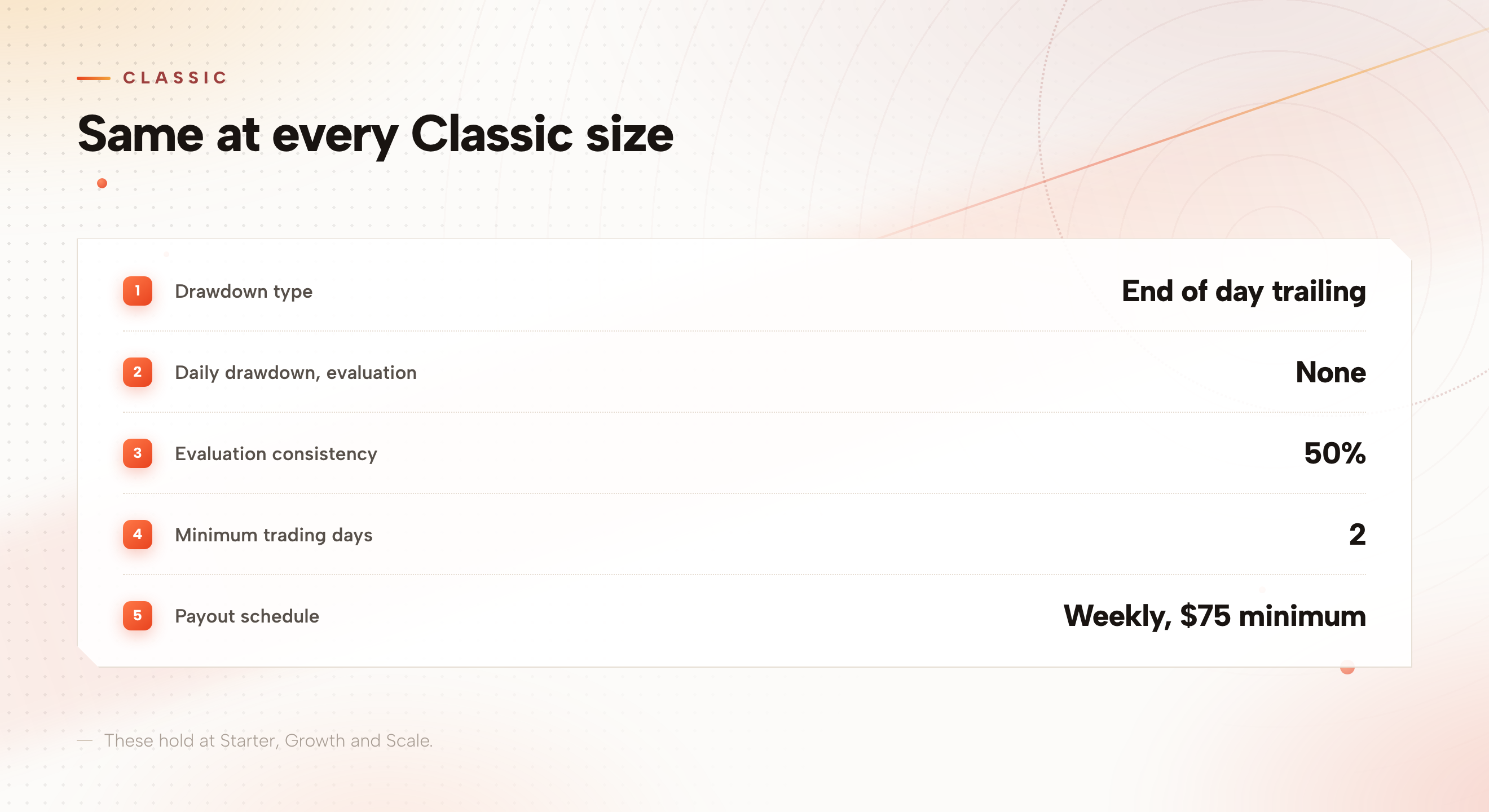
A trailing drawdown is a loss floor that follows your balance up as you profit and stops moving once it reaches your starting balance. End of day means the floor is recalculated after the session closes. A daily drawdown is a separate cap on how much you can lose in one day, and Classic has none during the evaluation.
Those two rules are identical at every size, and so are a 50 percent consistency rule on the evaluation and a minimum of two trading days. A consistency rule caps how much of your total profit any single day can supply. What changes is every dollar figure in the table below.
| Classic size | Balance | Monthly price (TFeed list) | Profit goal | Trailing drawdown | Highest contract limit | Reset fee |
|---|---|---|---|---|---|---|
| Starter | $25K | $89 | $1,500 | $1,500 | 1 mini or 15 micros | $89 |
| Growth | $50K | $128 | $3,000 | $2,000 | 3 minis or 30 micros | $128 |
| Scale | $100K | $269 | $6,000 | $3,000 | 6 minis or 60 micros | $269 |
- Starter, the $25K size, costs from $89 a month. Its profit goal is $1,500 against a $1,500 trailing drawdown, and it tops out at one mini or 15 micros.
- Growth, the $50K size, costs from $128 a month. Its profit goal is $3,000 against a $2,000 trailing drawdown, and it tops out at three minis or 30 micros.
- Scale, the $100K size, costs from $269 a month. Its profit goal is $6,000 against a $3,000 trailing drawdown, and it tops out at six minis or 60 micros.
Profit Goal Against Drawdown Room
A profit goal is the amount of profit an evaluation asks you to make before it counts as passed. Set it beside the drawdown and a pattern shows up that the price list hides.
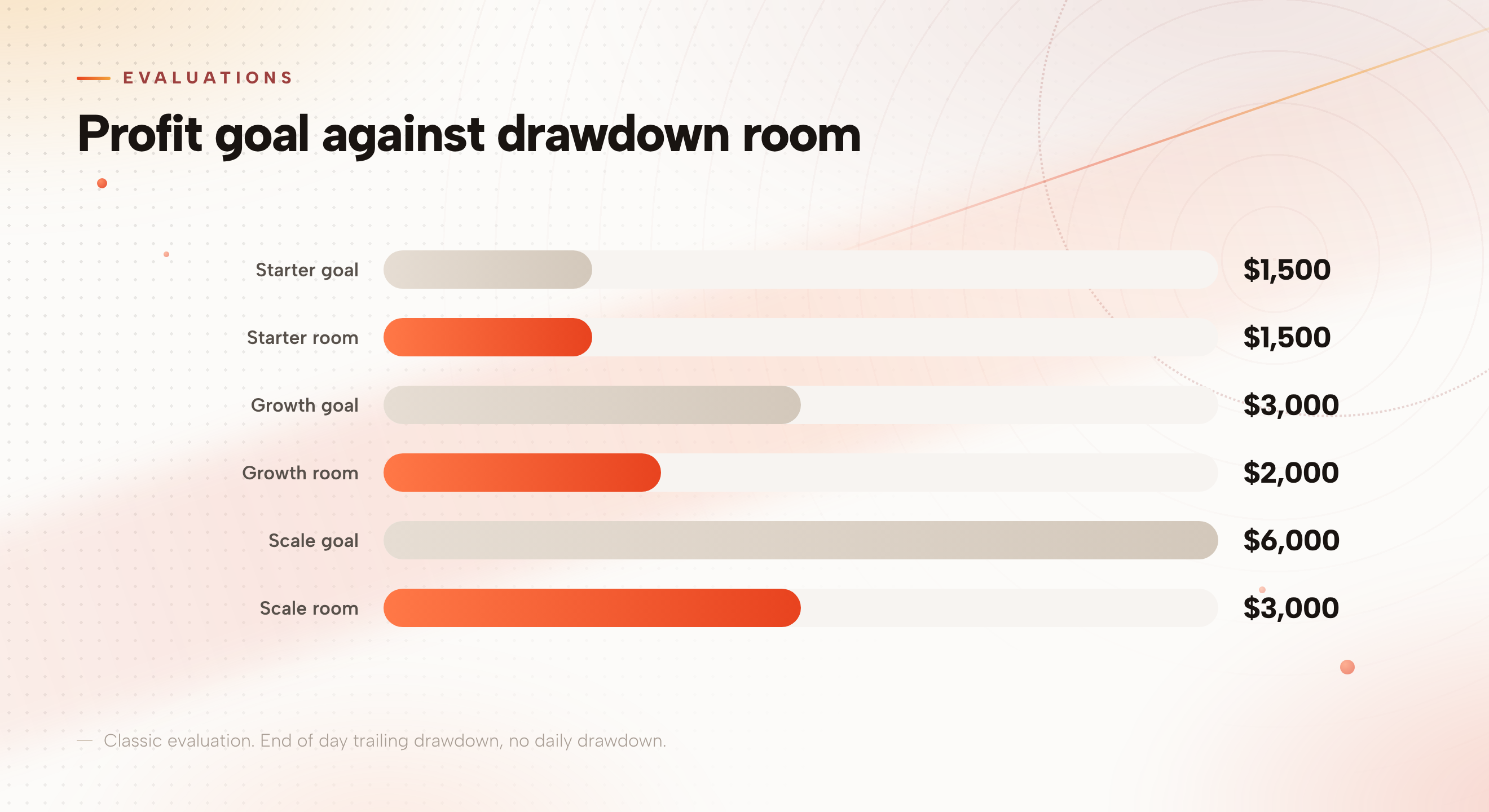
On Starter the two are equal: $1,500 to make with $1,500 of room. On Growth the goal is $3,000 with $2,000 of room, so the goal is one and a half times the room. On Scale the goal is $6,000 with $3,000 of room, which is twice the room.
That makes each larger size a bigger task as well as a bigger account. Because the goal grows faster than the room, you have to grow the balance further for every dollar of drawdown you are given.
A comparison you can run yourself: divide the drawdown by what one losing trade costs you at your usual size. On a fresh account, the answer is how many full losses in a row it takes to reach the floor.
Contract Limits: Where the Size Shows Most
A mini is a standard futures contract and a micro is a smaller contract on the same market. Every Classic limit is written both ways, as a number of minis or a number of micros, and the two are alternatives, never a total.
Classic opens small and adds contracts as profit grows. A scaling plan is a schedule that raises the contracts an account may trade as its profit passes set thresholds, and each Classic size has its own.
- Starter opens at one mini or 10 micros and moves to one mini or 15 micros once profit is above $1,000.
- Growth opens at one mini or 10 micros, moves to two minis or 20 micros above $1,000 of profit, and to three minis or 30 micros above $2,000.
- Scale opens at two minis or 20 micros, moves to three minis or 30 micros above $1,000, to four minis or 40 micros above $2,000, and to six minis or 60 micros above $4,000.
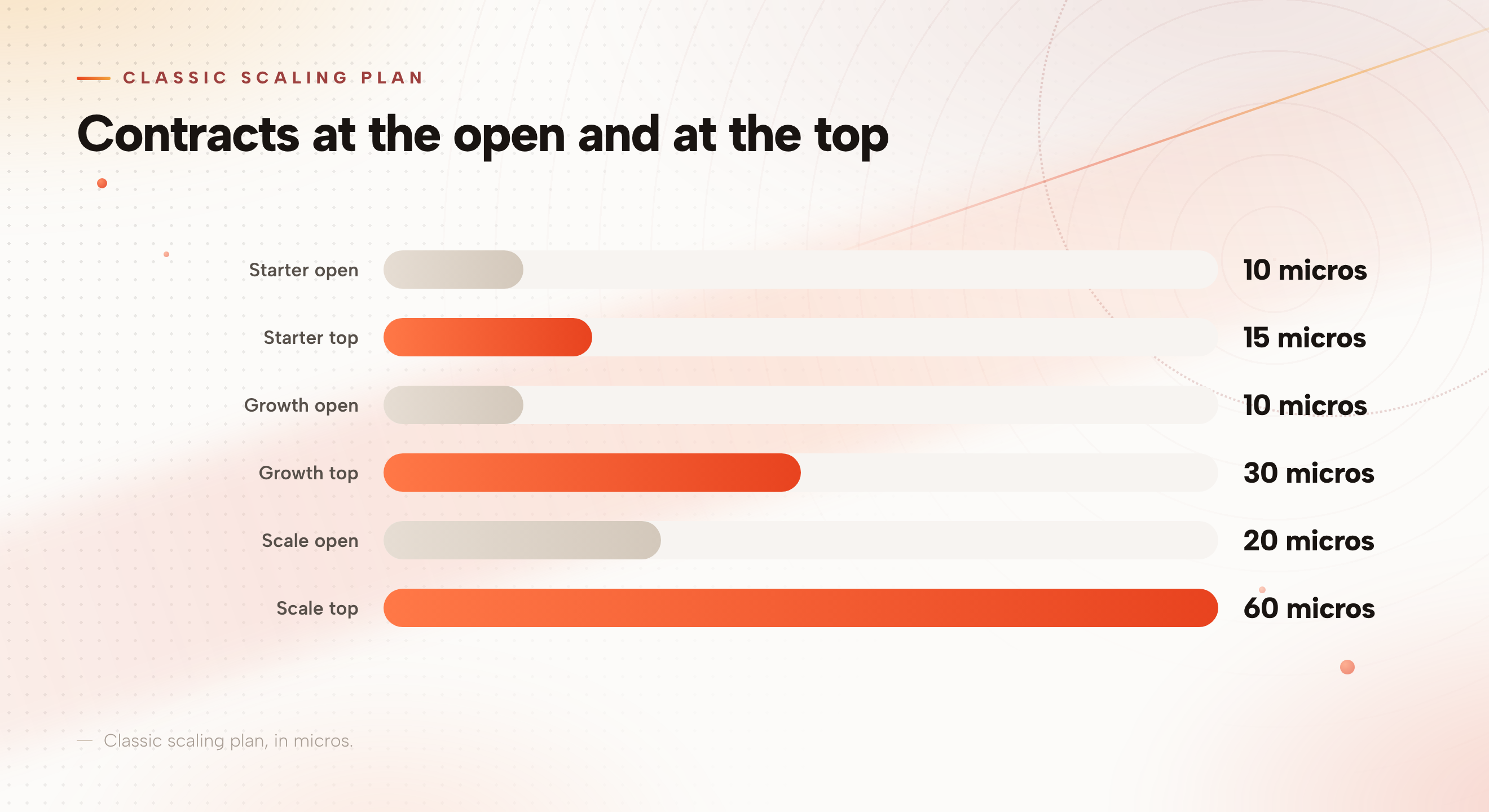
At the opening size, Growth gives the most drawdown room per mini: $2,000 behind one mini, against $1,500 behind the one mini on Starter and $3,000 shared by the two minis on Scale, or $1,500 each.
Every size's rule card is on the evaluations page. Our answer on how many contracts you can trade on a funded account covers what happens above a plan: more size is available only by request, after the trading has been reviewed.
What a Bigger Size Costs
Classic is priced per feed. TFeed is Phoenix's own execution feed and carries no market data, while dxFeed includes it. dxFeed adds $20 at every size, so a Starter is $89 on TFeed and $109 on dxFeed, a Growth is $128 and $148, and a Scale is $269 and $289.
The useful way to read the monthly price is against the drawdown room, because the room applies from the first trade. At TFeed list prices, Starter is $89 for $1,500 of room, Growth is $128 for $2,000 and Scale is $269 for $3,000.
Growth costs about one and a half times Starter for a third more room, and Scale costs about three times Starter for twice the room. Measured against the room, Starter is the cheapest of the three and Scale the dearest.
The subscription renews every 30 days and can be canceled at any time, and the challenge has no time limit. The bill therefore grows with every month an evaluation stays open, and a larger size costs more for each of them.
A reset restarts a failed evaluation. On Classic it costs the same as a month: $89 on Starter, $128 on Growth and $269 on Scale. Renewing a challenge that has not failed earns a reset coupon, and a banked coupon makes a reset free.
The Funded Stage Changes With Size Too
Pre-Funded is the simulation stage that follows a passed Classic evaluation, and it is where Classic payouts are requested. Payouts are weekly at every size, with a $75 minimum. What varies is how large one payout can be and how much of the balance has to stay put.
| Classic size | Per-payout cap | Locked buffer | Counted day closes with at least | Live account amount |
|---|---|---|---|---|
| Starter ($25K) | $600 | $1,500 | $100 of profit | $1,250 |
| Growth ($50K) | $1,000 | $2,000 | $200 of profit | $2,000 |
| Scale ($100K) | $2,000 | $3,000 | $300 of profit | $3,500 |
A locked buffer is an amount of the balance that has to stay in the account, so only profit above it can be withdrawn. It is $1,500 on Starter, $2,000 on Growth and $3,000 on Scale. A single payout is capped at $600, $1,000 and $2,000 in the same order.
A payout needs five counted days, and a counted day is one that closes with at least $100 of profit on Starter, $200 on Growth and $300 on Scale. A Classic account can reach a Live account after four payouts and risk approval.
The number of accounts you can hold also depends on the size. On TFeed, Pre-Funded accounts are capped at five for Classic Starter and three for Classic Growth and Scale, so on TFeed the smallest size allows the most accounts at once.
Which Classic Size Fits Which Trader
None of the three is a better version of the others. Each one trades a different cost for different numbers, so match the size to the contracts you actually trade.
- Starter fits a trader who sizes in one mini or a few micros and wants the lowest monthly bill of the three. It has the smallest gap between goal and room, one to one, and on TFeed the highest cap on Pre-Funded accounts, five against three.
- Growth fits a trader who opens with one mini and wants the most room behind it, $2,000, with the plan stepping up to three minis as profit builds.
- Scale fits a trader who already sizes in several minis and wants a drawdown to match: $3,000 of room with two minis at the open and up to six at the top of the plan. It carries the largest payout cap, locked buffer and Live account amount of the three.
These are comparisons of published numbers, not a recommendation on how much to risk, and passing an evaluation is never guaranteed. A Practice account comes with every Classic challenge, on the same parameters as that challenge, with unlimited free resets, and it can never be funded. It is a place to rehearse the rules of the size you hold, and it is not an attempt at the evaluation.
Check any figure on the Phoenix site before you buy, because prices and rules can change after an article is written.
Common Questions
Do the rules change with a bigger Classic account?
The rule types stay the same at every size: an end of day trailing drawdown, no daily drawdown during the evaluation, a 50 percent consistency rule and two minimum trading days. The numbers change: profit goal, drawdown, contract limit, reset fee, payout cap, locked buffer, Live account amount and the cap on Pre-Funded accounts.
Is a $100K account $100K to trade with?
The balance names the account. What limits a trade is the contract limit, which caps position size, and the trailing drawdown, which is the loss floor. On Scale those are six minis or 60 micros at the top of the plan and a $3,000 drawdown.
Is there a deadline to pass a Classic evaluation?
No. Classic challenges have no time limit, but the subscription renews every 30 days and can be canceled at any time.
All three Classic sizes are on sale at Phoenix Trader Funding, and the home page shows today's list.
See the Classic sizes on the home pageNew funded-account types are trialled at Phoenix Labs as real, tradable accounts before they join the permanent offer. The ones that work graduate.