

Is There a Time Limit on a Futures Prop Firm Evaluation?
Classic and Spark have no deadline, so you set the pace. Here is what that does to cost, speed and risk, and where the Merit clock sits.
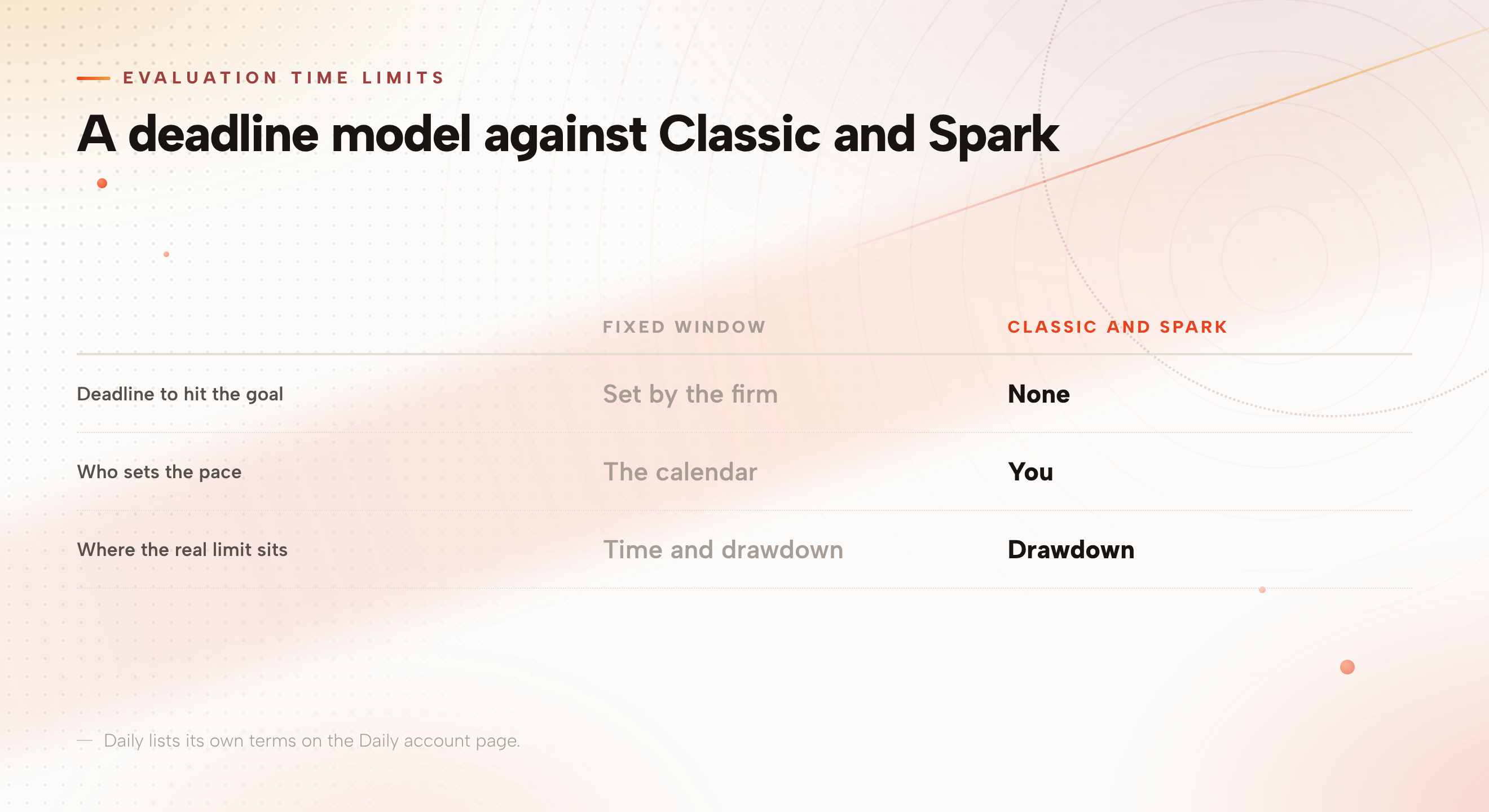
No, not on Classic or Spark. Phoenix Trader Funding sets no deadline for reaching the profit goal on a Classic or Spark challenge, so the pace is yours. Merit is different: it is a 30 calendar day assessment with no profit goal. On Classic and Spark, the drawdown limits an attempt, not a countdown.
- What a time limit does to an evaluation
- The time limit at Phoenix, account by account
- What waiting costs on Classic and on Spark
- How fast a pass can go
- What actually ends an attempt: the drawdown
- Merit runs on a 30 calendar day clock
- Who a no-deadline evaluation suits
- Frequently asked questions
An evaluation, also called a challenge, is the paid stage where you trade a simulated account toward a profit goal without breaching a drawdown. A time limit is the deadline a firm sets for reaching that goal. Some firms set one, and some leave the evaluation open.
What a time limit does to an evaluation
A fixed window turns every slow week into pressure. Late in the window, a trader who is behind the goal is tempted to trade bigger to catch up, and larger size is how a drawdown gets used up. This is general risk reasoning, not trading advice.
A deadline does not make the profit goal bigger. It makes the goal harder to reach calmly.
A profit goal is the amount of profit you must reach, and a drawdown is the loss limit that ends the attempt if you breach it. With no deadline, only the drawdown is a hard edge. You can pass in a quiet week with a few trades or a busy week with many, and the pass is the same pass.
Before you pay for any evaluation, put three questions to the firm.
- Is there a deadline, and is it written on the rules page?
- If the evaluation is open ended, what do you pay while you wait?
- What does a reset cost if you breach the drawdown?
The time limit at Phoenix, account by account
Classic and Spark challenges have no time limit. Nobody sets a date by which you must reach the profit goal, and the challenge stays open while you trade it. Merit is the exception: it is a 30 calendar day assessment, and it has no profit goal to reach.
| Account | Time limit | How you pay | Profit goal |
|---|---|---|---|
| Classic | None | Monthly, cancel anytime | $1,500 on the 25K, $3,000 on the 50K, $6,000 on the 100K |
| Spark | None | One time | $600 on the 10K, $1,500 on the 25K |
| Merit | 30 calendar days | One time | None |
Classic costs $89 for the 25K Starter, $128 for the 50K Growth and $269 for the 100K Scale, billed monthly. Spark costs $44 for the 10K Seed and $74 for the 25K Starter, paid once. Merit costs $69, paid once.
The Daily accounts list their own terms on the Daily page, and this guide does not state them.
What waiting costs on Classic and on Spark
No deadline does not mean no cost, and the two accounts differ. Classic is the only Phoenix account that bills monthly, so a slow pass on Classic is paid for month by month. You can cancel anytime.
Each renewal of a Classic challenge that has not failed earns one Reset Coupon. A Reset Coupon is a free reset, and coupons are cumulative, so they stack. The renewal is still the monthly charge. The coupon is a free reset you can use later.
Spark is paid once, so a slow month costs nothing more on the challenge itself. A one-time $29 activation fee is due when you pass, and it does not change with how long you take.
A deadline charges you in pressure. A subscription charges you in months. A one time payment charges you for neither.Three ways an evaluation can price your time
How fast a pass can go
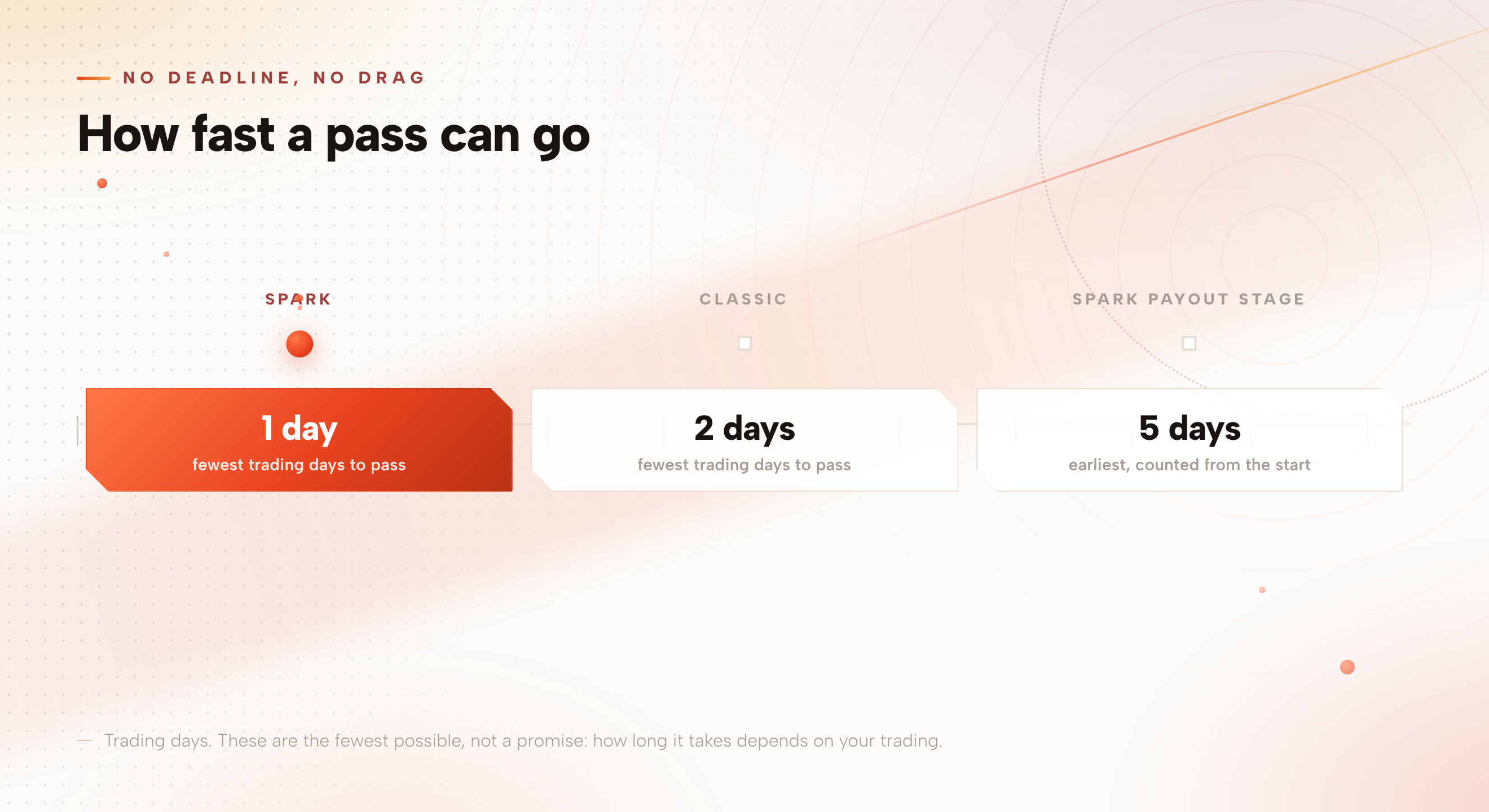
You can still pass quickly. On Classic, a pass can come in as little as 2 trading days. On Spark, it can come in as little as 1 trading day, and the payout stage can be reached 5 trading days after you start, at the earliest.
Reaching the profit goal inside the drawdown is still the work, and it takes the time it takes. Profit above the goal does not carry into the funded account, so there is no prize for overshooting it.
What actually ends an attempt: the drawdown
A trailing drawdown is a loss limit that trails your account's high point upward and stops rising at your starting balance. In an evaluation it is measured at the end of the day. With no countdown, this is the number that decides how long an attempt lasts.
The room differs by account and size. Classic carries $1,500 on the 25K, $2,000 on the 50K and $3,000 on the 100K. Spark carries $400 on the 10K and $1,000 on the 25K.
If you breach the drawdown, a reset restarts the challenge for a fee set by account and size. On Classic, a reset costs $89 on the 25K, $128 on the 50K and $269 on the 100K. On Spark, a reset costs $29 on the 10K and $39 on the 25K. So the drawdown is both the limit on an attempt and the cost of restarting one.
That is why pace and size are linked. With no clock, a trader can wait for a setup and size it so one bad day uses a small share of the room. A trader who takes a trade only because a deadline is close does the opposite. This explains how the rule works and is not trading advice.
Before you start a challenge at your own pace:
- Write down your drawdown room in dollars
- Decide the most one day may use before you place a trade
- Check whether you are on Classic or Spark, because their billing differs
- Check what a reset costs on your size
Merit runs on a 30 calendar day clock
Merit is the exception. It is a 30 calendar day assessment, and an assessment is a review of how you trade, not a race to a number. There is no profit goal. You trade your own way for the 30 calendar days, and the Phoenix risk team and an AI review every trade.
After the window, a person decides whether to fund the account on Live. A large profit can still be turned down for Live funding while a small one is funded, because only the quality of the trading counts. There is no guarantee of funding.
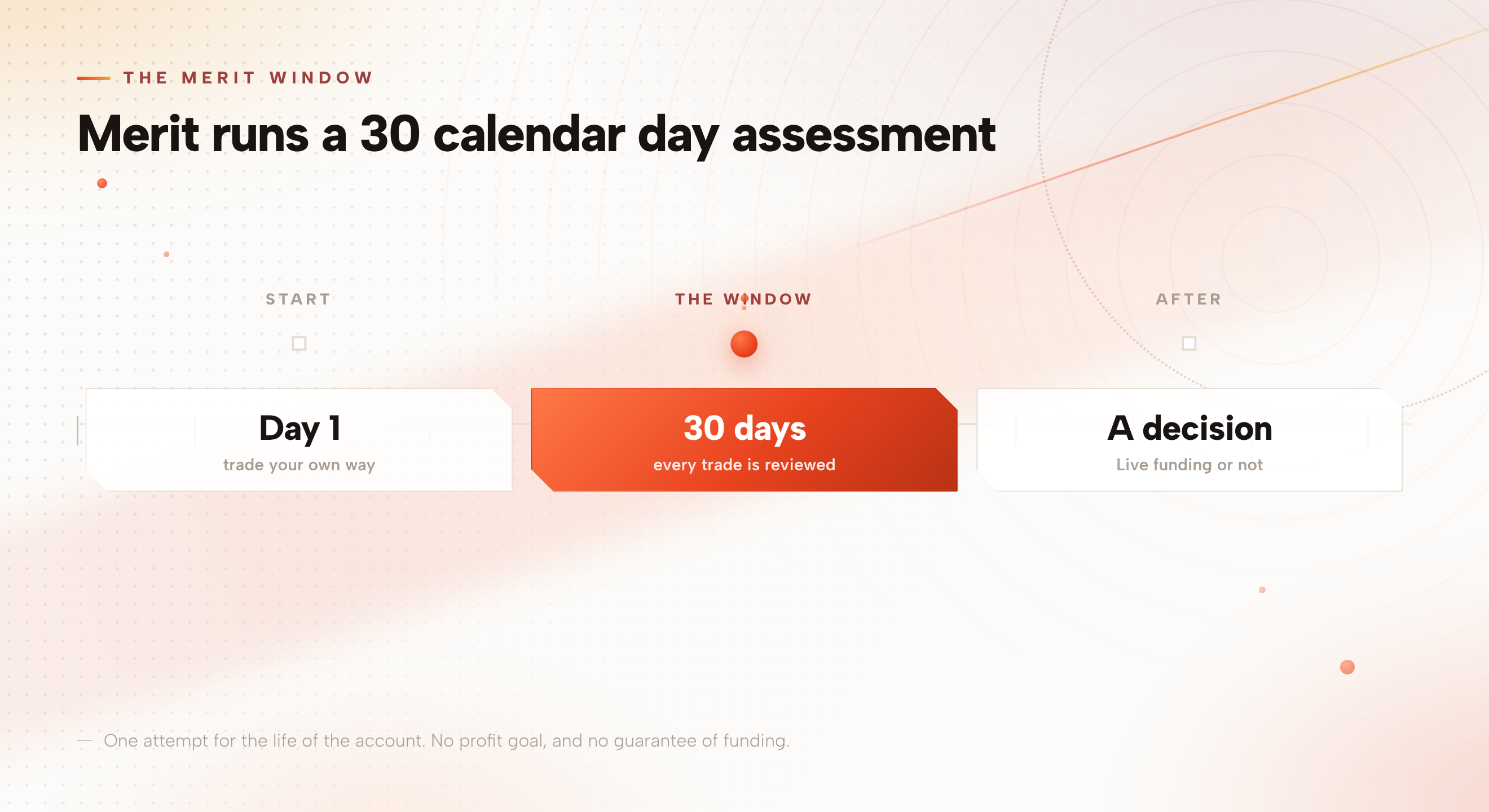
Merit costs $69, paid once. It is one attempt for the life of the account, and there is no reset at any price.
Who a no-deadline evaluation suits
It suits a trader with a day job, a trader who trades one session, or anyone who would rather skip a week with no setup than force one. It also suits a trader still learning how much of the drawdown a normal day uses, since a deadline leaves no time to find out.
If an outside date is what keeps you disciplined, nothing stops you writing one down yourself. The account will not enforce it, and it will not penalise you for moving it.
Frequently asked questions
Is there a time limit on a prop firm evaluation?
It depends on the firm: some set a fixed window and some leave the evaluation open. At Phoenix Trader Funding, Classic and Spark challenges have no time limit, and Merit is a 30 calendar day assessment with no profit goal.
How long do I have to pass a Classic or Spark challenge?
There is no deadline for reaching the profit goal. The fewest trading days a pass can take are 2 on Classic and 1 on Spark. Nothing here promises that you will pass: it depends entirely on your trading.
What happens if I stop trading?
A Spark challenge is disabled after 90 calendar days with no trade. It is not a deadline to hit the profit goal, and a trader who keeps trading is not affected by it. A Classic challenge has no inactivity rule, and it keeps renewing monthly until you cancel, which you can do anytime.
Does a Classic challenge keep billing while I wait?
Yes. Classic bills monthly, at $89, $128 or $269 by size, and you can cancel anytime. Each renewal of a challenge that has not failed earns one Reset Coupon, which is a free reset.
Spark and Merit are paid once, so neither bills you for the time you take.
Does Spark have a monthly fee?
No. Spark is paid once: $44 for the 10K Seed and $74 for the 25K Starter. A one-time $29 activation fee is due when you pass.
Does Merit have a time limit?
Yes. Merit is a 30 calendar day assessment with one attempt for the life of the account. It has no profit goal, so the window is not a deadline to hit a number.
The full rules for each account are on the evaluations page, the Classic rules are on the Classic page, the Spark rules are on the Spark page, and general questions are answered in the FAQ.
Start your evaluation at phoenixtraderfunding.com.
New funded-account types are trialled at Phoenix Labs as real, tradable accounts before they join the permanent offer. The ones that work graduate; the ones that do not are retired.