

What Is a Trailing Drawdown? 3 Accounts Trail, 1 Does Not
What moves the floor, where it stops, and how end of day differs from intraday on each Phoenix account.
A trailing drawdown is a loss floor that sits one drawdown distance below the highest balance your account has reached, rises when that high rises, and never falls. On Classic, Daily and Spark it stops rising once it reaches your starting balance, and from then on it stays put.
Classic, Daily and Spark accounts trail. Merit has no trailing drawdown.
- What a trailing drawdown is
- What moves the floor, and what does not
- Where a trailing drawdown stops
- End of day against intraday
- Each Phoenix account on its own line
- How to read your own floor
What a trailing drawdown is
A trailing drawdown is a loss limit that follows your account upward instead of sitting at one fixed level. It is built from two things. The high-water mark is the highest balance the account has ever reached, and it only rises. The drawdown distance is the amount printed on your account card.
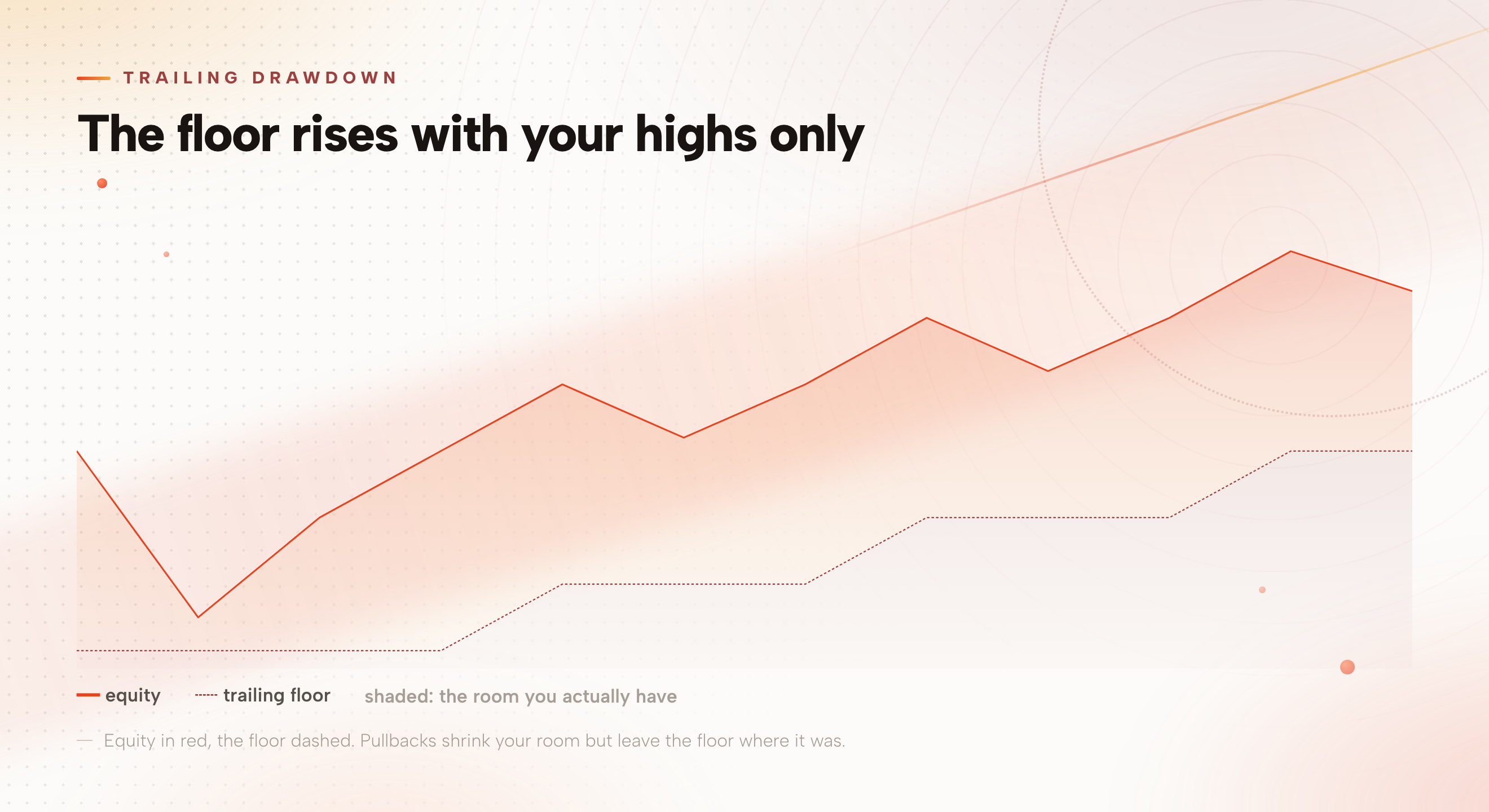
The floor is the high-water mark minus the drawdown distance. If your balance falls to the floor, the account breaches its drawdown rule, which makes the floor the number worth knowing before every session.
What moves the floor, and what does not
Only a new high-water mark moves the floor. When your account reaches a balance above any it has reached before, the mark rises, and the floor rises by the same amount behind it.
A losing day does not move the floor. Neither does giving profit back: if you climb, lift the floor and then fall back, the floor keeps the higher level. A winning week followed by one that hands the profit back can leave you with less room than you started with.
Until the floor locks, every new high gives you the full drawdown distance as room. Each dollar you give back from that high comes straight out of it.
The answer on what a trailing drawdown is and how it moves covers the same mechanics in a shorter format.
Where a trailing drawdown stops
On Classic, Daily and Spark, a trailing drawdown does not trail forever: it stops at your starting balance. Once the floor reaches the balance the account began with, it freezes there and never moves again, however high the account climbs.
That happens at one precise point. The floor sits one drawdown distance below the high-water mark, so it reaches the starting balance when your best balance is a full drawdown distance above the start. The profit that locks the floor equals the drawdown on your account card.
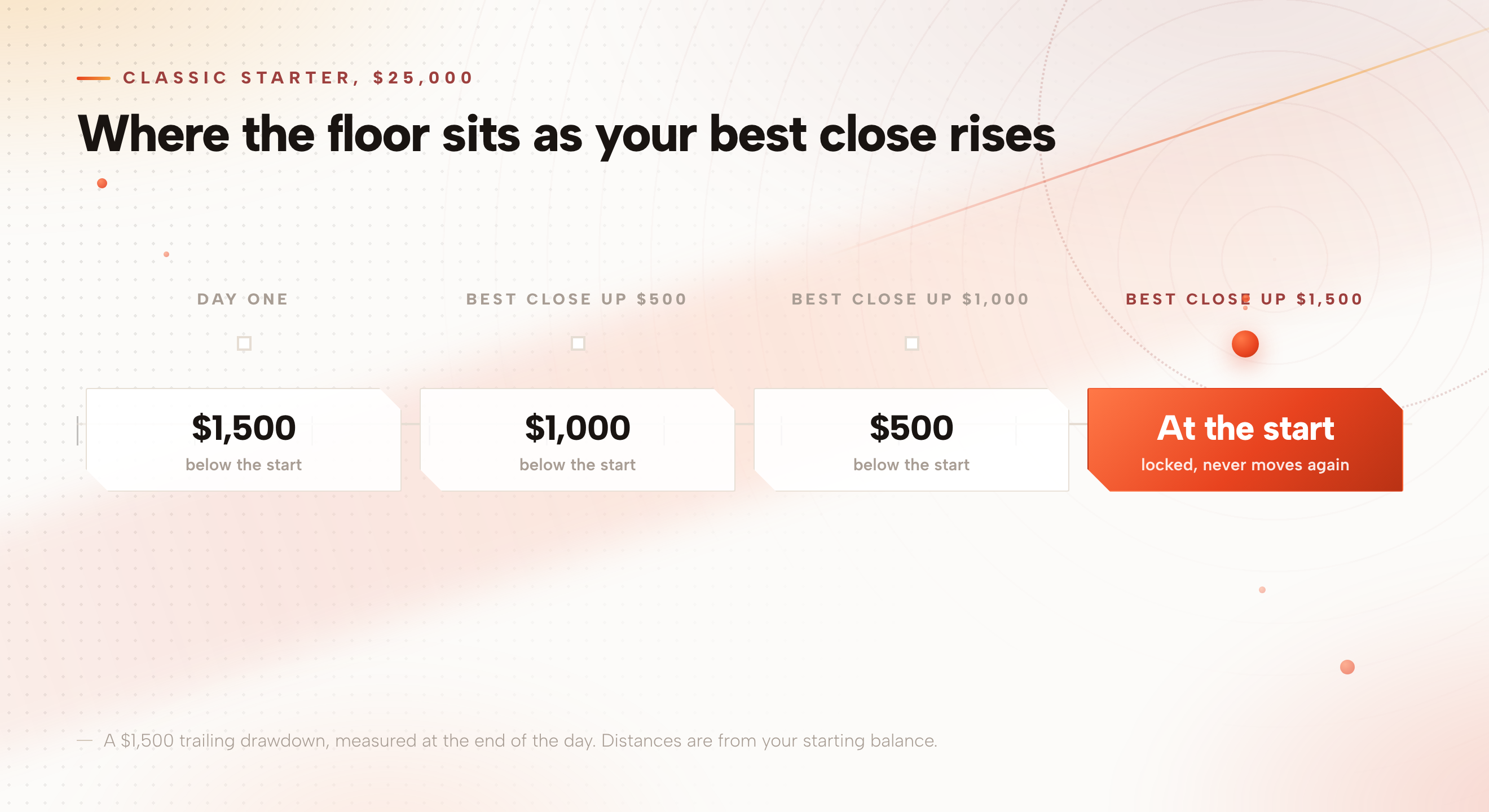
On a Classic Starter account, which is $25,000 with a $1,500 trailing drawdown, the floor opens $1,500 below your starting balance. Once your best close is $500 above the start, the floor sits $1,000 below it. At $1,000 above, it sits $500 below. At $1,500 above, it reaches the start and locks.
After the lock, the floor is the balance you started with. Gains above it become room rather than a reason for the floor to move, and only a fall back to your starting balance can reach it.
End of day against intraday
The drawdown distance is half of the rule. The other half is when the high-water mark is read. An end-of-day drawdown reads it once, from your closing balance after the session. An intraday drawdown, also called real time, reads it continuously, so open profit counts the moment it appears.
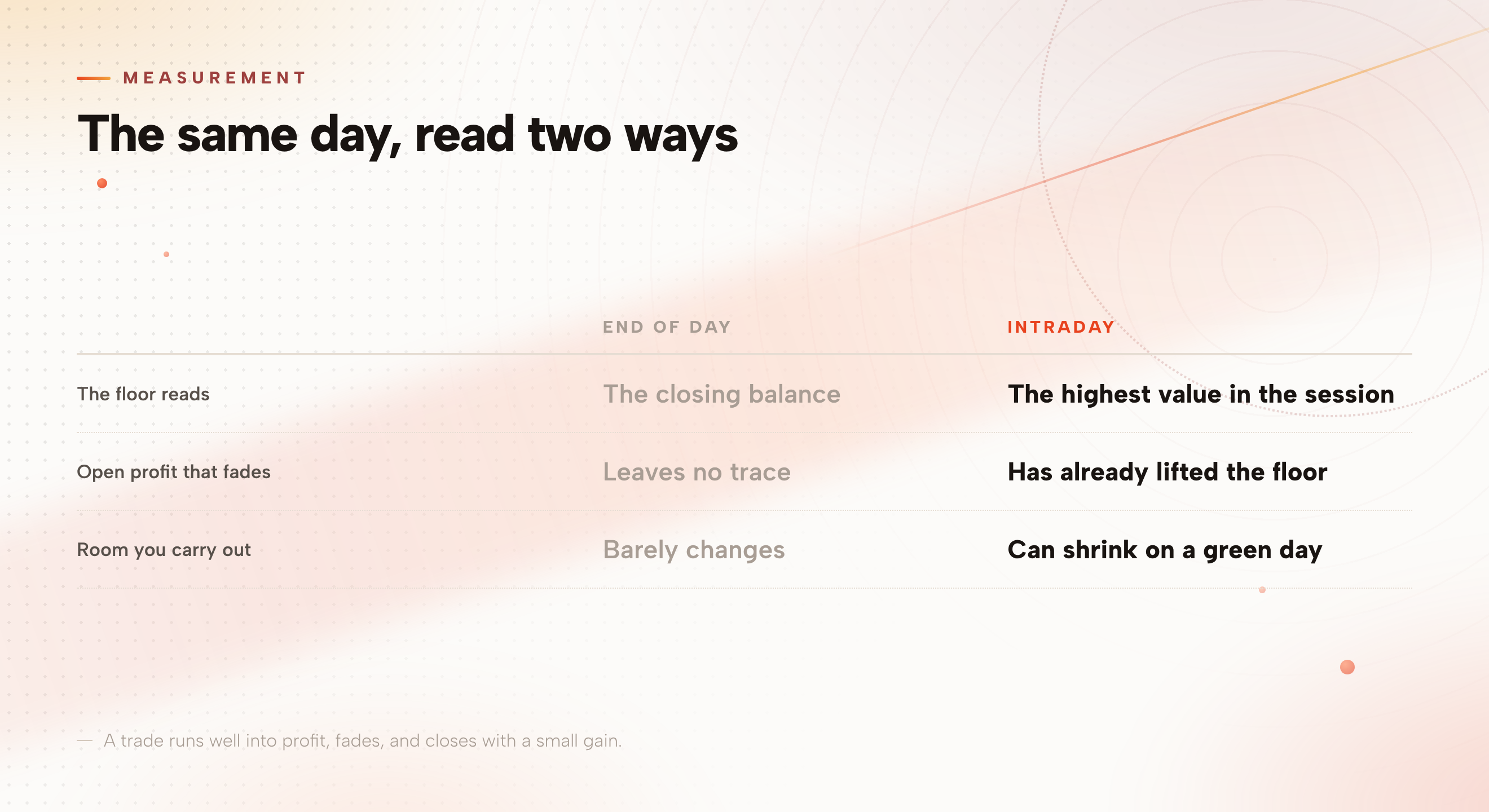
Picture a position that runs well into profit by mid-morning, fades through the afternoon and closes with a small gain. An end-of-day floor sees only the small closing gain. An intraday floor rose with the morning peak and stayed there, so you finish the same green day with less room.
The answer on how an intraday trailing drawdown differs from end of day walks through one trading day measured both ways.
Each Phoenix account on its own line
Phoenix Trader Funding sets the measurement by account type and stage, so there is no single answer for every account. Here is each account, with the trailing drawdown from its evaluation rules.
- Classic: a trailing drawdown of $1,500 on the 25K, $2,000 on the 50K and $3,000 on the 100K, measured at the end of the day in the evaluation and still at the end of the day once funded.
- Daily: $600 on the 10K, $1,500 on the 25K and $2,000 on the 50K, measured at the end of the day through both the challenge and the funded account.
- Spark: $400 on the 10K and $1,000 on the 25K, measured at the end of the day in the evaluation and in real time, intraday, once the account is funded.
- Merit: no trailing drawdown. Its loss limit is a static total of $2,000, which means one fixed level that never follows your balance. The rules sit on the Merit accounts page.
How to read your own floor
- Find your drawdown distanceIt is on your account card, and it differs by account and size.
- Find your highest balance so farUse the best close on an end-of-day account, or the best intraday peak on a funded Spark account.
- Subtract the distanceThe result is your floor, unless it would sit above your starting balance. Then the floor is your starting balance.
The gap between your balance and that floor is your room, and it is the number to check before you size a trade.
FAQ
Does a trailing drawdown trail forever?
Not on Classic, Daily or Spark. On those accounts it stops at your starting balance. Once your best balance is a full drawdown distance above the start, the floor reaches the starting balance, freezes there and never moves again.
Can a trailing drawdown go down after a losing day?
No. The floor follows the high-water mark, which only rises. A losing day lowers your balance and shrinks your room, but the floor stays exactly where it was.
Classic, Daily and Spark challenges also come with a practice account on the same parameters, with unlimited free resets, so you can watch a floor trail and lock before it costs anything.
Does open profit count toward a trailing drawdown?
It depends on how the drawdown is measured. An intraday drawdown counts open profit the moment it appears, even if you give it back. An end-of-day drawdown reads only your closing balance.
Is a trailing drawdown the same as a daily drawdown?
No. A trailing drawdown follows your highest balance, while a daily drawdown caps what a single session can lose. No Classic, Daily or Spark evaluation carries a daily drawdown, and the Merit evaluation carries its own daily limit.
Comparing firms? Check whether a drawdown is measured at the end of the day or intraday before you compare the dollar figures. The same distance gives you different room under each.
Which Phoenix accounts trail intraday?
A funded Spark account measures its trailing drawdown in real time. Every evaluation measures at the end of the day, and funded Classic and Daily accounts stay at the end of the day.
Check the trailing drawdown on every account size before you choose one.
See the Phoenix Trader Funding evaluationsNew funded-account types are trialled at Phoenix Labs as real, tradable accounts before they join the permanent offer. The ones that work graduate.