

Is Hedging Allowed at a Futures Prop Firm?
What counts as hedging between accounts at Phoenix Trader Funding, where copying ends and hedging starts, and what a flag costs.
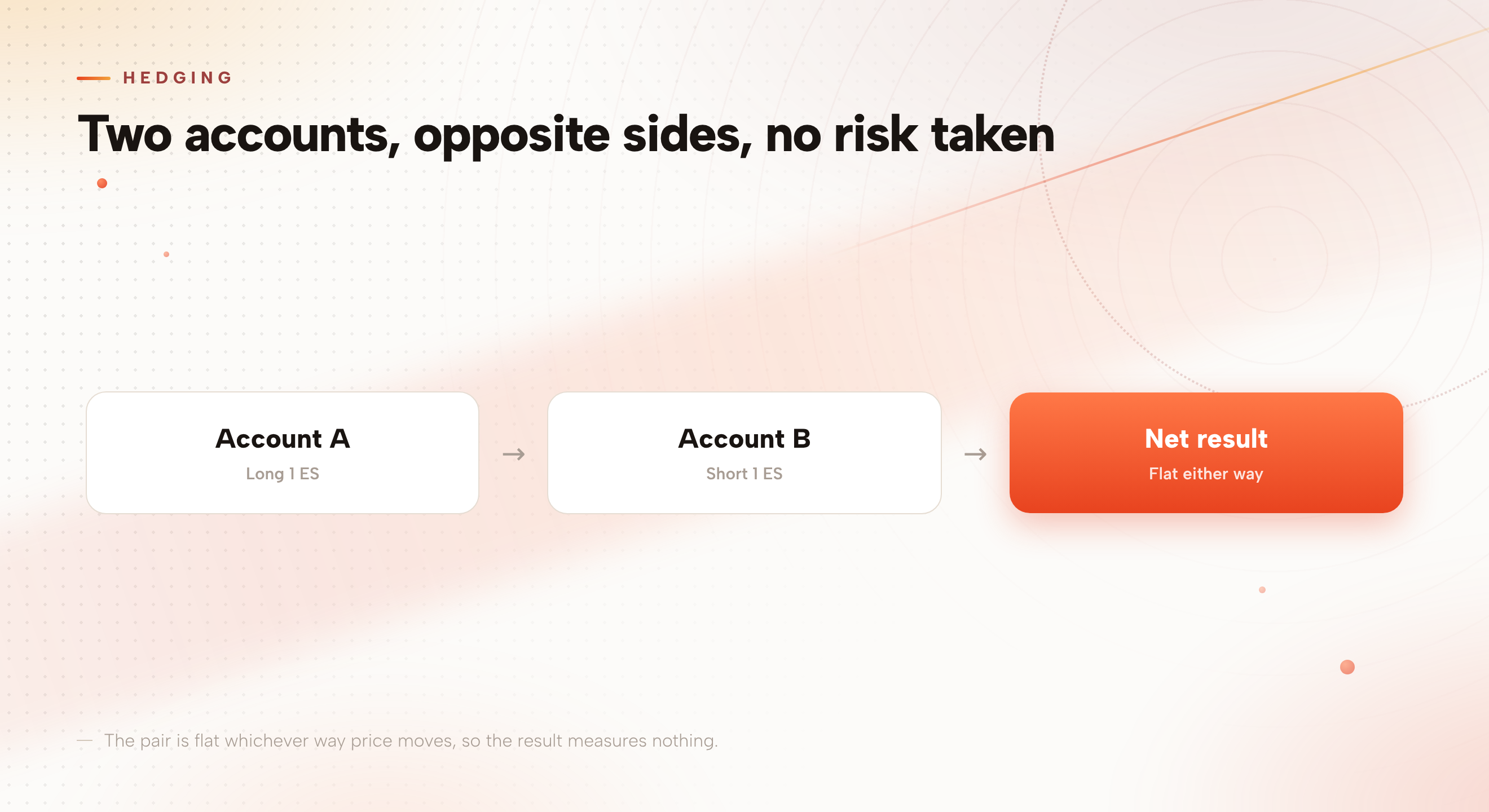
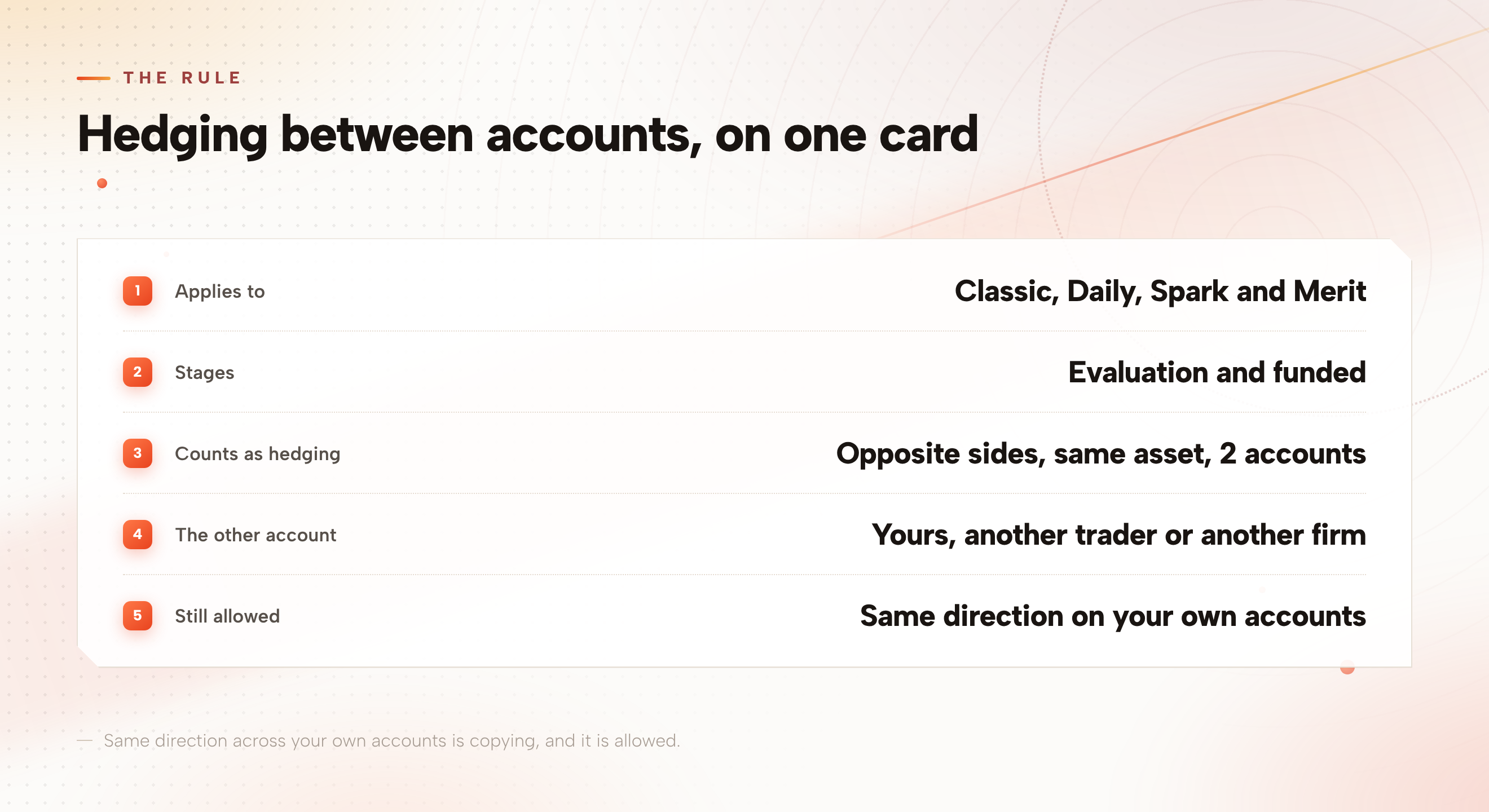
No. Phoenix Trader Funding prohibits hedging between accounts on Classic, Daily, Spark and Merit, in the evaluation and on a funded account. Hedging means holding opposing positions on the same asset at the same time across two accounts, yours or anyone else's, so that the pair is flat whichever way price moves. Copying the same direction across your own accounts is different, and it is allowed.
- What hedging means on a futures account
- Why a prop firm bans it
- Is hedging allowed on Classic, Daily, Spark and Merit?
- Hedging or copy trading: where is the line?
- A worked example: one move, two accounts
- How does a prop firm detect hedging?
- What happens if hedging is detected?
- Which neighbouring rules also span accounts?
- How to check a setup before you place it
- Who does this rule actually affect?
- Frequently asked questions
What hedging means on a futures account
Hedging means holding two positions that cancel each other's risk, so a gain on one side pays for a loss on the other. In futures, an account carries one net position in each contract, so a buy and a sell in the same contract on one account net into a single position. Across two accounts nothing nets, so that is the pair the Phoenix rule is written around.
ES is the E-mini S&P 500 futures contract, and it is the example used in this guide. Long means you bought and profit if price rises, short means you sold and profit if it falls. Put one account long and another short, and one of them gains whatever the market does.
If you come from forex, where some brokers let you hold a buy and a sell on one pair at the same time, the futures version looks different. On a futures account, a sell in the same contract nets against your long instead of opening a second position beside it.
Why a prop firm bans it
An evaluation exists to measure how you handle risk, and a hedged pair takes none. One account passes, the other fails, and nobody traded a view. The result says nothing about skill, and it makes the rules meaningless for every trader who passed honestly.
A pair that cannot lose tells nobody how you trade.The idea behind the rule
Is hedging allowed on Classic, Daily, Spark and Merit?
No. The rule is the same on all four, in the evaluation and on a funded account, which is the account you trade after you pass an evaluation. Live Funded accounts have their own, lighter rule set, so this guide covers the stages before Live.
The Help Center entry on hedging sets the test: opposing positions on the same asset, held at the same time across two accounts. It does not matter whose account sits on the other side or where it is held. Another Phoenix account, another trader's account and an account at another firm all count.
Hedging or copy trading: where is the line?
Copy trading means running the same trades in the same direction across several accounts, usually with a copier that mirrors one account's orders onto the rest. It is allowed on every Phoenix account at every stage, and Thor, the Phoenix trade copier, exists to do it.
The test is direction. If every account moves together, you are copying. If one account only wins because another loses, you are hedging. The number of accounts does not decide it, and neither does the copier.
| Setup | Verdict |
|---|---|
| Long ES on three of your own accounts, mirrored by a copier | Copying, allowed |
| Long ES on one account and long ES on another, entered a minute apart | Copying, allowed |
| Long ES on one Phoenix account, short ES on another | Hedging, prohibited |
| Long ES on a Phoenix account, short ES on an account at another firm | Hedging, prohibited |
| Long ES on your account, short ES on a friend's account, opened together as a pair | Hedging, prohibited |
Size and timing do not rescue a pair. Detection looks at more than an exact match, so a short slightly smaller than the long, opened a little later, can still read as a hedge. The same direction at different times is copying, and it is fine.
A worked example: one move, two accounts
Take account A long 1 ES and account B short 1 ES, opened at the same price. Then price rises 10 points. The numbers below are in points on one contract, so they hold at any contract value.
- OpenAccount A buys 1 ES and account B sells 1 ES at the same price.
- Price rises 10 pointsAccount A is up 10 points and account B is down 10 points.
- Net resultThe pair is flat, yet A moved toward its profit target while B moved toward its drawdown floor.
That is the point of the trade, and the reason it is flagged. Repeat it and the winning account is carried toward a pass while the losing account is written off as the cost of the attempt.
How does a prop firm detect hedging?
At Phoenix Trader Funding, detection is automated and runs continuously across accounts. It compares four things between accounts, which is why a pair does not need to match exactly to be identified.
All four things detection compares are about the positions, and none is about why each trade was placed. If your accounts run different strategies, check the direction across them before each entry.
What happens if hedging is detected?
The consequence depends on the stage. During an evaluation, the funded account is refused, whatever the result looks like on paper. On a funded account, the payout is refused and the associated profits are removed, and the account can be closed.
If an account is closed, you are told the specific reason. What happens to money already earned depends on that reason, and the funded agreement you signed sets out the terms.
Which neighbouring rules also span accounts?
Two more rules cross account lines, and traders often mix them up with hedging. Both sit on the Help Center's list of strategies prohibited everywhere.
- Account rolling or stacking: buying, resetting or rotating through accounts one after another, each risked in full on the same kind of bet, until one of them hits
- Martingale or loss recovery across accounts: re-entering a stopped-out trade on another account, or sizing up on the next one to win back the last loss
Martingale inside a single account is allowed, and this guide to martingale on a funded account shows how far a ladder runs under each contract cap. Holding several accounts is fine too, and the guide to how many funded accounts you can hold sets out the limit.
How to check a setup before you place it
- Check the directionAre all the accounts on the same side of the market, or is one on the other side?
- Check the asset, not the symbolES and MES, the Micro E-mini S&P 500, track the same index, so a mini on one account against micros on another is the same asset. A different market that merely moves with it, such as ES against NQ, the E-mini Nasdaq-100, is not named by the rule, so ask first at step 4.
- Count every accountInclude your other Phoenix accounts, any account at another firm and another trader's account trading alongside yours, because the rule counts them all.
- Ask firstIf you are unsure, ask through the contact page before you place the trade, not after.
Who does this rule actually affect?
Most traders never meet it. A one-account trader meets the rule only when someone else holds the other side with them. It matters to traders who run several accounts, traders who also hold accounts at other firms, two traders who agree to take opposite sides with one account each, and anyone tempted to spread one view across two accounts and call the pair a safe pass.
This article describes account rules. It is education, not financial or trading advice, and trading futures carries a risk of loss. Phoenix Labs experiment accounts publish their own rulebook, so this page covers only Classic, Daily, Spark and Merit. The experiments archive records the real rules of every concept put on sale.
Frequently asked questions
Is hedging allowed at Phoenix Trader Funding?
No. Opposing positions on the same asset across two accounts are prohibited on Classic, Daily, Spark and Merit, in the evaluation and on a funded account. The second account can be yours, another trader's or held at another firm.
Can I hedge inside a single account?
The rule names two accounts. On one account, opposite orders in the same contract net into a single position, so nothing is left offsetting. Two different contracts on one account, such as ES against MES, do not net, and the rule does not address that case. Ask through the contact page before you place it.
Is copy trading the same as hedging?
No. Copy trading runs the same direction across your own accounts and is allowed. Hedging puts the accounts on opposite sides. If every account moves together, you are copying.
Does an account at another firm count?
Yes. The rule does not depend on where the second account is held. Another Phoenix account, another trader's account and an account at another firm all count, and a pair does not need matching size or timing to be identified.
Detection compares timing, direction, size and instrument across accounts, and it runs continuously, so a loose match can still be identified.
What happens if I am flagged for hedging?
In an evaluation, the funded account is refused whatever the result on paper. On a funded account, the payout is refused and the associated profits are removed, and the account can be closed. You are told the specific reason.
Can I ask before I place a setup I am unsure about?
Yes, and that is the better order. Ask through the contact page before you place it, so the question is settled before any trade exists.
Read the rules of the account you plan to trade before you buy it, and check the direction across your accounts before each entry.
See the accounts on the home pageNew funded-account types are trialled at Phoenix Labs as real, tradable accounts before they join the permanent offer. The ones that work graduate.